
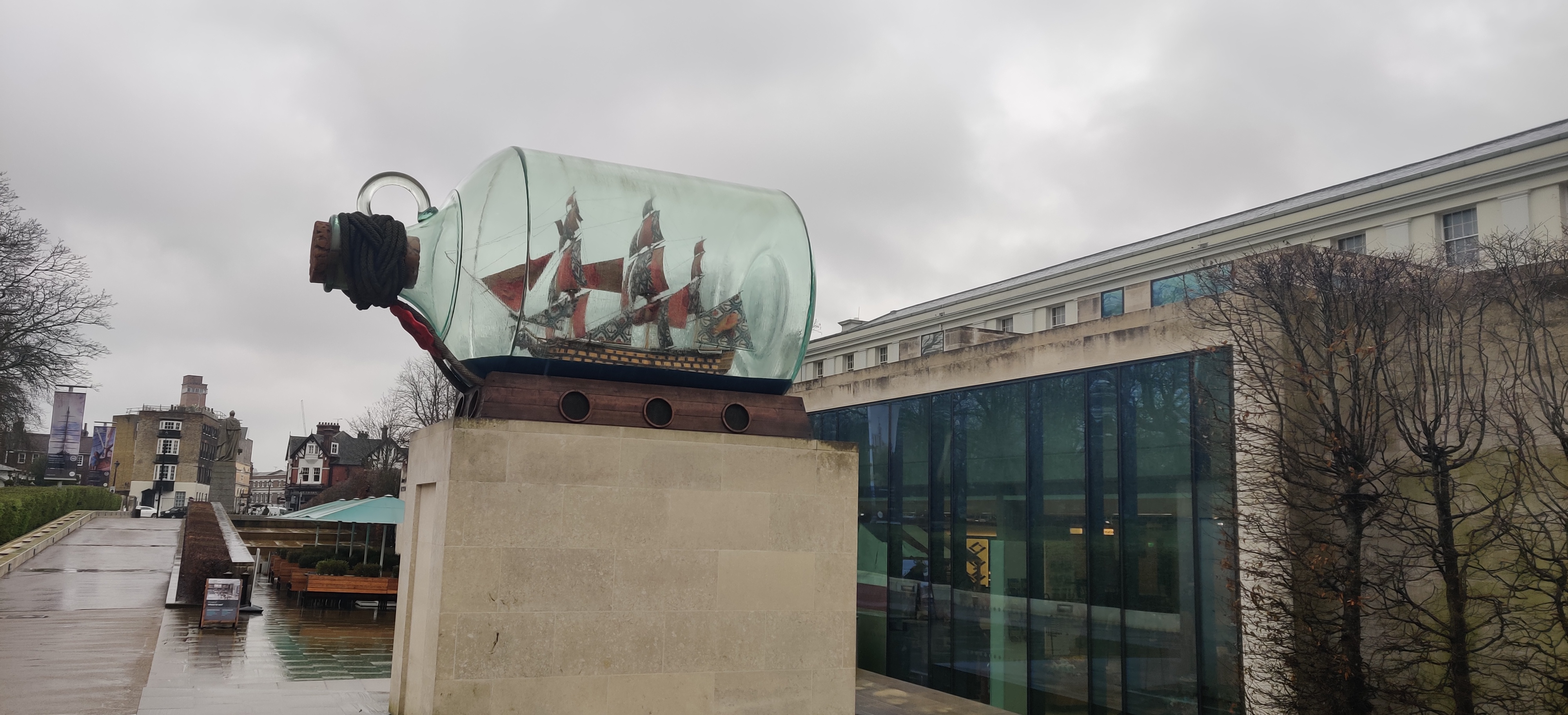
On 3 February 2020, Prime Minister Boris Johnson delivered his address following Britain’s no-deal exit from the European Union at the Painted Hall of the Royal Naval College at Greenwich, originally part of the Royal Hospital for Seamen established in 1694. A historic moment, in a historic location. The Old Royal Naval College is a 17th-century Baroque naval college at the Maritime Greenwich World Heritage Site in London.
Tudors in Greenwich
Long before King Henry V gave the land to his brother Humphrey, the Duke of Gloucester and Regent of England in 1427, there was a royal manor house on the site of the Royal Naval College. On the land that was gifted to him, Humphrey constructed a defensive tower and a sizable riverfront home known as “Bella Court.” In addition, Charles created the first royal park in London by enclosing the rectangular plot of ground that surrounded his court. After his death in 1447, the ‘home’ was returned to the Crown, and Henry VI’s wife Margaret of Anjou moved into Bella Court. She called her new palace “Placentia,” which means “pleasant place,” and added a pier to allow boats to arrive and depart even during low tide. For the next two centuries, it quickly rose to prominence as the main Royal palace.
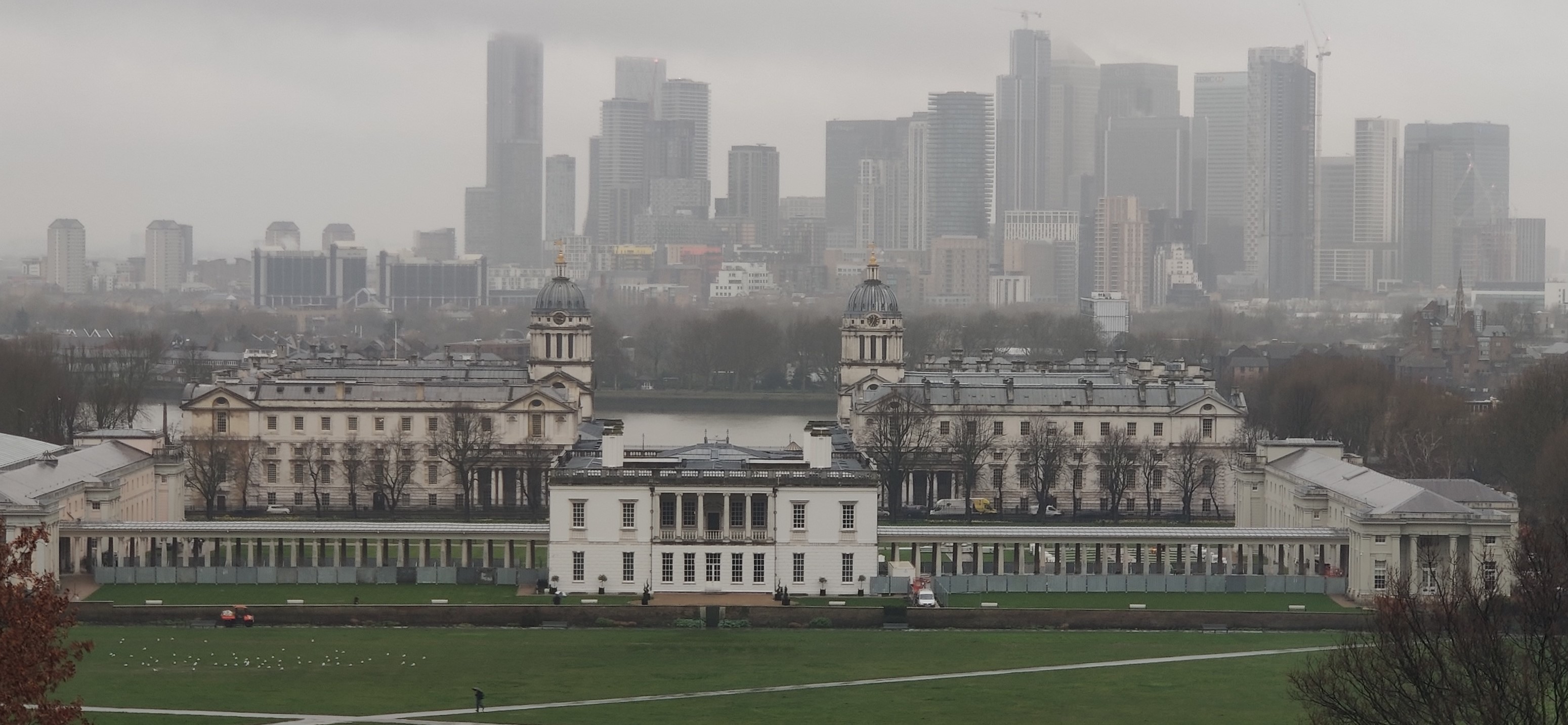
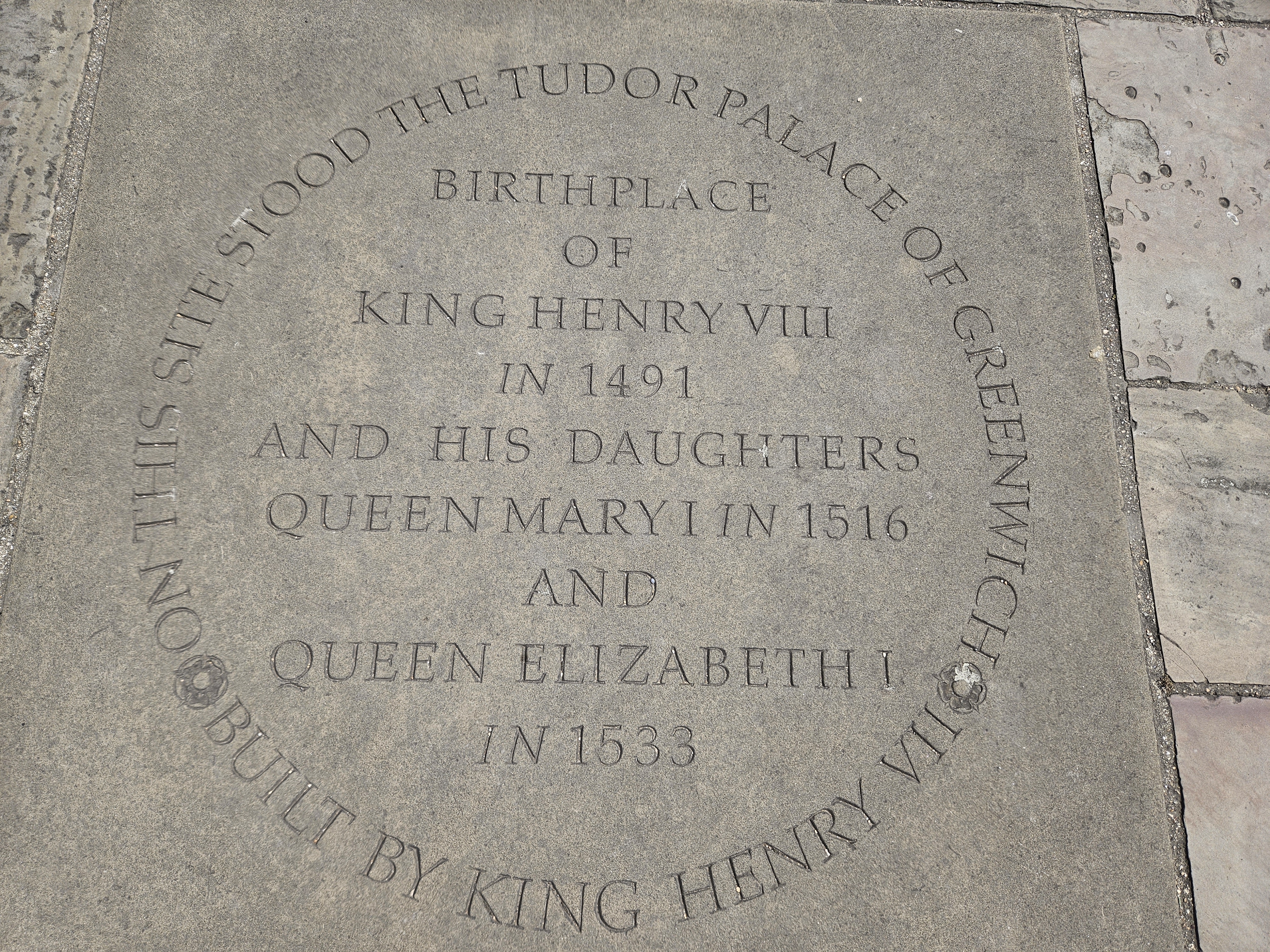
The first Tudor ruler, Henry VII, expanded the Greenwich palace. He installed fresh red brick facing throughout the mansion. The Tudors came to love this palace, in part because of its proximity to the royal shipyards on the River Thames. On June 28, 1491, the future Henry VIII, the son of Henry VII, was born at the palace. Henry VIII’s preferred place to live was this one. He greatly expanded the Greenwich Palace, adding stables, forges, a new dining hall, and armories to produce military mail suits. It was there that he wed two of his wives and gave birth to his daughters, Elizabeth and Mary.
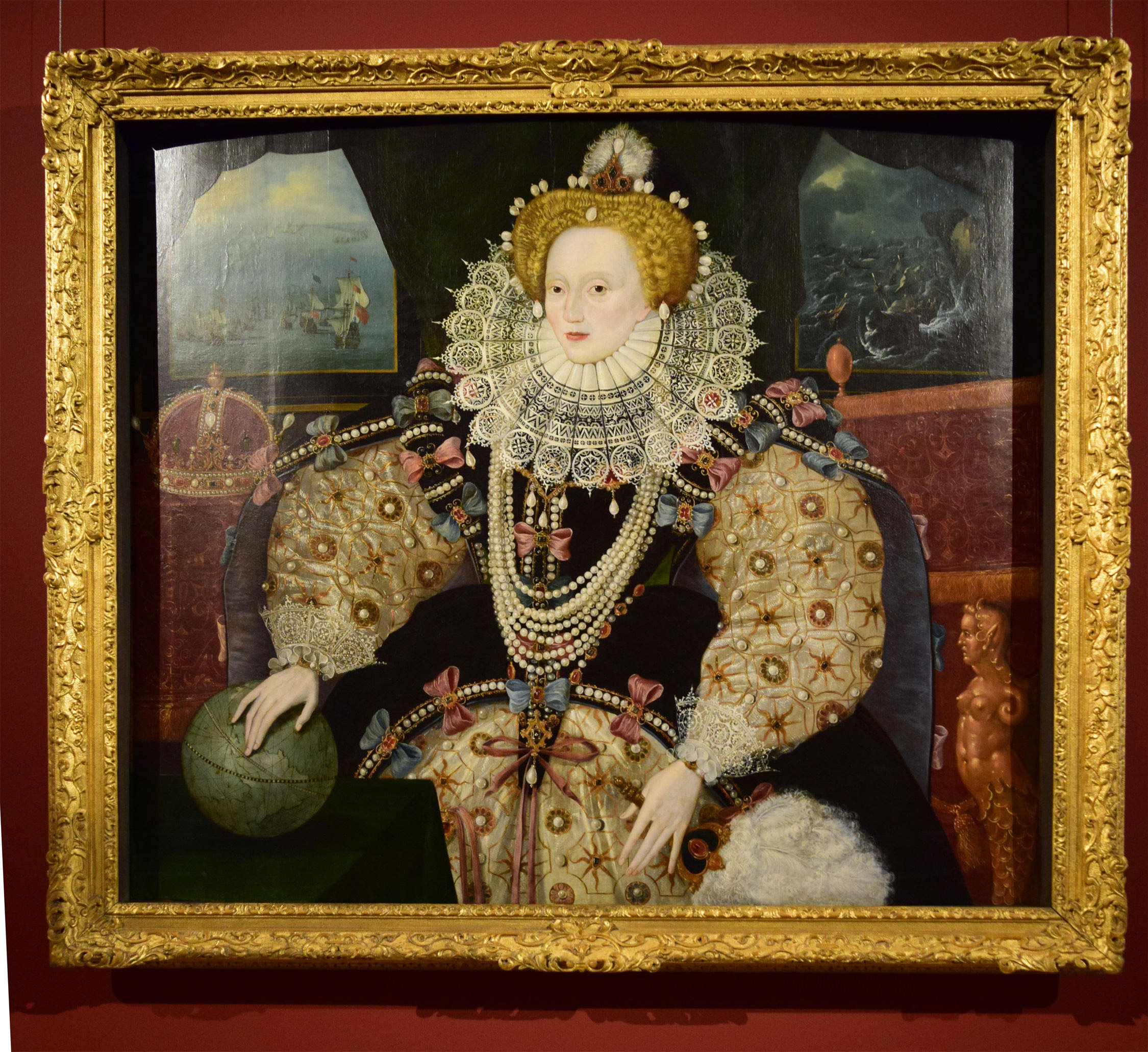
In reality, during the pandemic-induced lockdown in 2020, archaeologists discovered the remains of Henry VIII’s tiltyard. A tiltyard was a jousting enclosure. The yard was found using ground-penetrating radar, and it is believed that this is the location of Henry’s well-known 1536 jousting mishap, which left him unconscious for two hours. After receiving his father’s five warships, Henry set out to construct a fleet that might equal those of his rivals in Europe. Greenwich was ideally located for visiting the new shipyards at neighboring Deptford and Woolwich, as Henry VIII had a special fondness for ships and the navy. By the time Henry passed away in 1547, the Royal Navy had grown to include almost 40 ships. The notorious Tudor monarch had established Greenwich as the hub of British naval operations and, eventually, the global center.
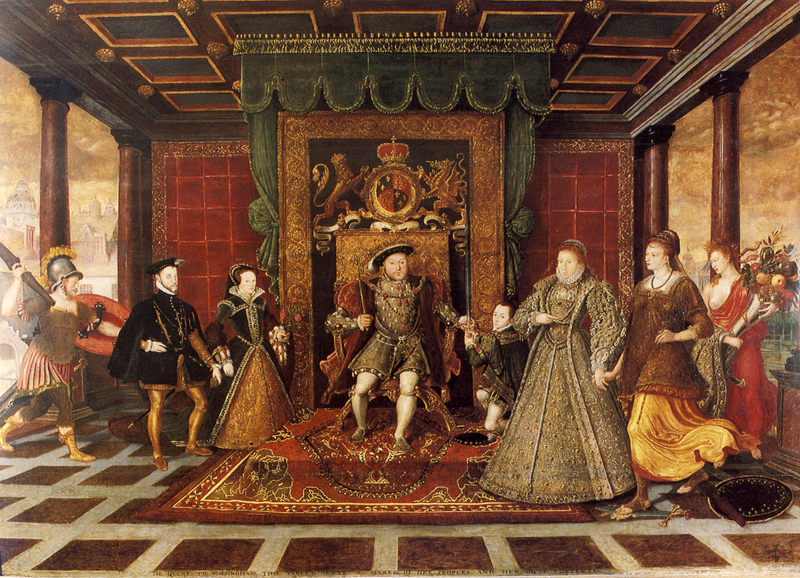
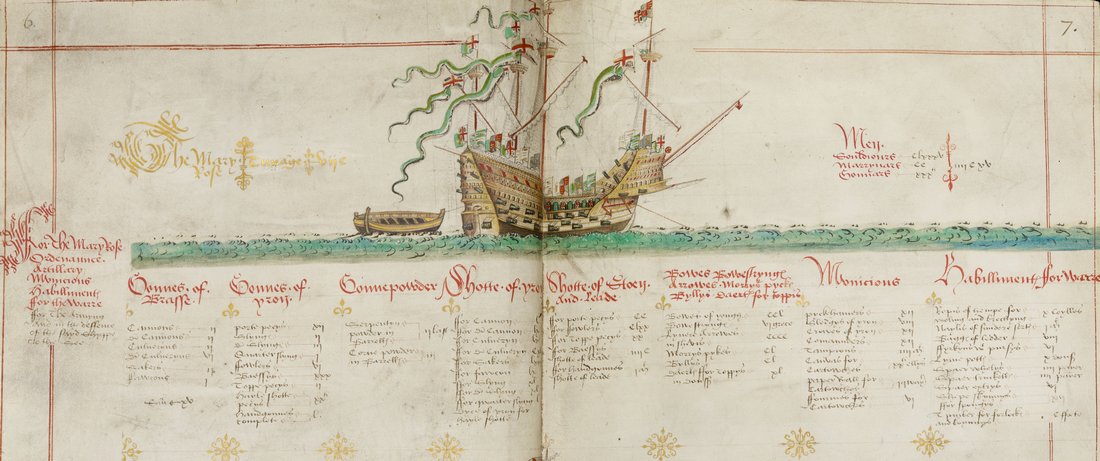
The Palace was maintained as the principal residence of both King James I and King Charles I, but the benefits of this old manor house would soon be terminated because of the Parliamentary (Civil) War. Infact, after taking control, Cromwell made an unsuccessful attempt to sell the Palace. Instead, he converted the entire building into a biscuit factory and, for a brief period of time, a POW camp. Unlike what the name had once suggested, the Palace of Placentia soon became anything but pleasant by the time England had returned to monarchy.
Remarkably, the construction of the Queen’s House, which stands in sharp contrast to the old red-brick Tudor palace, corresponds with the collapse of the Tudor palace. The 17th-century Queen’s House, the first classically styled building in Britain and a distinct contrast to the Tudor-style buildings, was constructed by renowned architect Inigo Jones on a commission from King James I. Today, it is the sole portion of the former Palace of Placentia that still stands. Contemporary sources suggest that King James I had the Queen’s House built by way of apologizing to his Danish wife, Anne, for swearing at her after she shot his dog by mistake. Given her death in 1618, Anne was unable to witness the completion. Painting this very little, symmetrical house white instead of red brick must have looked incredibly out of the ordinary. And yet, even after 400 years, it continues to have this distinct aristocratic look and feel.
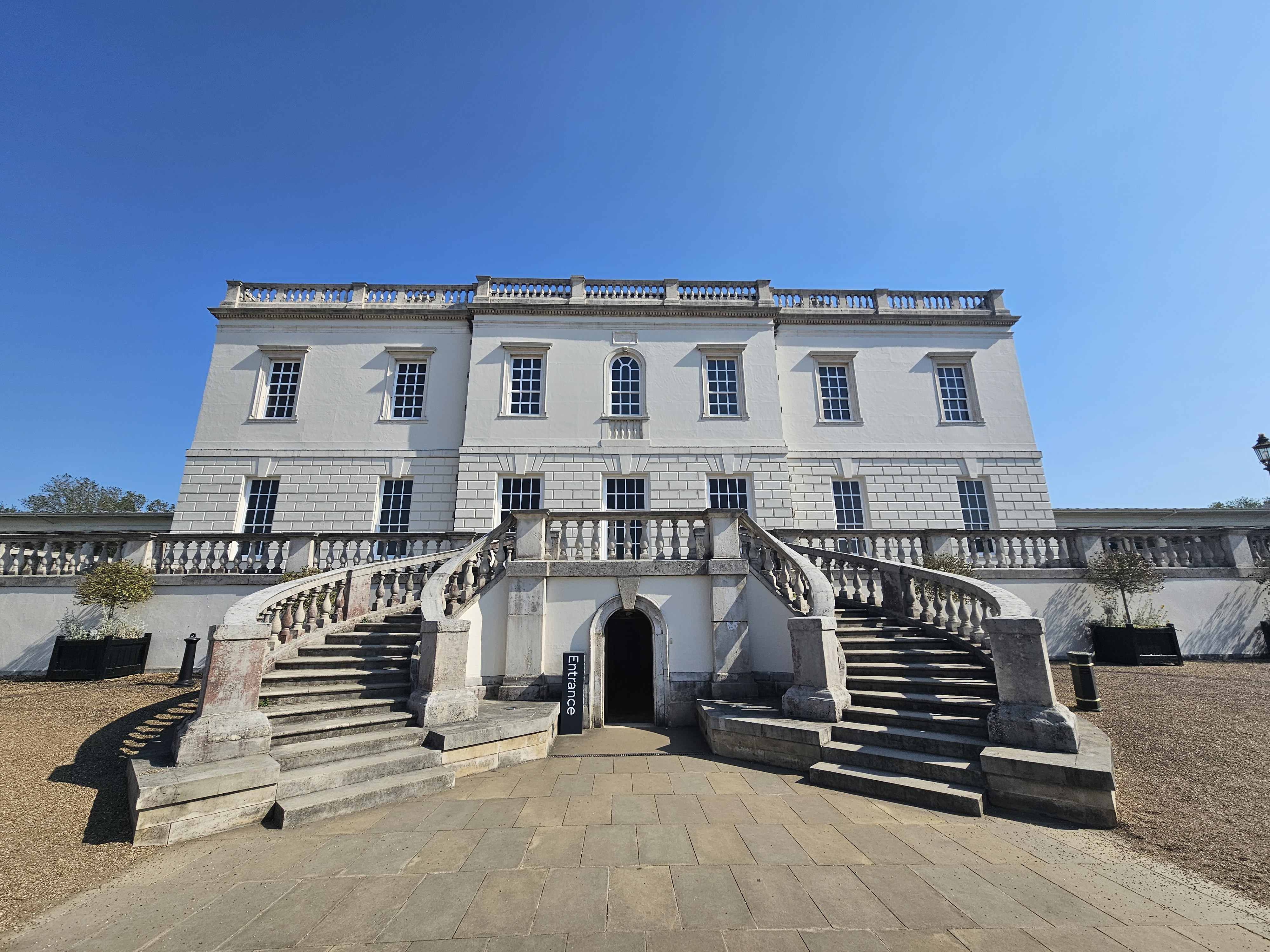
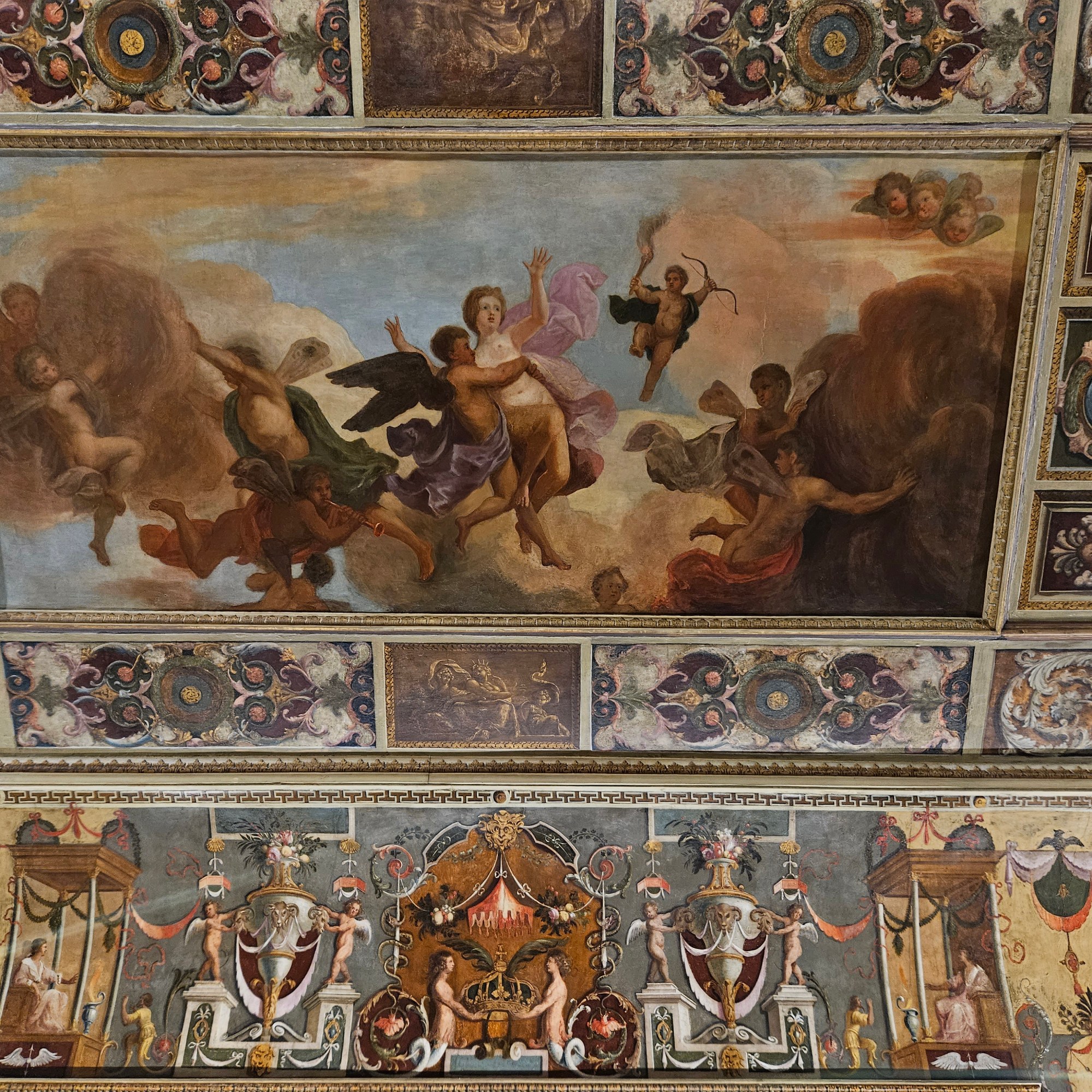
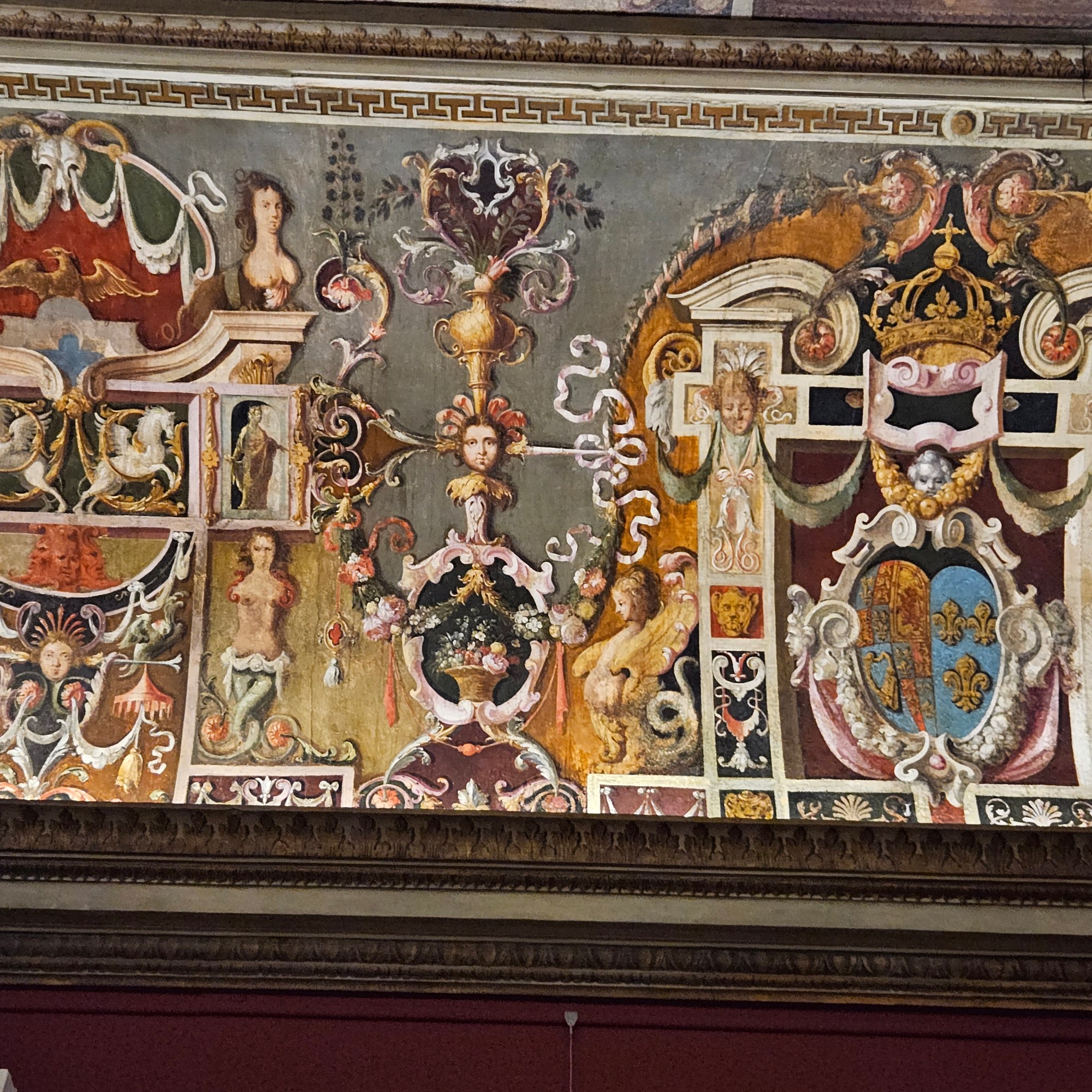
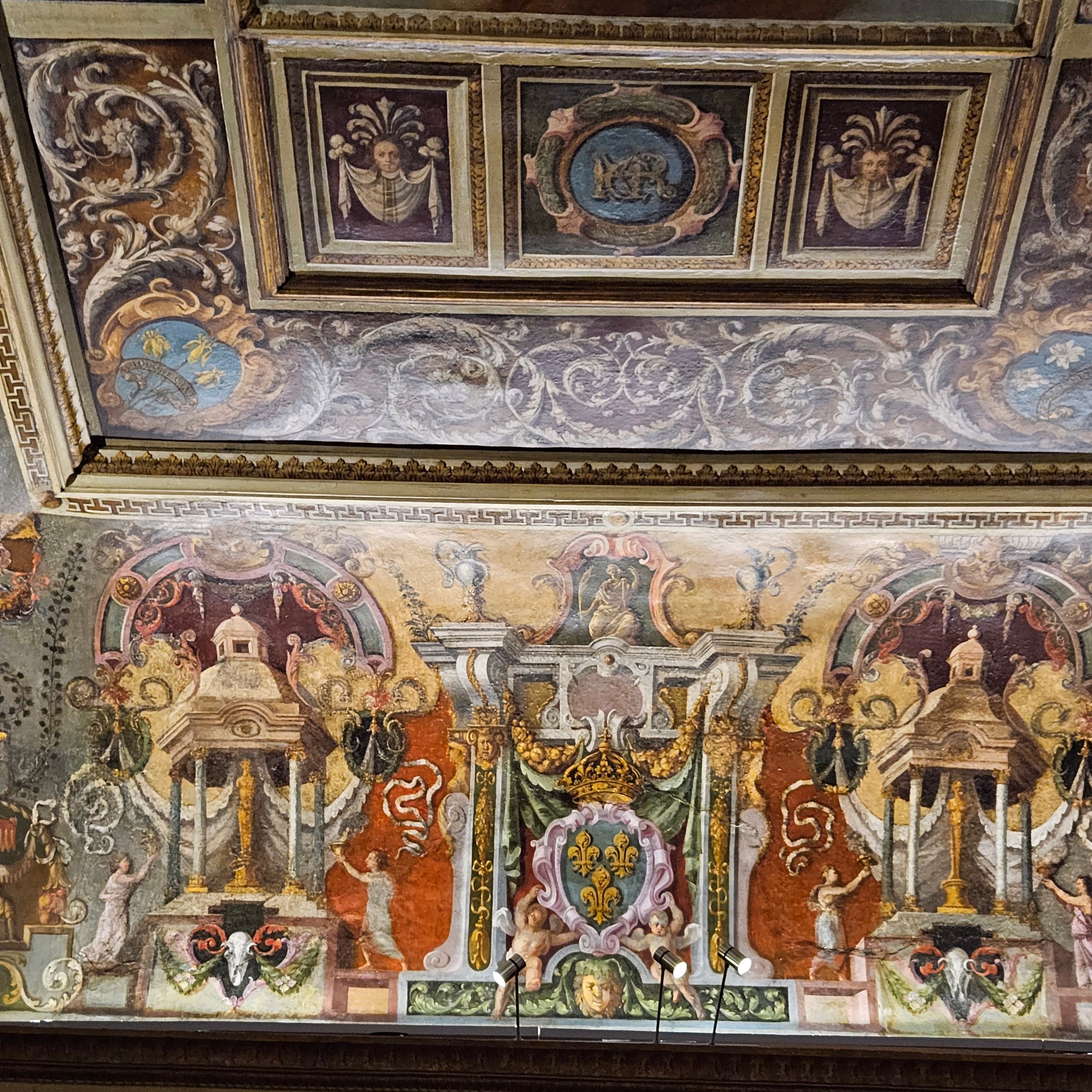
Henrietta Maria’s husband, Charles I, gave her the mansion in 1629; it was completed sometime in 1636. Walking through the house gives a quaint sense of victorian aesthetics. For instance, witnessing Queen Henrietta Maria’s bedroom ceiling itself is a work of art fitting of a queen. Edward Pearce Senior, an associate of the architect Inigo Jones, painted the ceiling borders, which are still intact, in a manner reminiscent of those found in Italy. The arrangement of the royal arms of France and England to create a heart above the queen’s bed is a nod to the queen’s French ancestry.
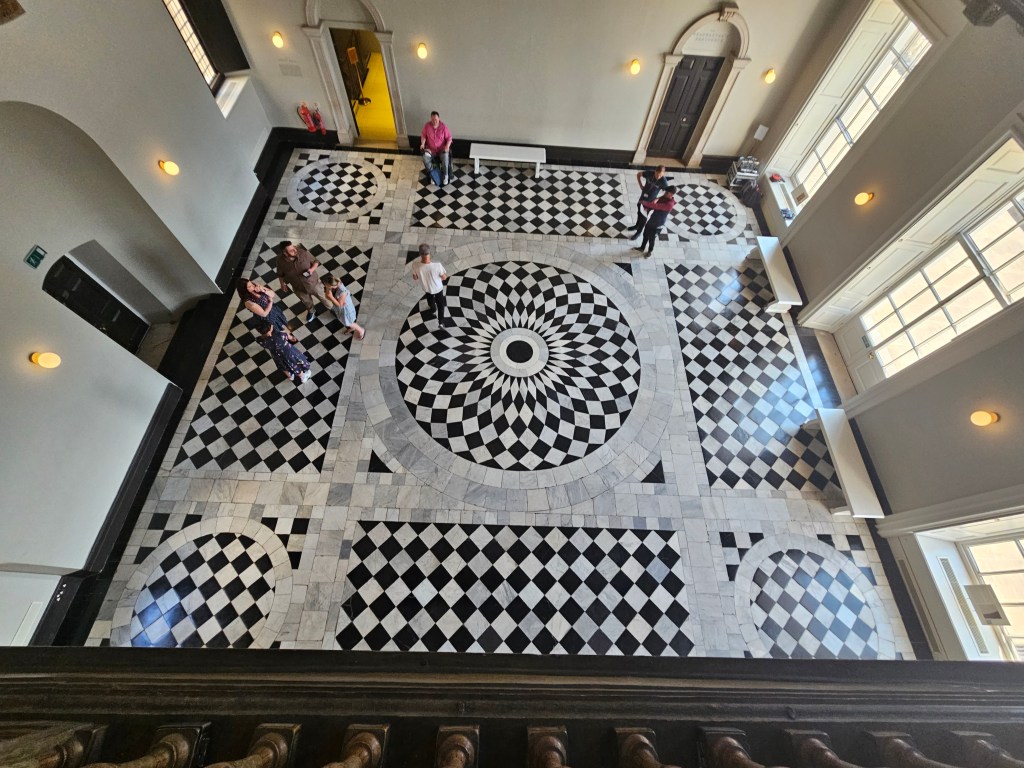
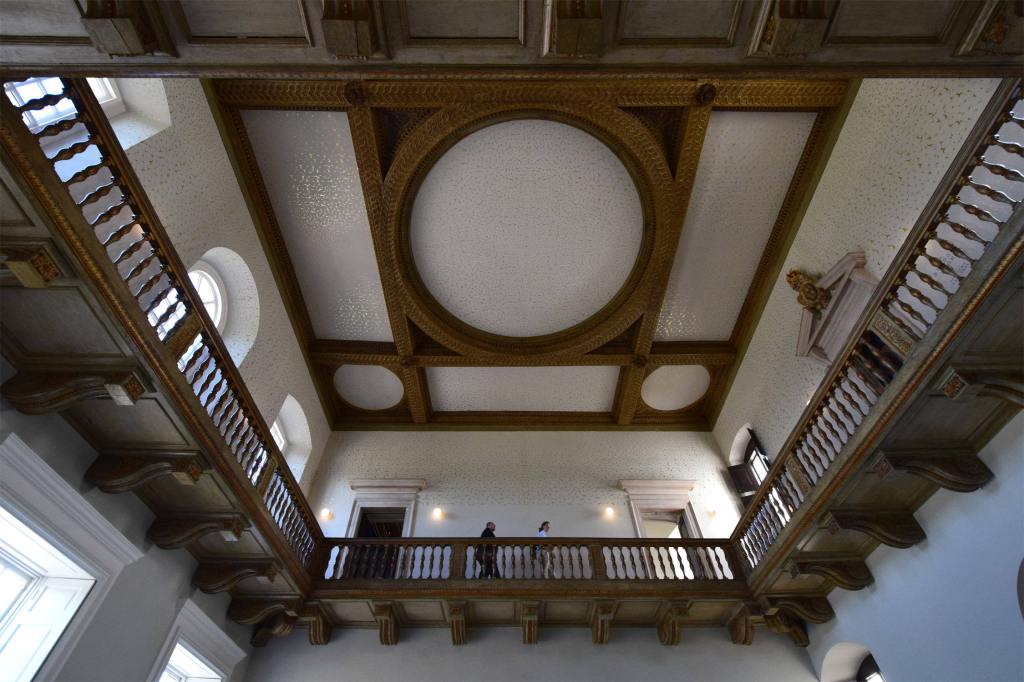
Another notable feature is the precisely square and precisely cubic marble-floored salon. The black-and-white pattern on the floor is reflected in the ceiling beams, highlighting the significance of playing with geometry in the design of architectural spaces. The notorious Tulip steps deserves a special note because of this play of aesthetics. Now I know why mom used to say “Geometry is the easiest component of mathematics.”
The building complex comprises of four distinct blocks, each with a central courtyard. King Charles Block and Queen Anne Block are located along the river, and King William Block and Queen Mary Block are located to the south of them. Charles II hired John Webb in 1662 to rebuild and expand the Queen’s House in addition to designing a new palace. As a result, the King Charles’ Block was built and Greenwich Palace was demolished. It was the first phase of a large palace that was never completed due to royal over-expenditure.

In place of the former palace, Queen Mary II intended to erect a philanthropic establishment catering to the needs of retired men who had served in the Royal Navy. Following its merger with the newly established Naval Hospital in 1694, the partially completed Palace of Placentia became the Royal Naval College, which subsequently evolved into the University of Greenwich and the Royal Naval Museum. The general designs for the new complex, which included Webb’s incomplete King Charles block, were created by Christopher Wren. Wren and Nicholas Hawksmoor, his assistant, donated their time without charge to the Naval Hospital. The project started in 1696 and was finished in 1769.
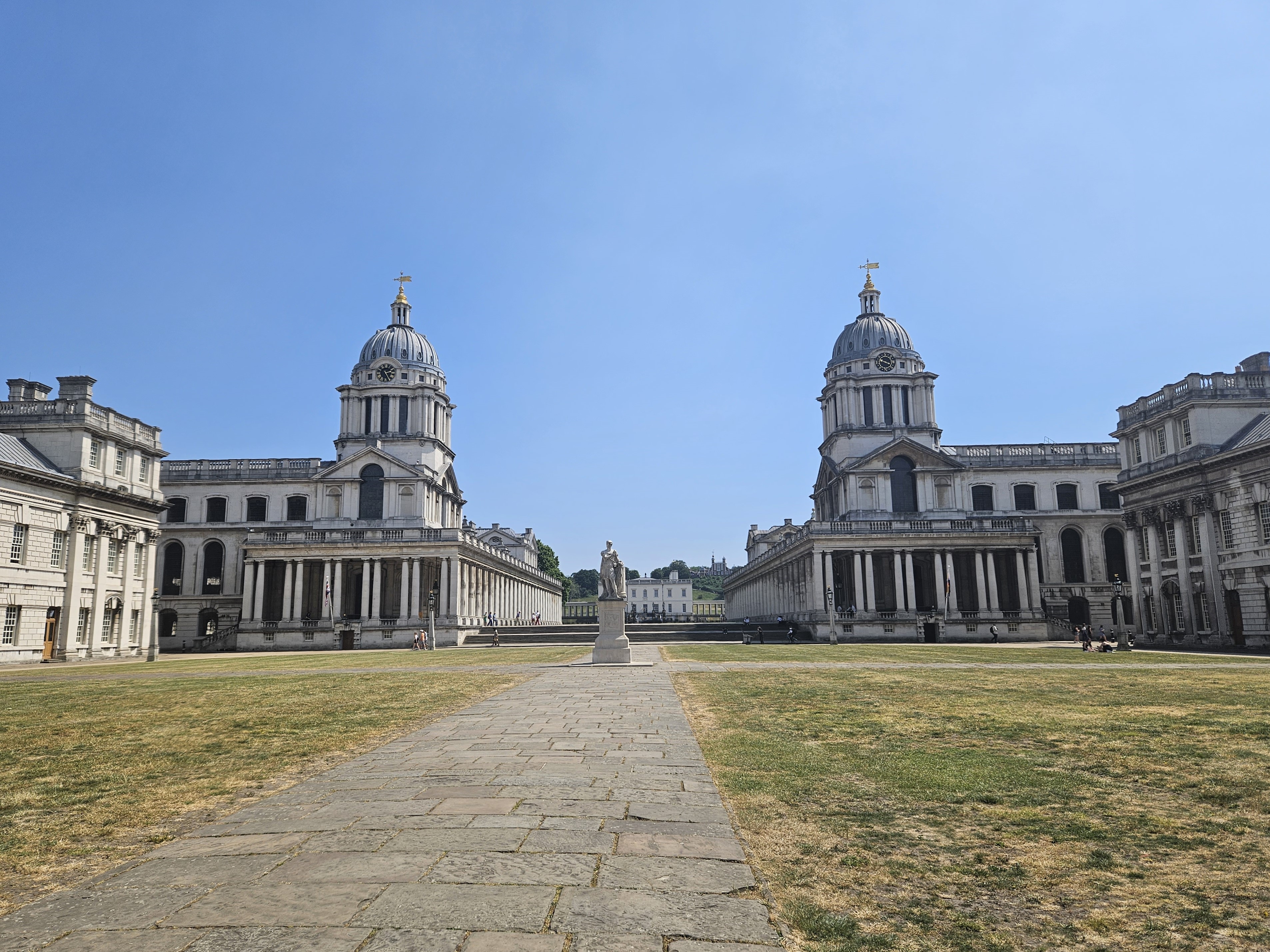
The hospital, which began housing disabled or retired seamen in 1705, had around 3000 residents by 1814. However, the number fell off significantly after the Napoleonic Wars. By 1869, the hospital was shut down. The Royal Naval College moved from Portsmouth when the Admiralty acquired the buildings in 1873. Eventually, lecture halls, classrooms, offices, and residential areas were created out of the wards. The Navy’s staff colleges were combined, and the National Maritime Exhibition opened in 1937, rendering the Greenwich buildings unnecessary. Trustees were appointed to manage the properties when the government leased the buildings in 1996. The Greenwich Foundation for the Royal Naval College became the new owner of the location after the Royal Navy departed in 1998.
The Medical Chapel
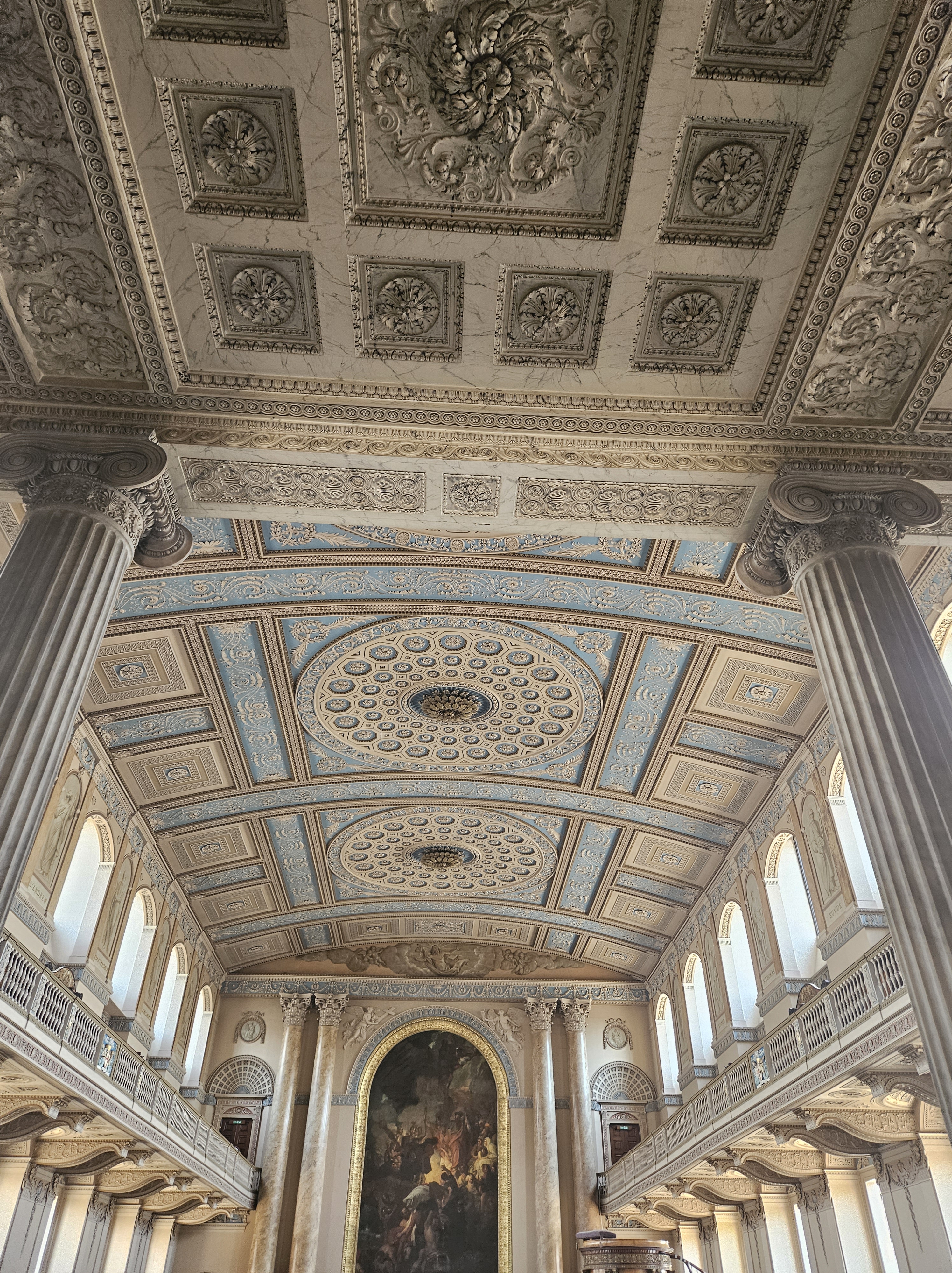
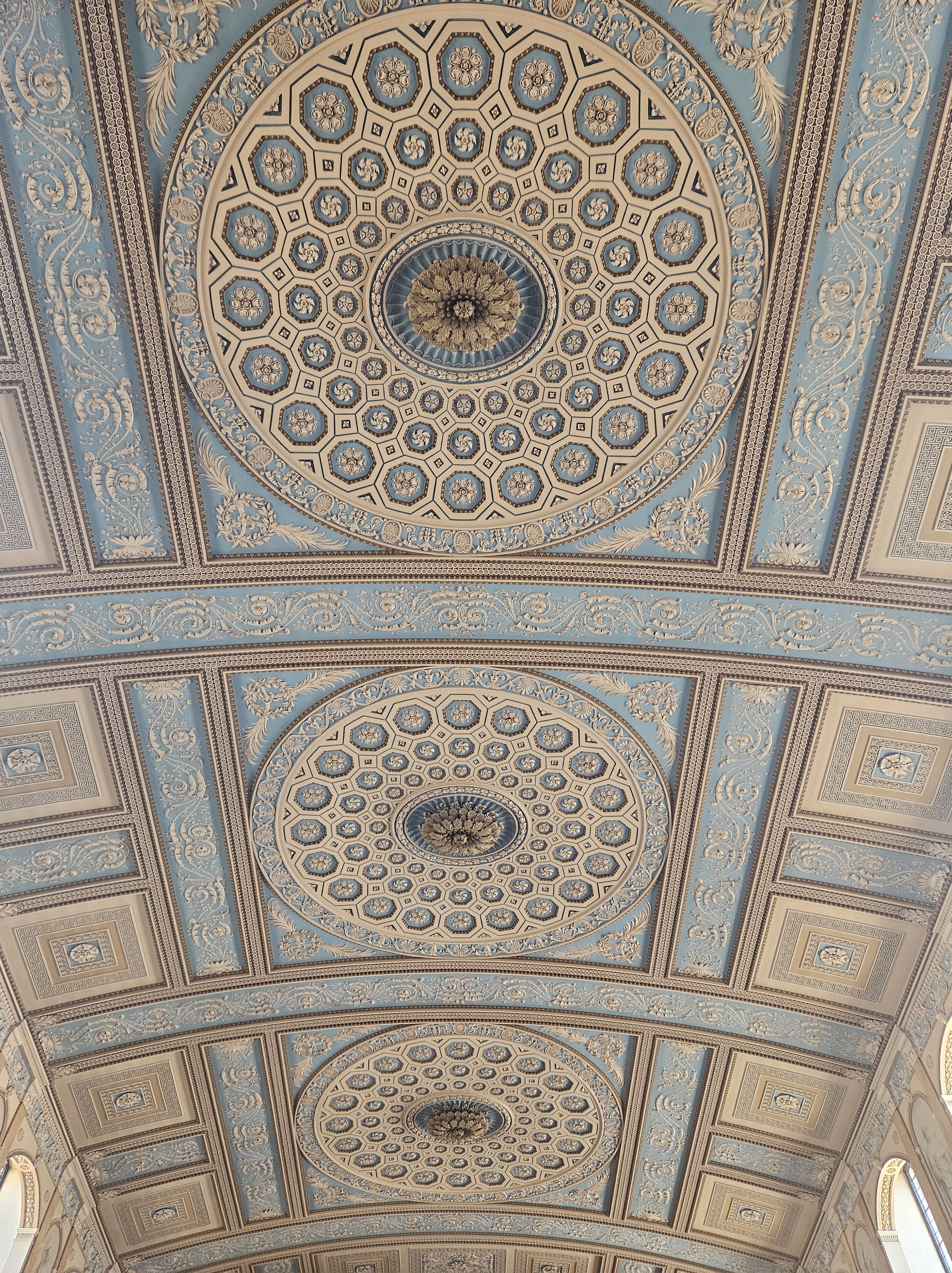
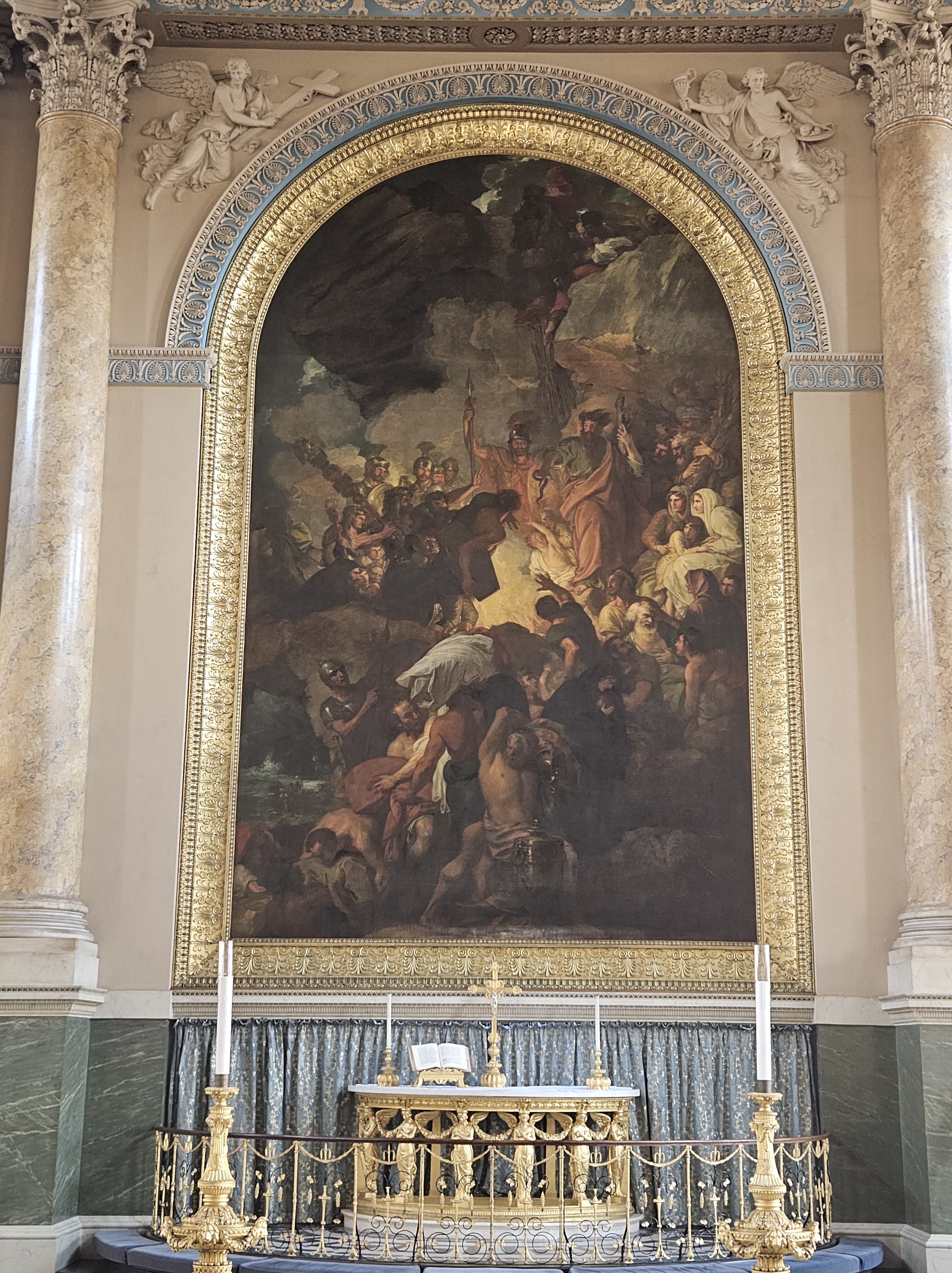
Unlike the fancy header, Sir Christopher Wren’s original plan for the Royal Hospital for Seamen at Greenwich included the stunning Chapel of St. Peter & St. Paul. James “Athenian” Stuart reconstructed the Chapel in 1779 following a terrible fire. The Chapel is generally considered one of the best neo-classical interiors in existence because of its magnificent altarpiece painted by Benjamin West, dubbed “the Raphael of America,” and its beautifully decorated ceiling with nautical themes.
The Painted Hall
The goal of the Royal Hospital’s design was to forge unity, wow foreign guests, and match the opulence of Louis XIV’s construction endeavors, particularly the Hôtel des Invalides in Paris. However, the murals frequently erected in many British sites were created by migrant French, Italian, and Dutch artists. Early in the 1670s, Antonio Verrio, an Italian by birth, introduced High Baroque ornamental painting to England, influencing both James Thornhill and Louis Laguerre. Sir James Thornhill, an artist, was the mastermind behind the Greenwich Painted Hall ceiling, which dates back to 1707 and is undoubtedly one of the most exquisite (and well-known) Baroque interiors in all of Europe. The location is so magnificent and lovely that it has gained popularity as a backdrop for movies and television shows. This includes some of the biggest movies that have come out in recent years, such as blockbusters like The King’s Speech, Thor II: Dark World, James Bond’s Skyfall, Les Misérables, Four Weddings and a Funeral, Pirates of the Caribbean 4, and Netflix’s The Crown and Enola Holmes. Most recently, it served as the Netflix series The Crown’s Buckingham Palace substitute. Indeed, Empire magazine praised the Old Royal Naval College in 2013 as one of ‘the most popular filming location[s] in the world’.
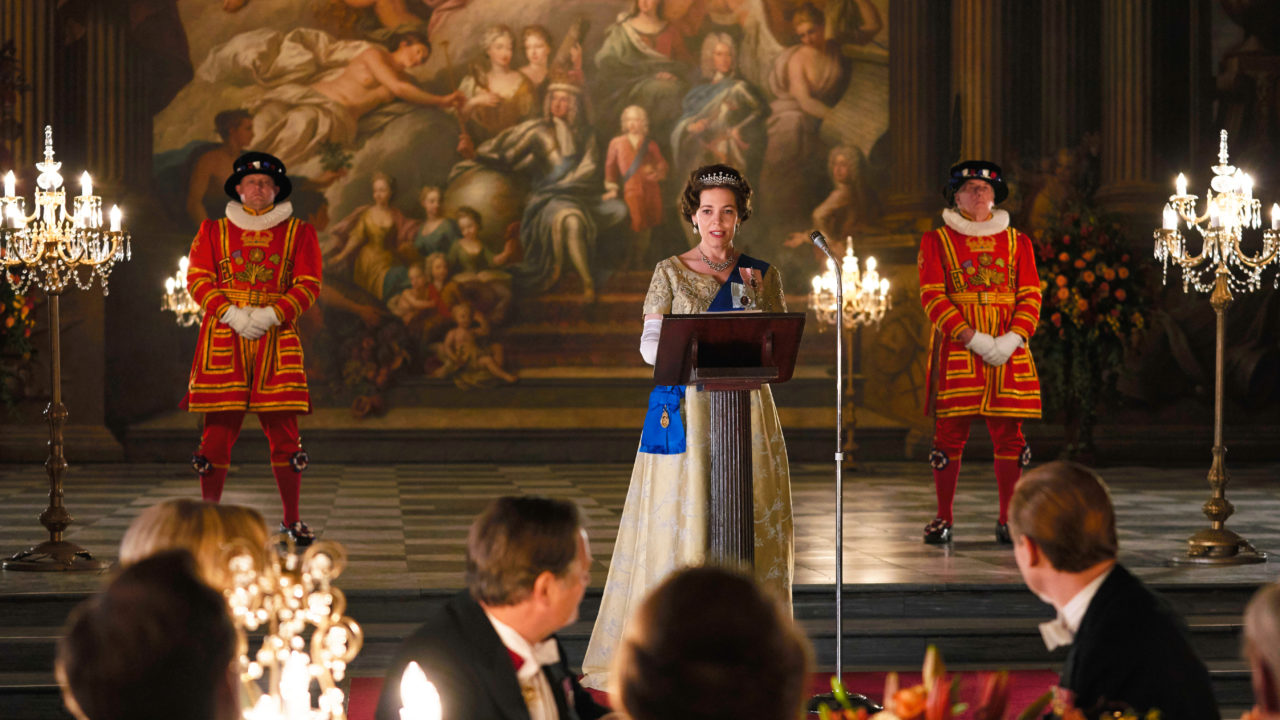
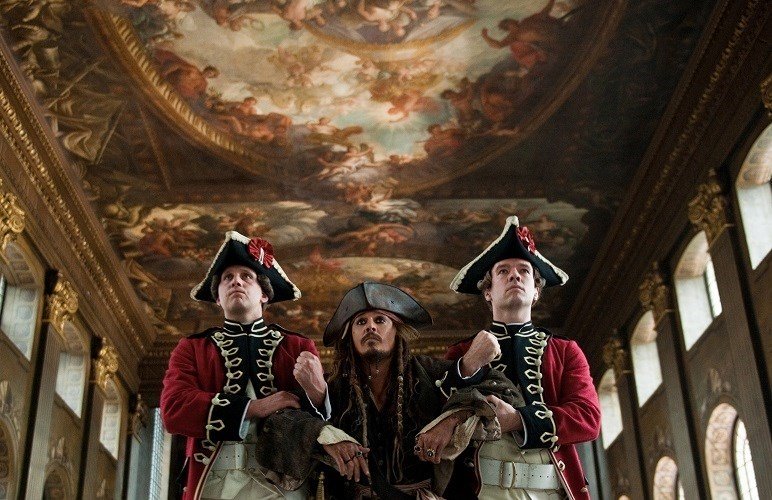
One of the most well-known aspects of the college is the Painted Hall, a Baroque masterpiece that is referred to as “Britain’s Sistine Chapel” and has amazing ceiling and wall decorations that were created by Sir James Thornhill. The hall uses a combination of mythological, historical, and metaphorical figures to portray the “pivotal moment when the United Kingdom was created and became a dominant power in Europe.” Three monarchs ruled Britain during the 19 years that Thornhill painted the hall, from 1707 to 1726: King William III (1689–1702) and Queen Mary II (1689–1694), Queen Anne (1702–1714), and King George (1714–1727). In his early thirties, Thornhill was happy to take on the commission and did not haggle over the cost of his services. He was given payment of £6,685 for his efforts, based on a fee of £1 per square yard for walls and £3 per square yard for ceilings. After the ceiling was finished, King George I knighted Thornhill, the first English artist, and titled him Painter-in-ordinary in 1718.
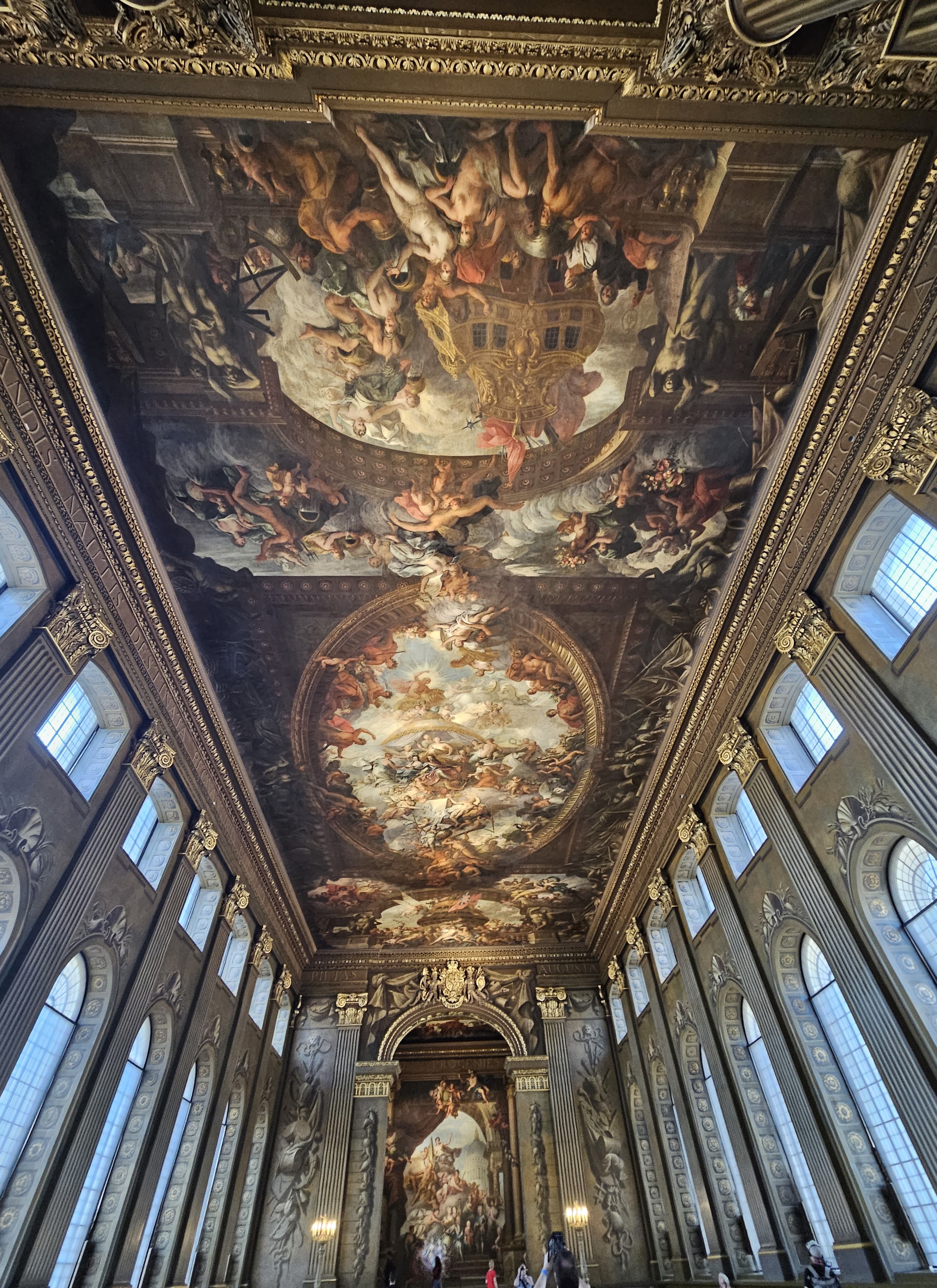
Thornhill created 200 figures, each intended to demonstrate the impact of strong governance – on the British fleet, the economy, science, and the arts. He accomplished this by employing illusionistic techniques reminiscent of Italian Baroque paintings. The Painted Hall’s Lower Hall, finished between 1707 and 1714, is the largest room. King William III and Queen Mary II, the founders of the Royal Hospital for Seamen, are honored in the ceiling. The phrase “By Royal piety, under the auspices of Mary, the Palace of Greenwich is dedicated to seamen needing help so that they may dwell securely and be publicly maintained, who have watched over the public security, in the reign of William and Mary” surrounds the Painted Hall and furthers this theme.
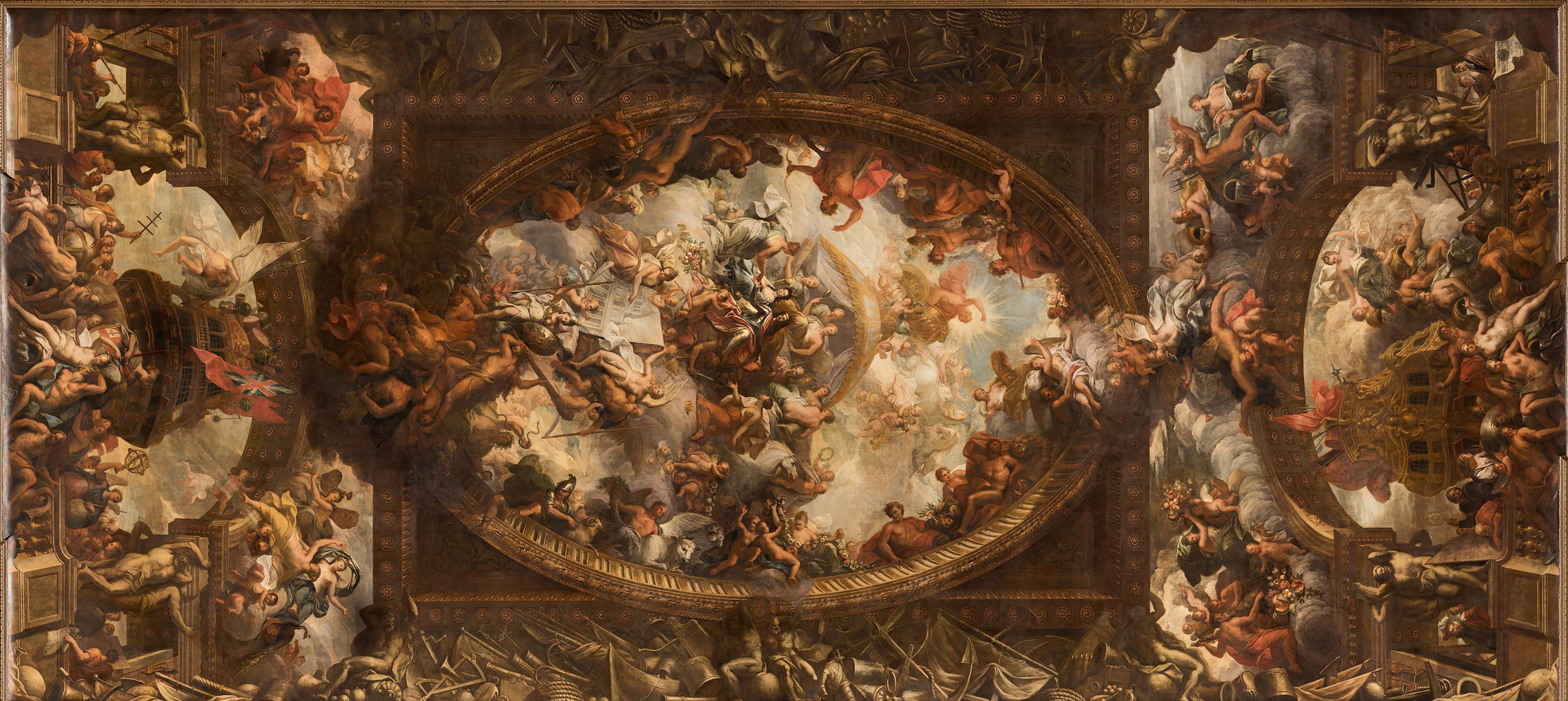
First, let’s address the expansive middle region encircled by an oval frame. King William III and Queen Mary II are seated in the center of the ceiling, beneath a canopy, and encircled by numerous mythological figures, gods, and other allegories which celebrate and symbolize William III’s constitutional authority. They were crowned as joint Protestant kings of England in 1689, following the Glorious Revolution. In the late 17th and early 18th centuries, England saw significant transformation. The Dutch prince William of Orange succeeded to the kingdom as William III in 1688, succeeding his Catholic father-in-law, King James II, along with his spouse, Princess Mary. Together, William and Mary ruled over Britain. And starting during their rule, Roman Catholics were prohibited from taking the throne by Parliament in the 1689 Bill of Rights, stating that “it hath been found by experience that it is inconsistent with the safety and welfare of this protestant kingdom to be governed by a papist prince.”
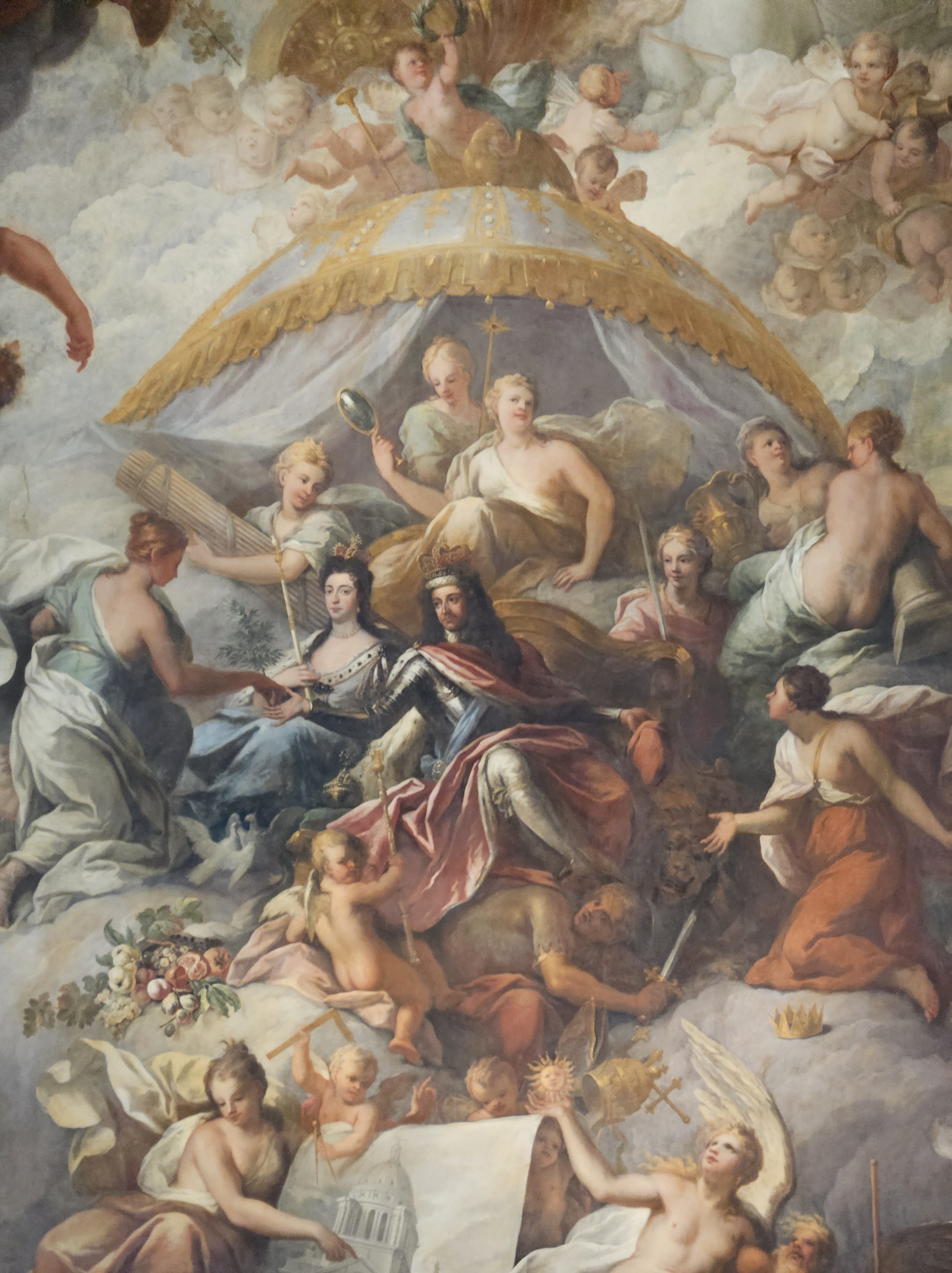
The royal pair, Queen Mary (1694) and King William (1702), had passed away several years prior to the painting of these portraits, which were created between 1707 and 1714. With a stick in hand, Queen Mary is seen seated with assurance and gazing straight out of the painting. King William is depicted delivering the red Phrygian cap, or the cap of liberty, to a kneeling figure that represents Europe and receiving an olive branch from a figure that represents peace. In keeping with the custom of the handshake, William and Peace both shake hands with their right hands. Europe, seen kneeling on William’s left side, stretches out toward the cap, possibly indicating that William thinks he is releasing Europe from the oppressive rule of France. It’s also possible that William’s decision to accept Peace’s olive branch before declaring Freedom is a sign that Peace must come first. The painting’s title, “The Triumph of Peace and Liberty over Tyranny,” is a reflection of this concept.

To continue celebrating William’s achievement, Thornhill made some adjustments to the painting. Since William III could not stand on a defeated lion: the feline evoked his family’s coat of arms, the Nassau, and his homeland, the Dutch Republic, of which he was still Stadtholder. To address this iconographic dilemma without lessening the meaning of the painting, Thornhill decided to replace the lion with the allegorical Tyranny. He then positioned the cat in the shadows, growling at the figure of tyrannical authority represented by King Louis XIV. Beneath William’s right foot is a defeated King Louis XIV of France, clutching a broken sword. France was the strongest country in Europe, and Britain was afraid of its might. William’s top goal abroad was to stop France, Britain’s formidable foe, from expanding. The ideologies of the two nations were different. In contrast to the Protestant constitutional monarchy in Britain, France had an absolute Catholic monarchy. ‘Tyranny and Arbitrary Power’ was the theme of Louis’ presentation in the painting.
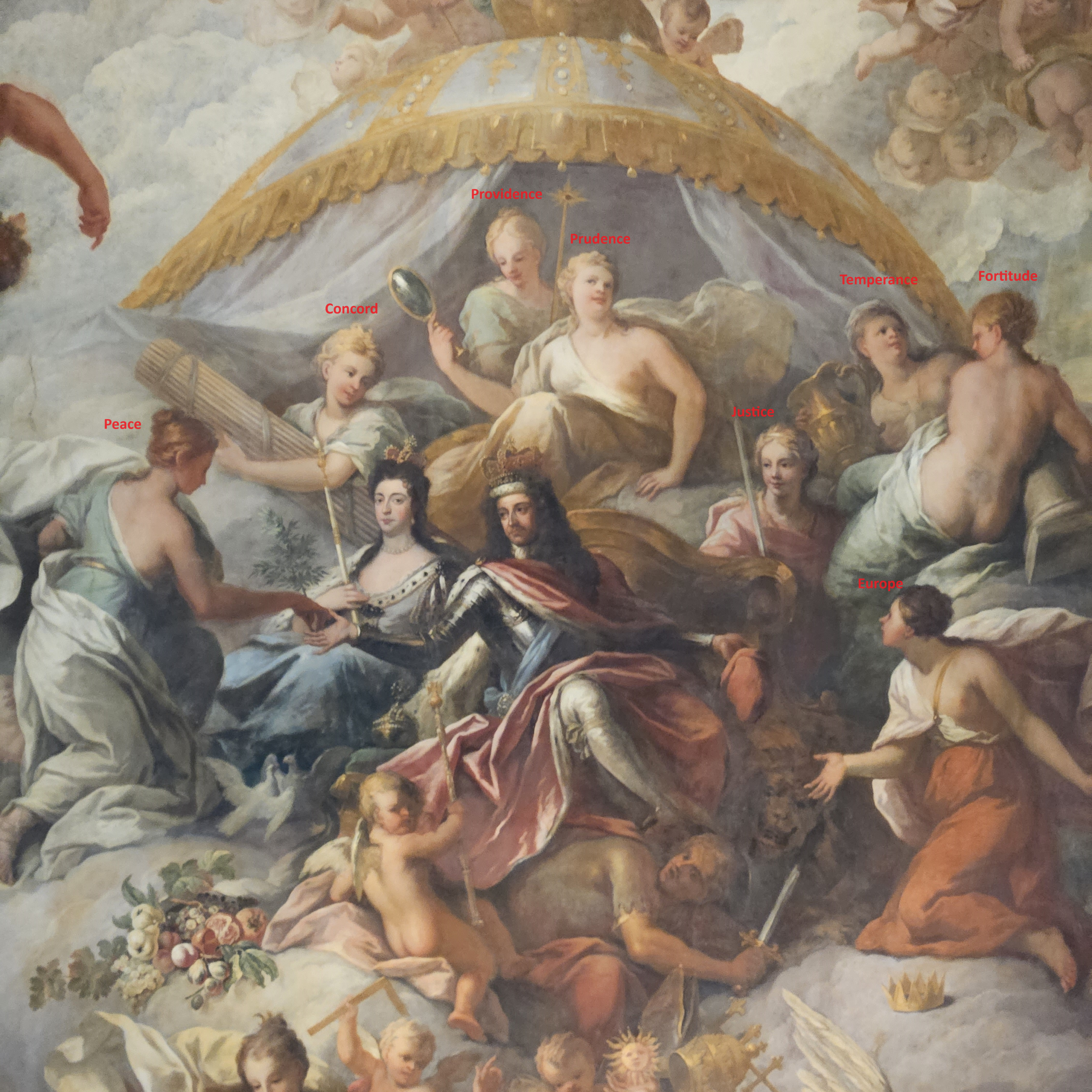
The Cardinal Virtues, Temperance (carrying a golden jug), Justice (holding a sword), Prudence (holding a mirror), and Fortitude (holding a stone column), surround the focal figure of the royal pair. The theme of “The Triumph of Peace and Liberty over Tyranny,” is reinforced by these virtues.
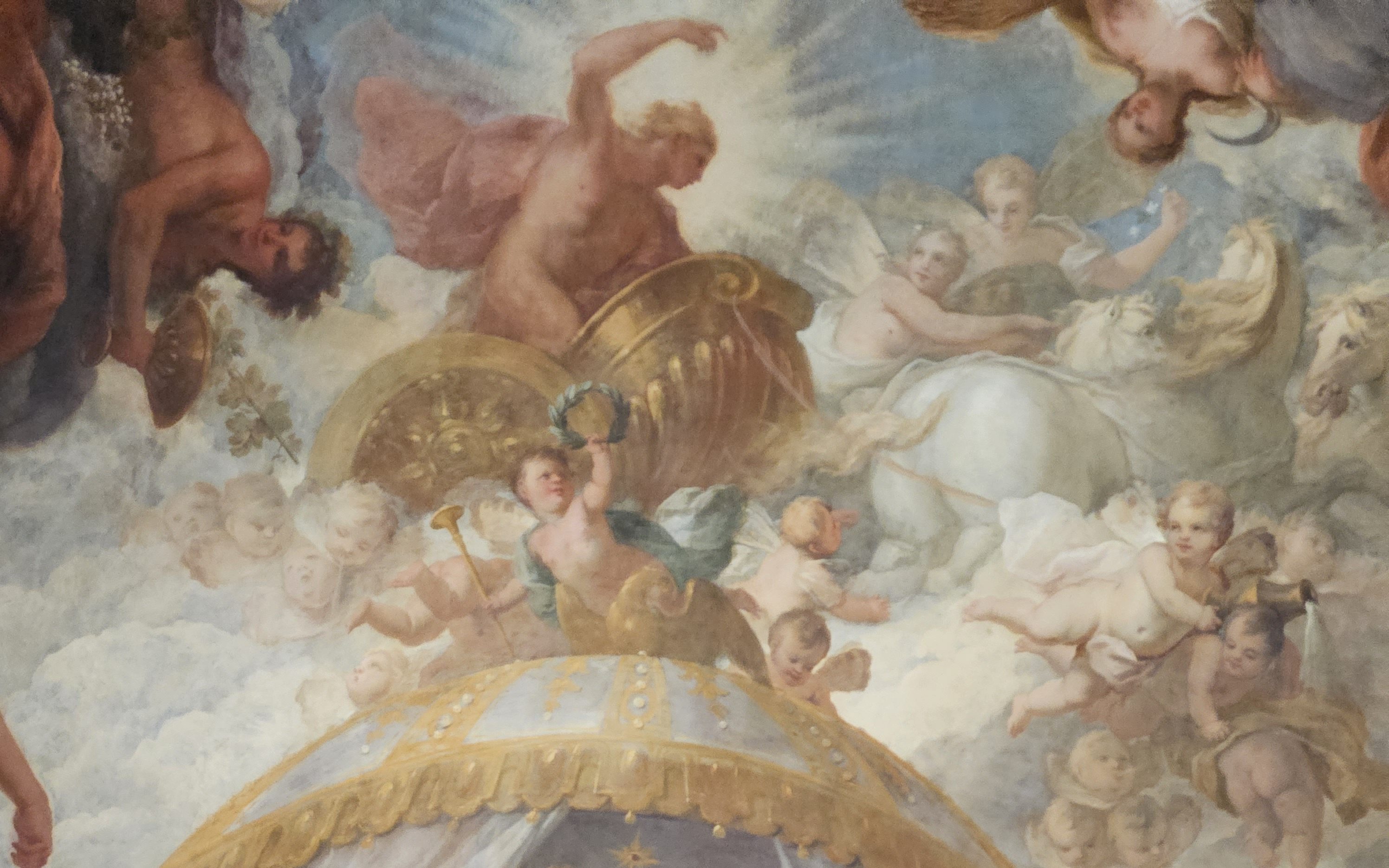
The morning dew is symbolized by a cherub holding a water jar, while Apollo, the Sun God, is seen driving it away from the top of the canopy. He brings light to the royal couple below, welcoming a new day for the Kingdom of Britain. Apollo was a Greek mythological figure who took pleasure in creating cities and civil constitutions. In addition, Apollo defends the realm by fending off evil and lending a hand to those in need. To maintain goodness and grow the empire, all these are considered as necessary characteristics of any virtuous government.
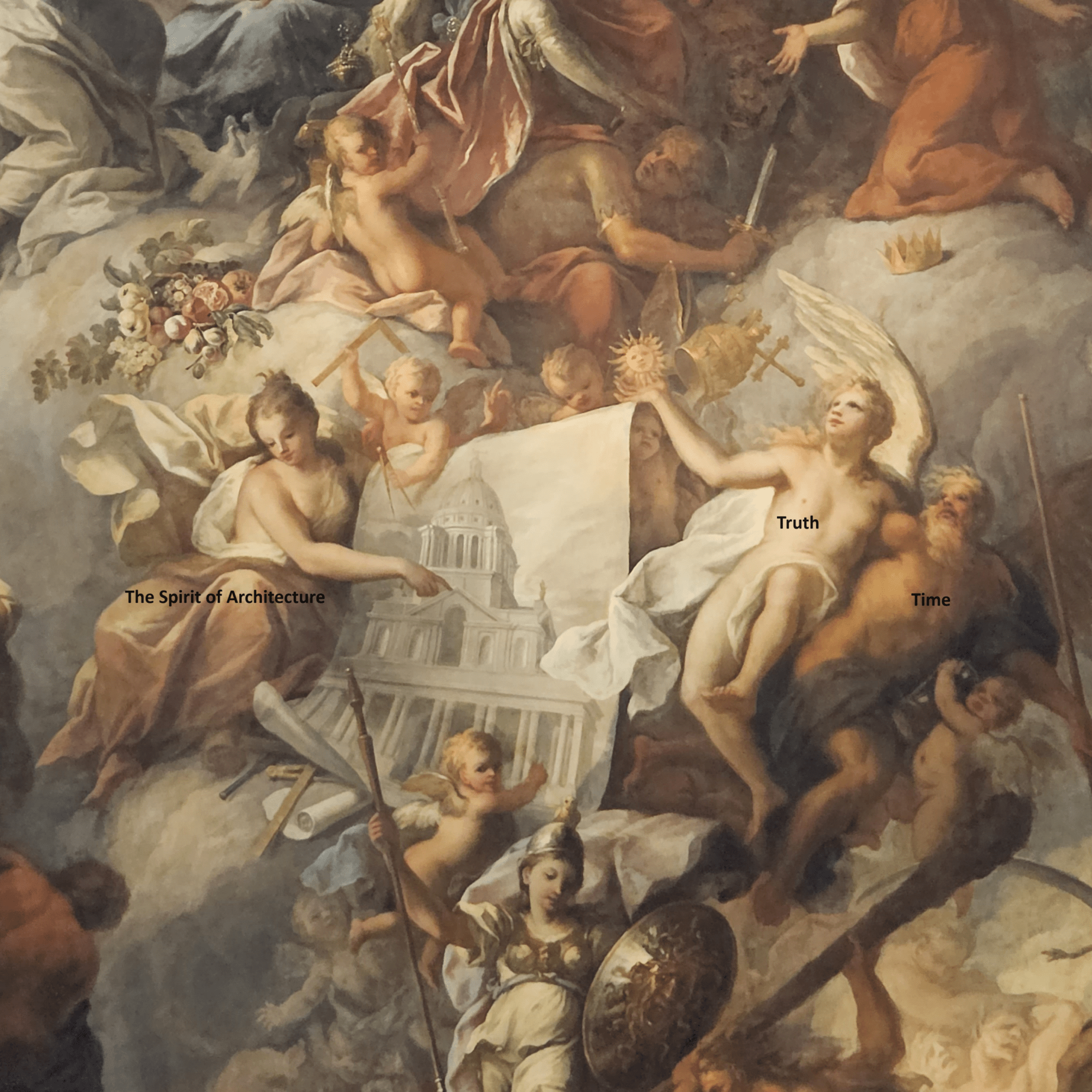
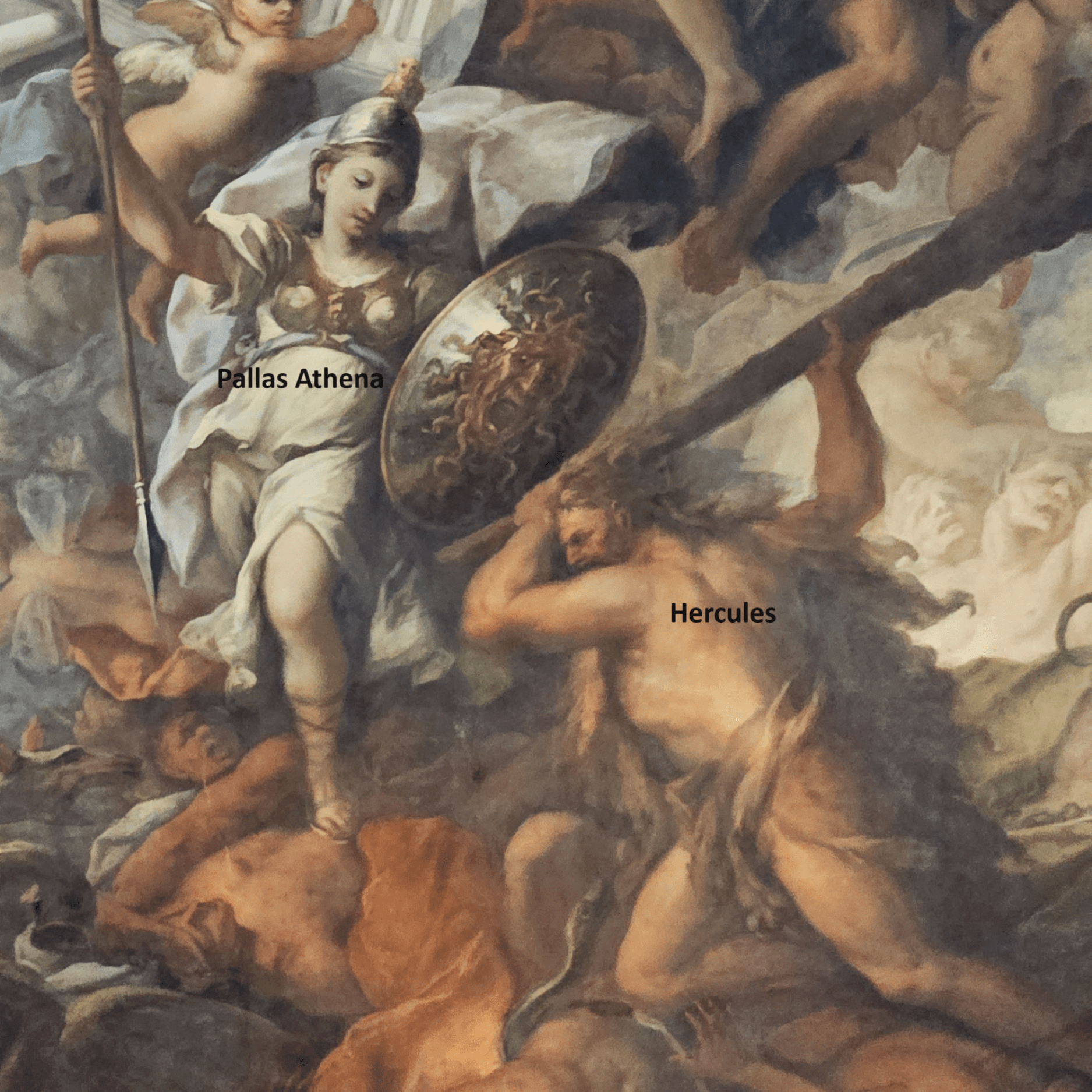
The illustration of the Royal Hospital at Greenwich as indicated by the Spirit of Architecture, is positioned beneath the King and Queen’s portraits. Leading architects of their era, Nicholas Hawksmoor and Sir Christopher Wren, worked together to create the structure. London still beholds several of their constructions, such as St. Paul’s Cathedral. The central oval of the Lower Hall ceiling also features the mythological figures Hercules and Pallas Athena, who represent power and knowledge, further reinforcing Greek mythology with contemporary reality. They are shown as a driving force against the Vices from William and Mary’s reign, which is symbolized by the multiheaded Hydra in this image.
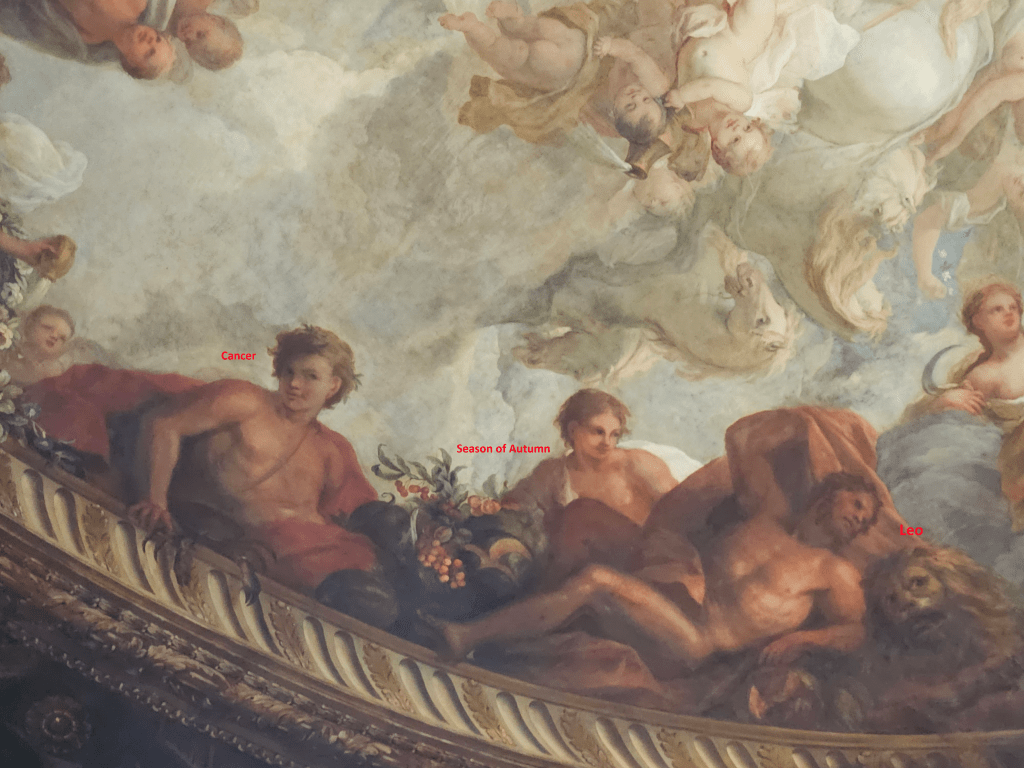
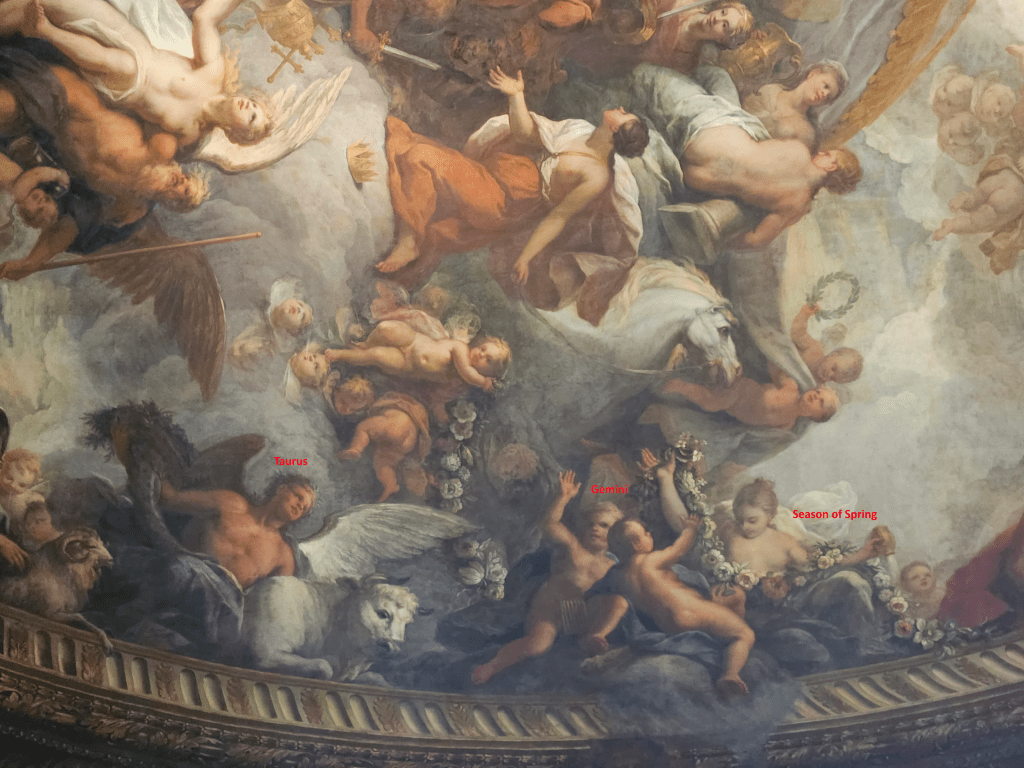
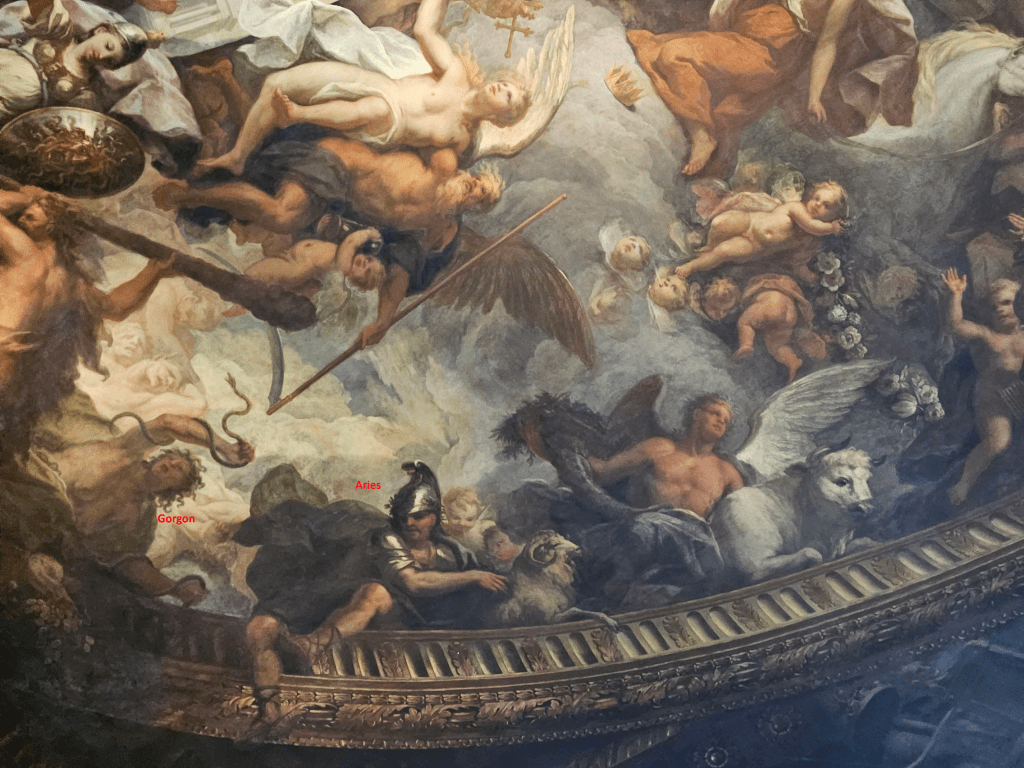
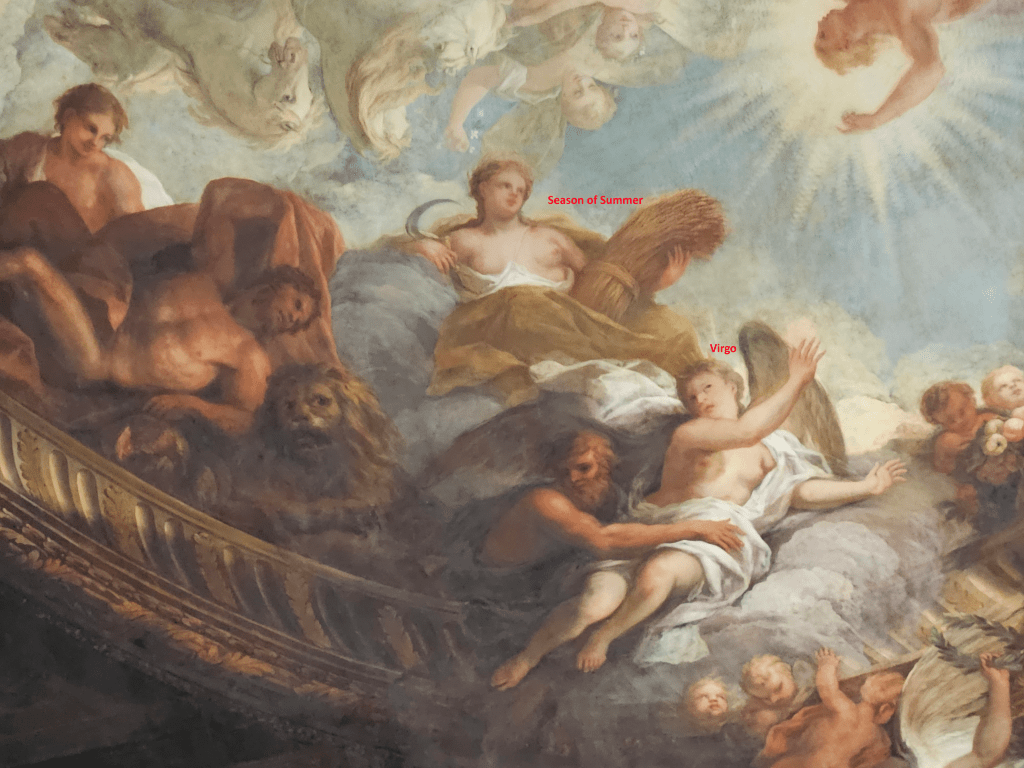
Around the edgers of the oval rim, zodiac signs and the fours seasons have been showcased, expressing the passage of time.
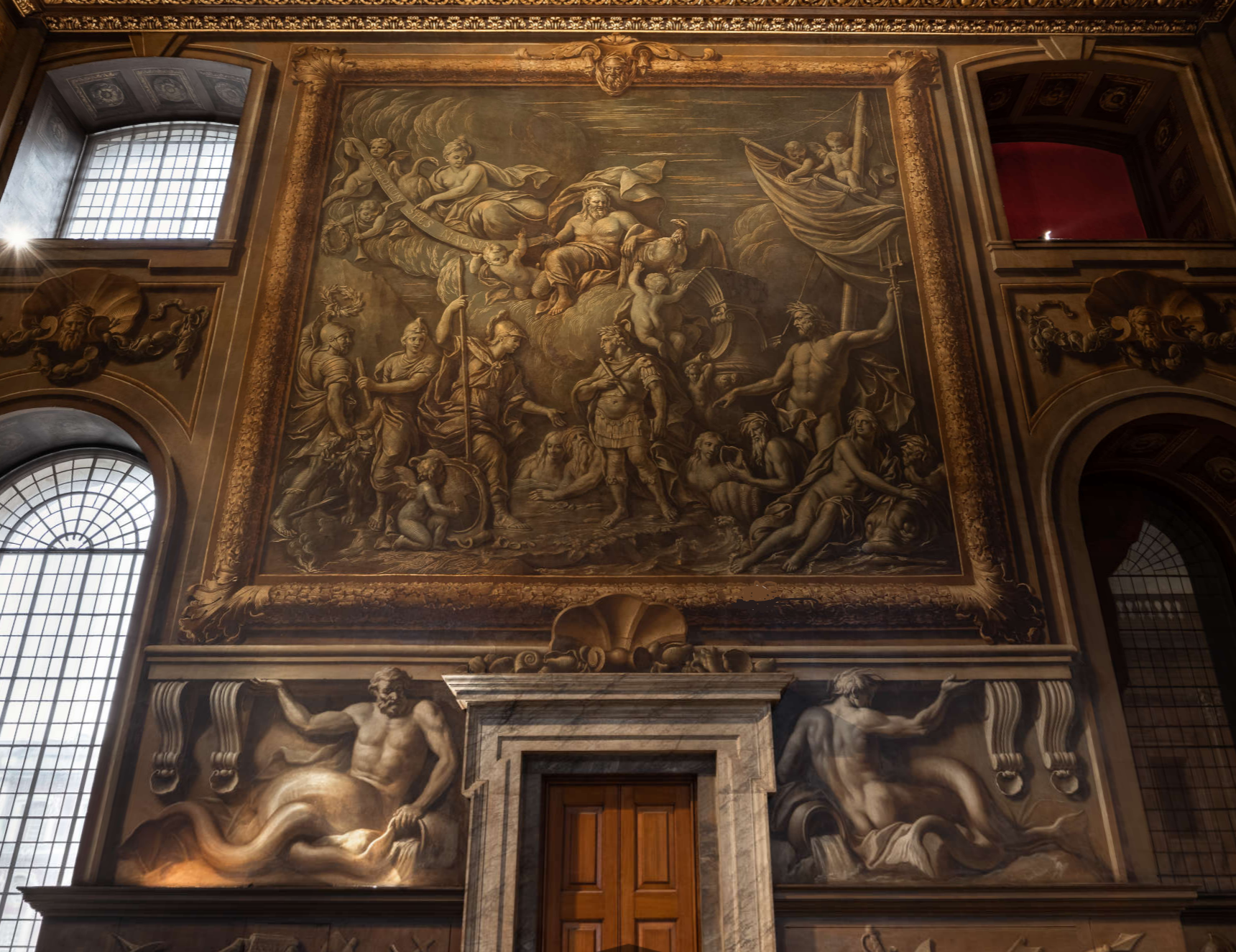
The HMS Blenheim, dubbed a “British man of war,” is positioned between Zeus on the left and Juno on the right, beneath Hercules defeating Hydra. This section of the picture symbolizes the growing naval power of Britain. In the first image below, there’s a man holding a telescope directly underneath Zeus (the man with the red cloak). This man is frequently identified as Galileo Galilei (1564–1624), who may not have invented the telescope but contributed to its improvement such that it could be used for a number of astronomical investigations. The telescope he is looking through is not from his own period, but from the early 1700s, when this ceiling was being painted.
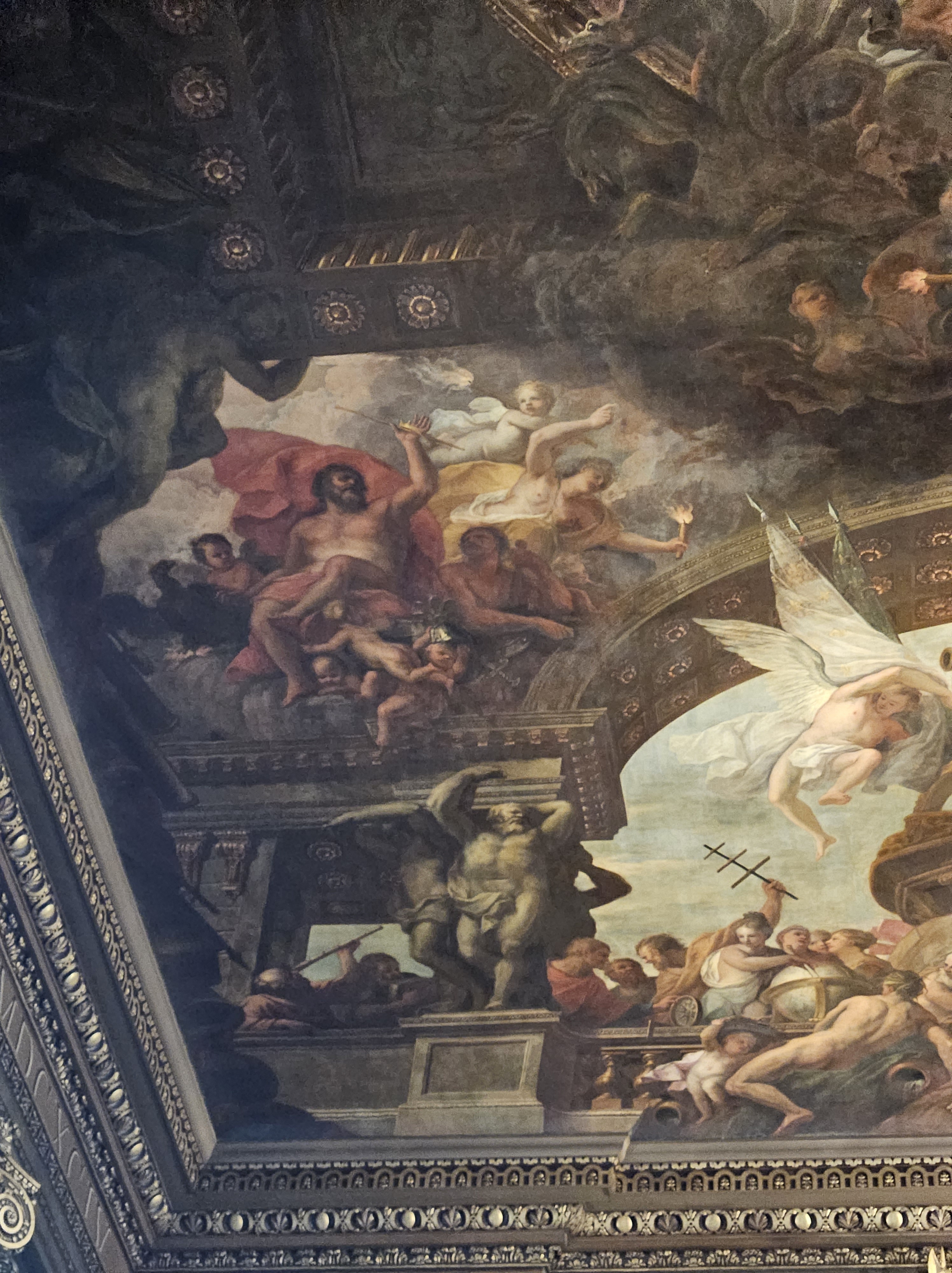
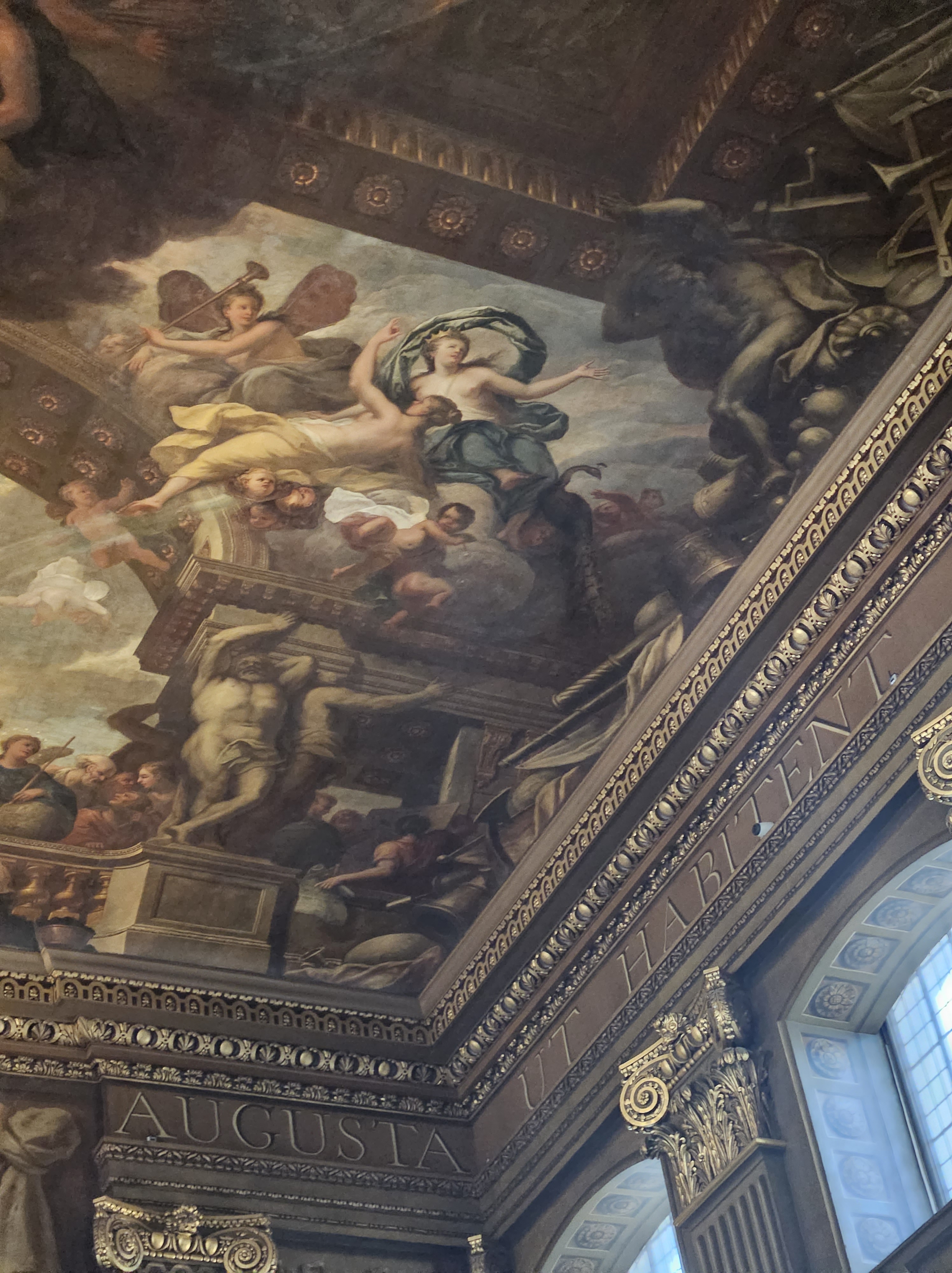
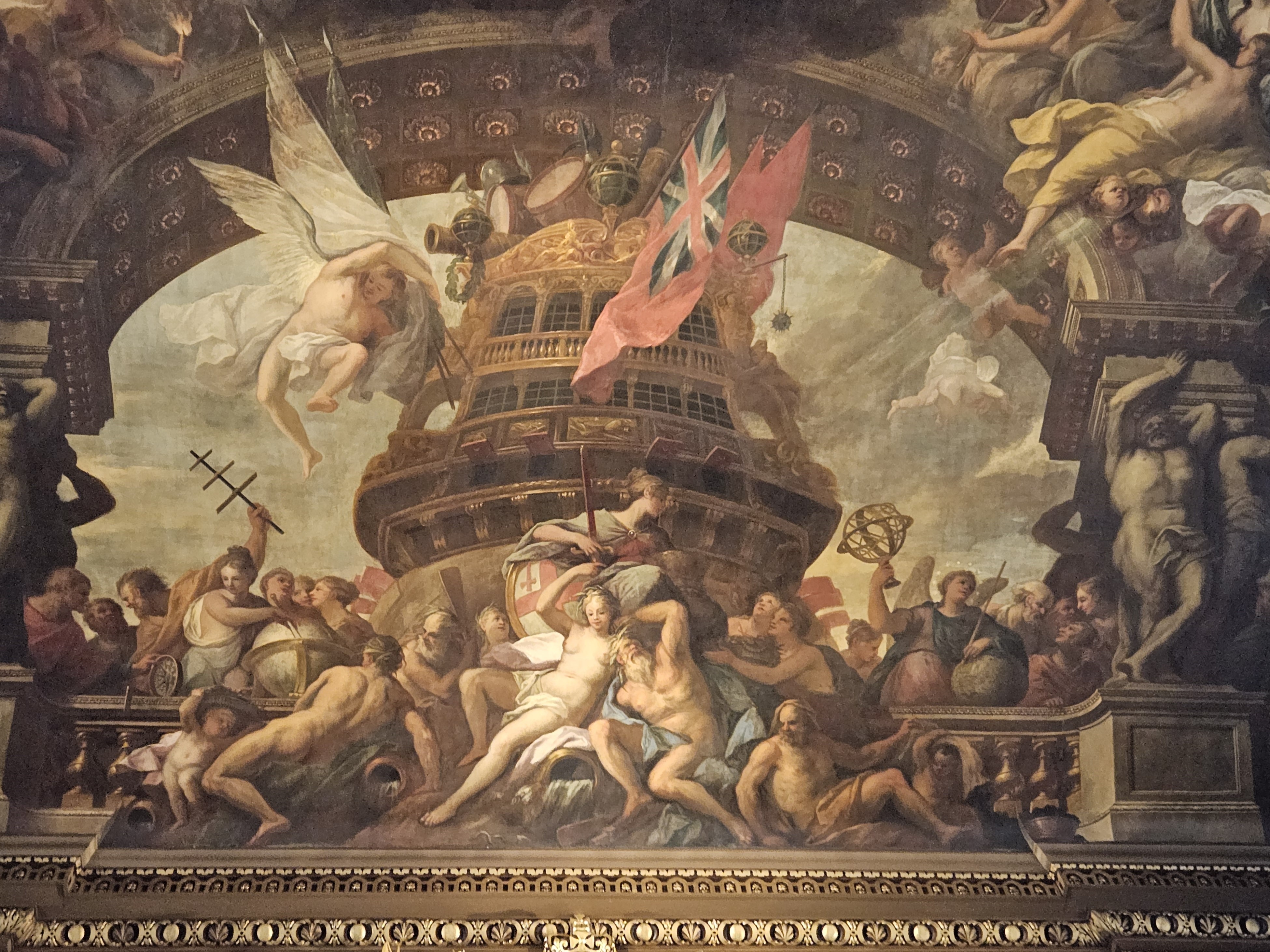
The winged figure of Victory is seen loading the ship with loot and awards that the enemy has stolen, while clutching seized French colors adorned with the fleur-de-lis. The upper portion of the River Thames is known as the River Isis. The woman with the sword and shield, who represents the City of London and its expanding trade and prosperity, is supported by Thames and Isis together. A coal sack is seen being poured into a golden bowl by the River Tyne. Coal was shipped down the east coast from the Tyne to London, and the Royal Hospital relied heavily on the coal tax for funding.
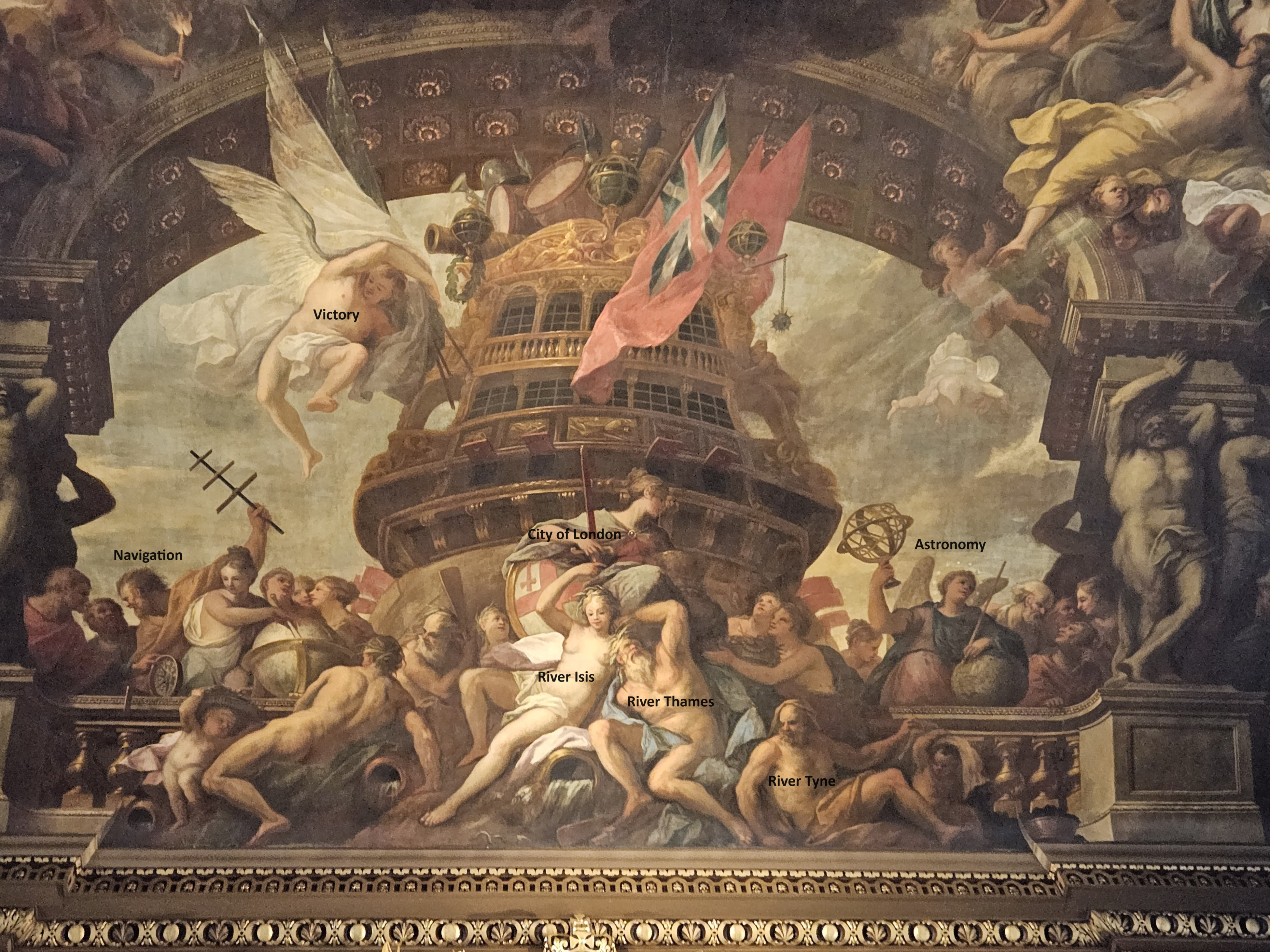
The skills in navigation and astronomy developed to support Britain’s maritime dominance can be seen on the opposite end of the oval frame. Along with representations of the rivers Avon, Severn, and Humber, the goddess Diana, and the scientists Copernicus, Brahe, and Flamsteed, it also features a captured Spanish galleon. An illustration of the Spanish Galleon, a ship that was taken prisoner and was loaded with war booty, weaponry, and military trophies. The picture was meant to serve as a reminder of Gibraltar’s seizure by the British in 1704 as part of the War of the Spanish Succession. Diana, the goddess of the moon, is depicted right next to the ship. A knowledge of tides is essential for safe navigation since the moon affects the tides in rivers and seas. In this section of the artwork, Diana is shown to impart her knowledge of the tides to British seamen, who aspire to rule the oceans and rivers worldwide.

The River Severn is symbolized by the female figure beneath the Spanish Galleon. The fish next to her, known as lampreys, are eel-like fish without jaws that were regarded as a delicacy back then and are spilling out over the floor. Other English rivers, the Humber to the left and the Avon to the right, are depicted flanking her. The rivers were a major factor in boosting the nation’s trading power.
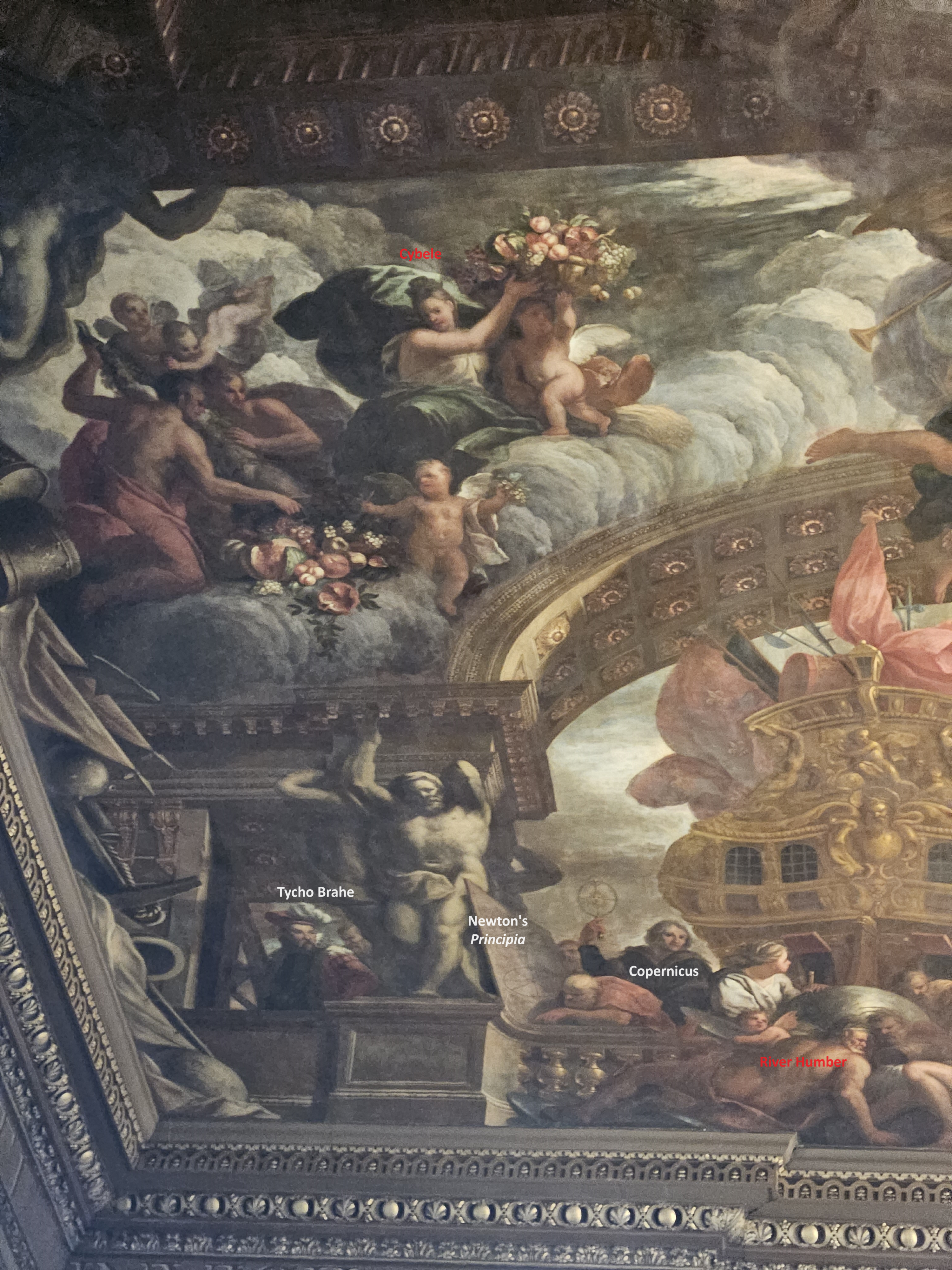
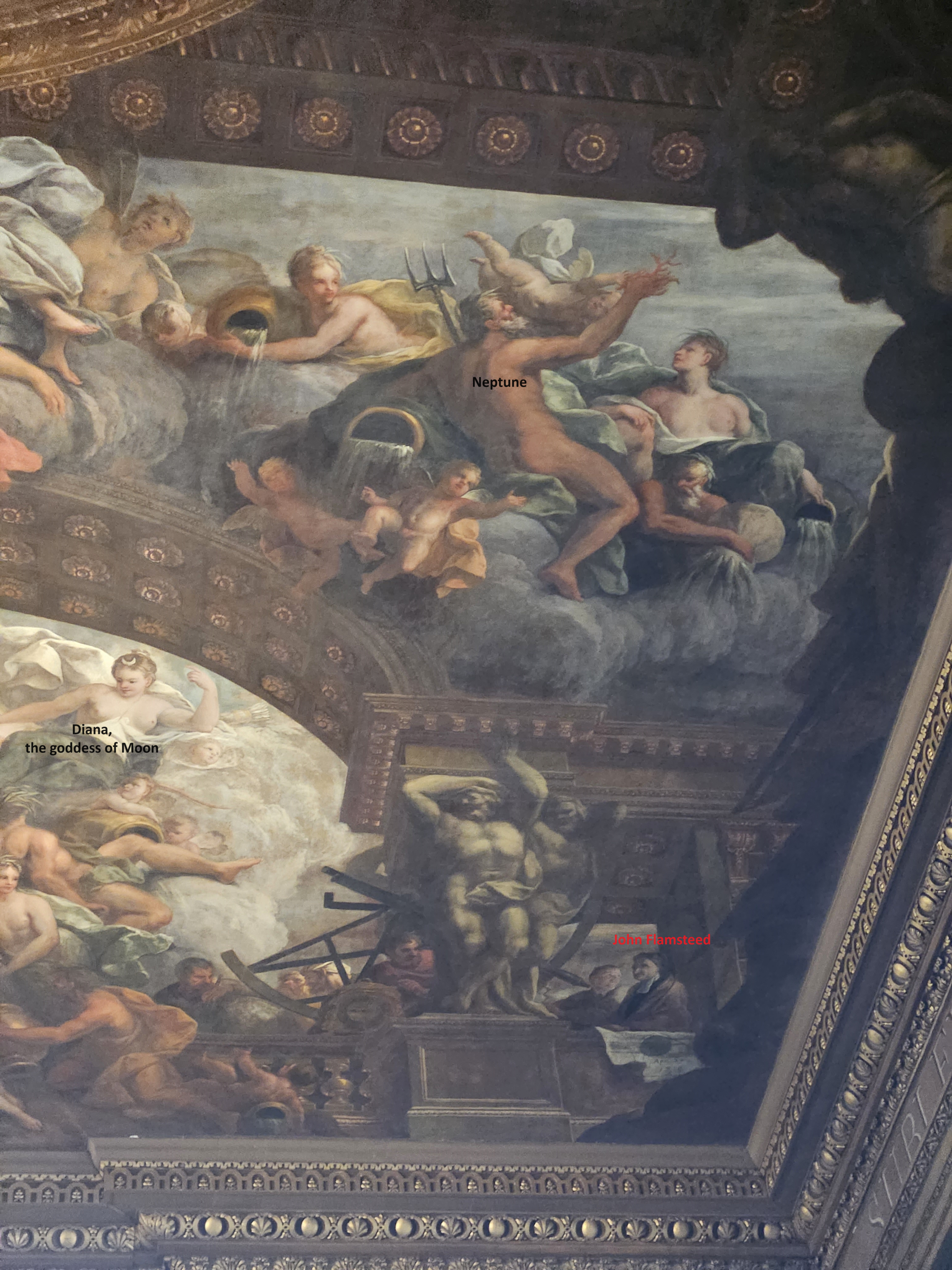
Tycho Brahe (1546–1601), a Danish astronomer, was a “naked eye” astronomer—one who observed the skies accurately without the use of a telescope. A sheet of illustrations from Newton’s Principia, originally published in 1687, sits next to Copernicus (1473–1543), who is seen holding up his astronomical model, which put the sun at the center of a solar system with Earth and other planets orbiting it. John Flamsteed (1646–1719), the first Royal Astronomer, is another notable figure in the painting. He worked out of the Royal Observatory at Greenwich. Understanding the stars was essential for maritime navigation. On this piece of paper, Flamsteed predicted a solar eclipse for April 22, 1715. Luckily, Flamsteed’s prophecy came true when the eclipse happened after the painting was finished!
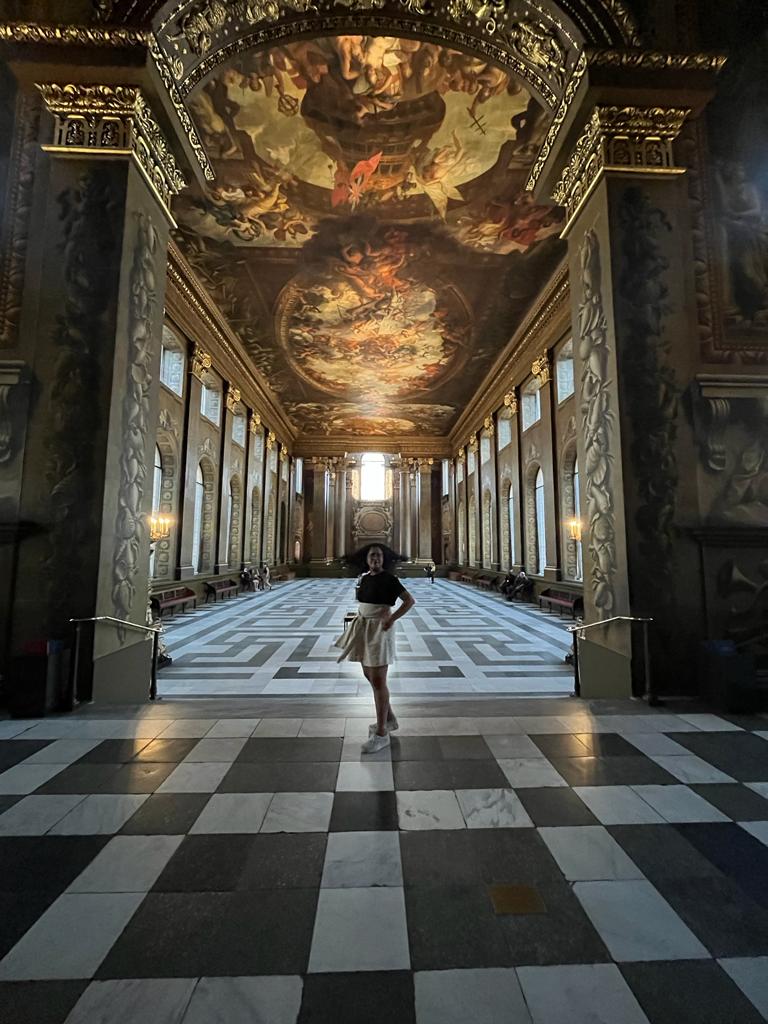
The Painted Hall’s Upper Hall, which was finished between 1717 and 1725, is the third-largest area. This area features four key scenarios, the first of which is the Hanoverian monarchy on the west wall. The quotation on the wall from Virgil’s Eclogues reinforces the emergence of new dynasty, as per the translation ‘A new generation has descended from the heavens’. The figure with the trident is pointing to a scroll listing significant naval triumphs, which begins with the Spanish Armada’s loss in 1558 and concludes with the Spanish fleet’s defeat off the coast of Sicily in 1718.

The new generation is depicted against the backdrop of St. Paul’s Cathedral, which was also created by Sir Christopher Wren. Sir James Thornhill, who is represented in the mural is shown gesturing as though he is introducing the entire scenario. With his elbow resting on a cornucopia spilling gold coins, signifying the wealth and prosperity to come, the bearded figure actually portrays the return to the Golden Age. Sophia of Hanover, the granddaughter of James I, passed away two months before Queen Anne, making her son George I. She is depicted as the realm’s defender while donning a “mural crown.” George I of Hanover, who ruled from 1714 until 1727, was the next Protestant heir apparent, surpassing more than fifty Catholics in the line of succession after Anne died intestate.

George I’s offspring includes the future Prince of Wales, King George II; Princess Caroline holding a mirror, signifying the virtue of prudence; and Princess Sophie holding a bundle of tied rods, signifying unity and concord. There were no surviving successors to the recent British kings. The West wall painting’s depiction of George I’s descendants and grandchildren gave solace in the knowledge that the Protestant royal dynasty would endure and prosper. Frederick, the son of George II and grandson of George I, however, passed away before taking the throne. He had a son named George III.
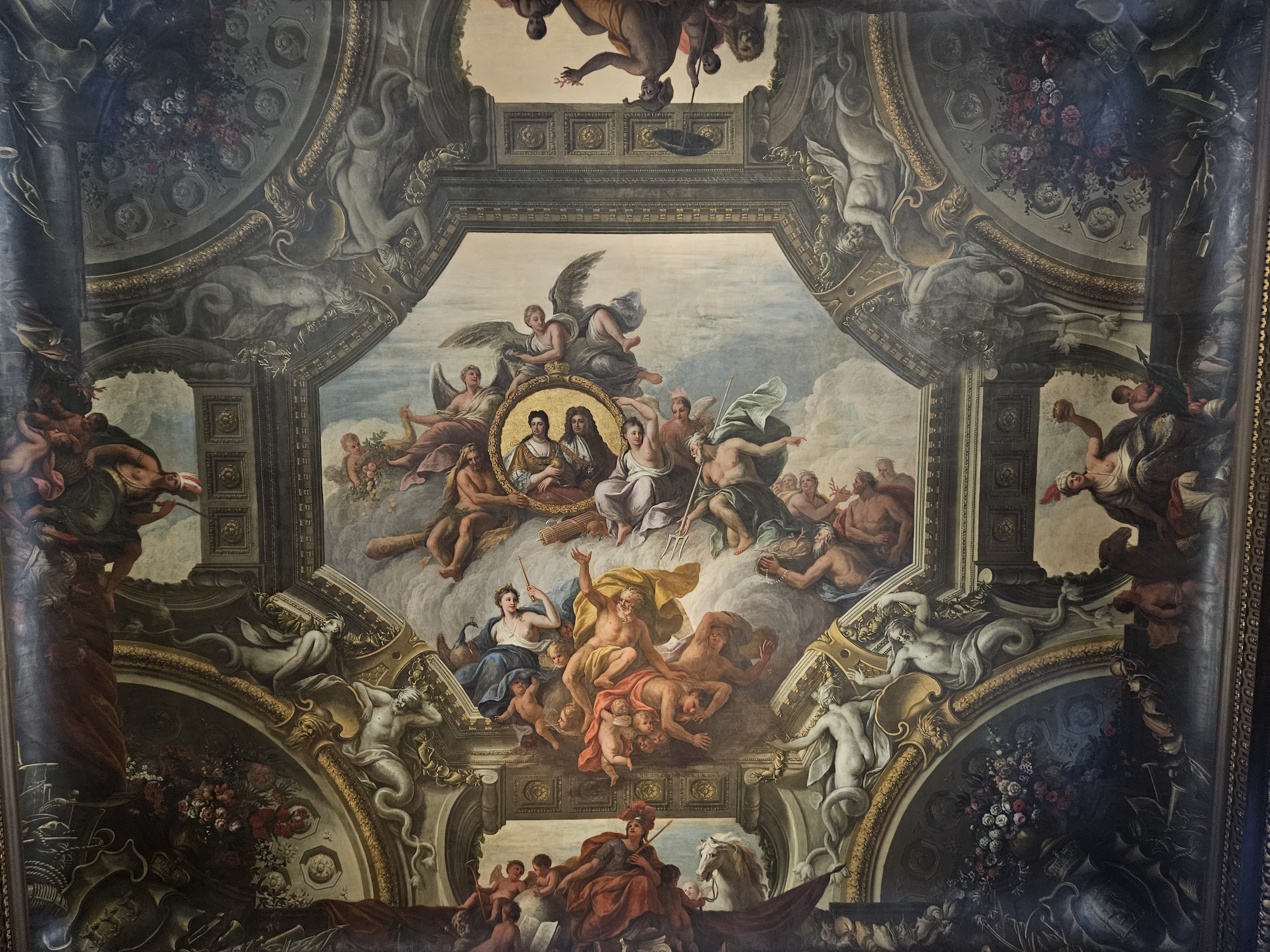
The mural on the ceiling features Queen Anne and her husband, Prince George of Denmark. Mary’s younger sister, Queen Anne, took the throne after her parents, William and Mary, and ruled from 1702 until 1714. Before the painting was finished, Anne passed away without having children, thus she and her consort, Prince George of Denmark, were relegated to the ceiling rather than the Upper Hall’s west wall.

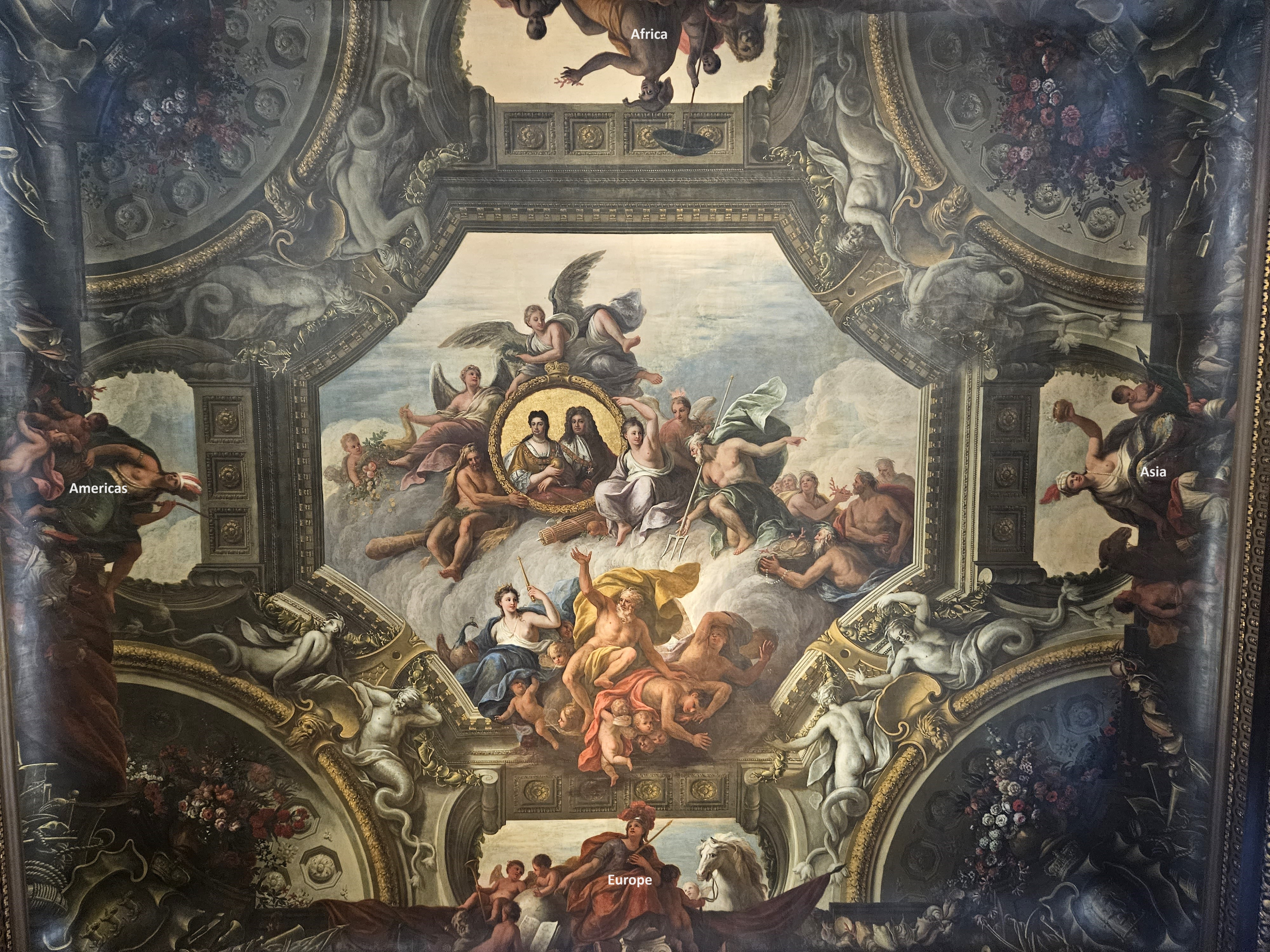
Figures depicting continents are used to decorate the ceiling’s edges. Europe is represented by a figure holding a globe and a white horse. In addition, a copy of Principia by Isaac Newton is present, signifying knowledge. In 1687, Newton released Principia; more editions followed in 1713 and 1726. The Americas are represented by a figure in headdress made of feathers with an alligator. Africa is represented by the figure with the green parasol and a lion, and Asia by the figure with a camel and an incense pot.
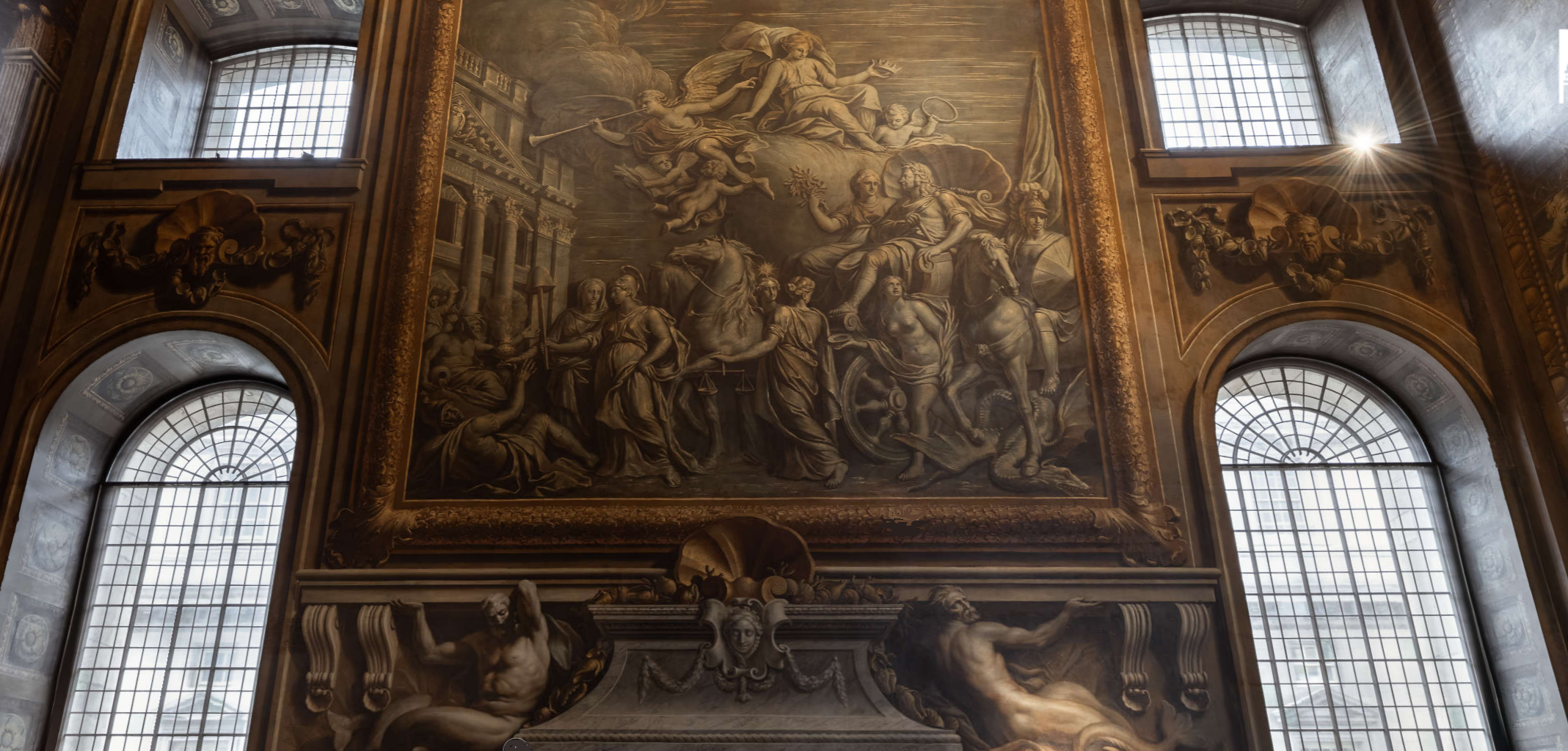
Monochrome grisaille paintings on the side walls give the impression of stone statues. One of the paintings depicts George I riding into England in a chariot in 1714, followed by a mounted St. George carrying a dead dragon beneath his feet. The purpose of the painting is to convey the idea that he arrived with the same assurance and triumph that William III did, less than thirty years previously. However, George’s appearance on that misty night was actually not that stunning. A painting depicting William of Orange’s entrance in England in 1688, when he took the throne as King William III, is displayed on the wall’s other side. The Latin inscription ‘anglorum spes magna‘, meaning ‘England hopes great things’, is located at the top left of the scroll.
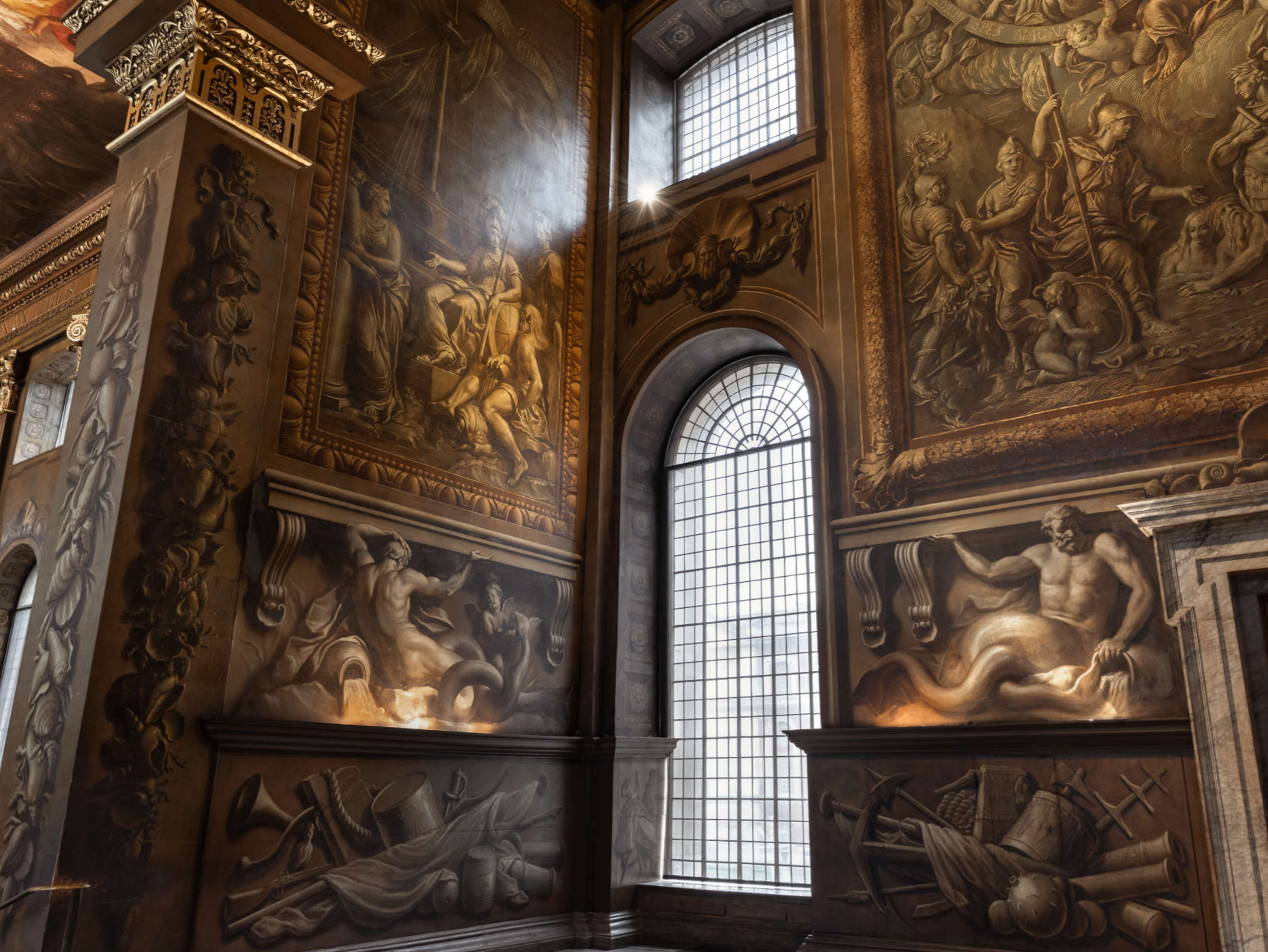
Two commemorative plaques are located on the floor: one honors Vice Admiral Cuthbert Lord Collingwood, who commanded HMS Sovereign during the Battle of Trafalgar, and the other honors Vice Admiral Horatio Lord Nelson, Britain’s greatest naval hero, whose remains lay in state here in January 1806.
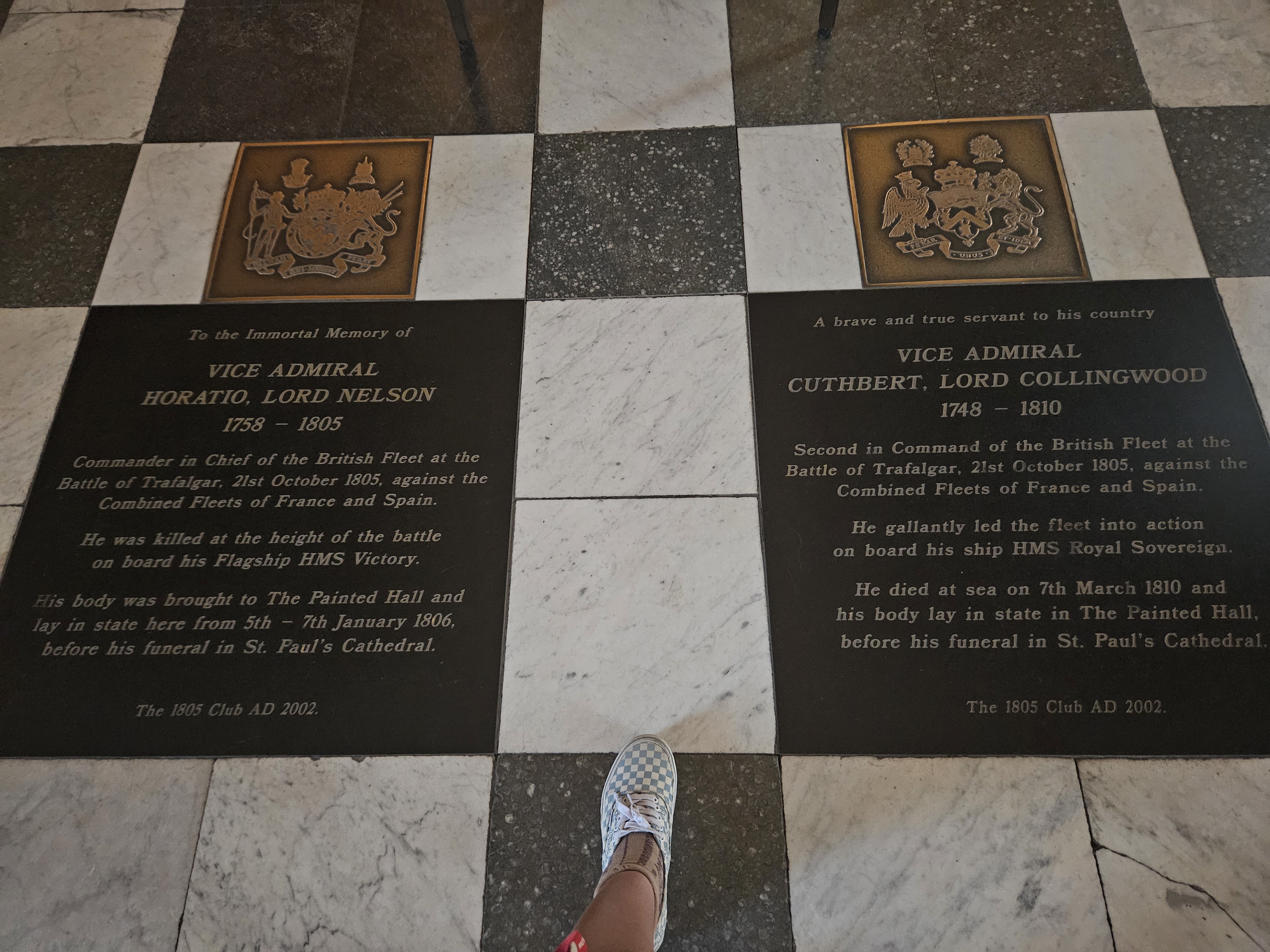
Three months after the October Battle of Trafalgar, Horatio Nelson’s body was transported to lay in state in the Painted Hall in 1806. Thousands of people (estimates ranged from 15,000 to 100,000!) poured through the doors of the Hall, which was draped in black. The location of his coffin prior to its removal for interment in the St. Paul’s Cathedral crypt is designated by a plaque.
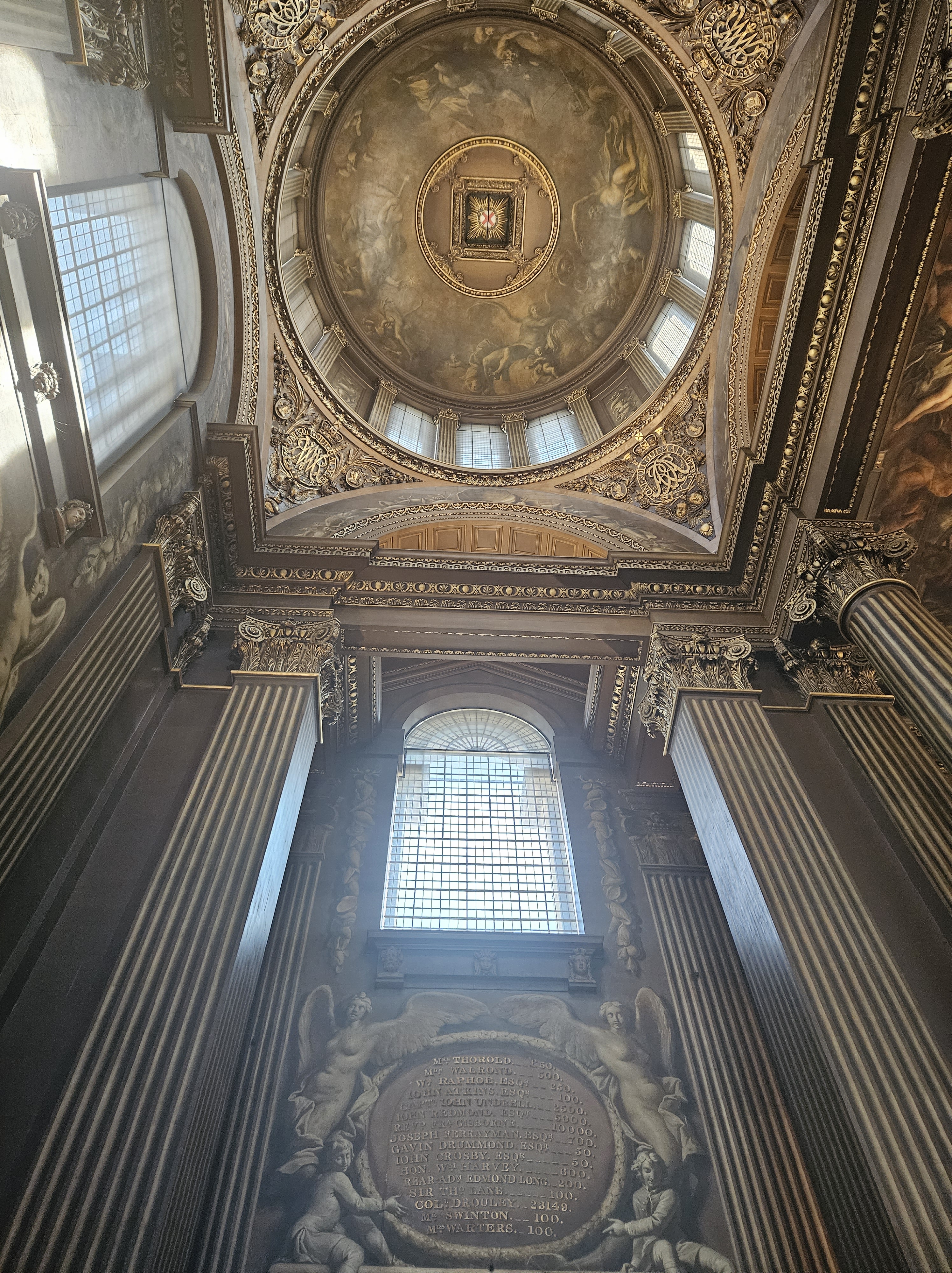
Vestibule was the last room painted in the Painted Hall, having been finished in 1726 despite being the first area we see. The dome is located 45 meters above the head by following the tall columns. The eight-pointed star, a representation of the Order of the Garter, sits at the center of the dome. The royal cipher is located in each of the four corners that round the dome. Within the dome are four painted characters, each of which symbolizes one of the four winds: Eurus (East wind) brings light to the earth, as the sun rises, Auster (South wind) brings the rain, Zephyrus (West wind) whose flowers and attendants bring the joys of spring, and Boreas (North wind) who brings hail stones and snow.
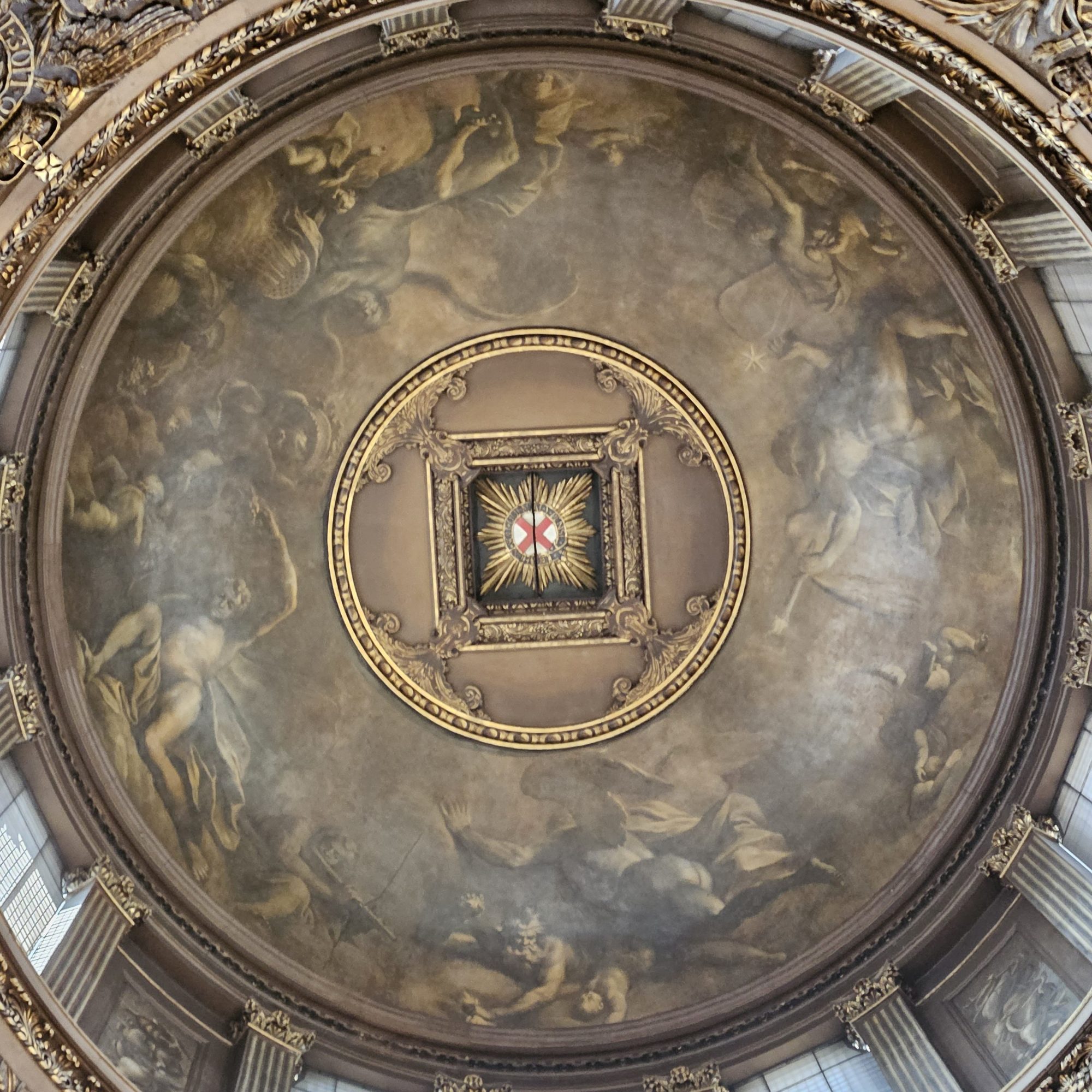
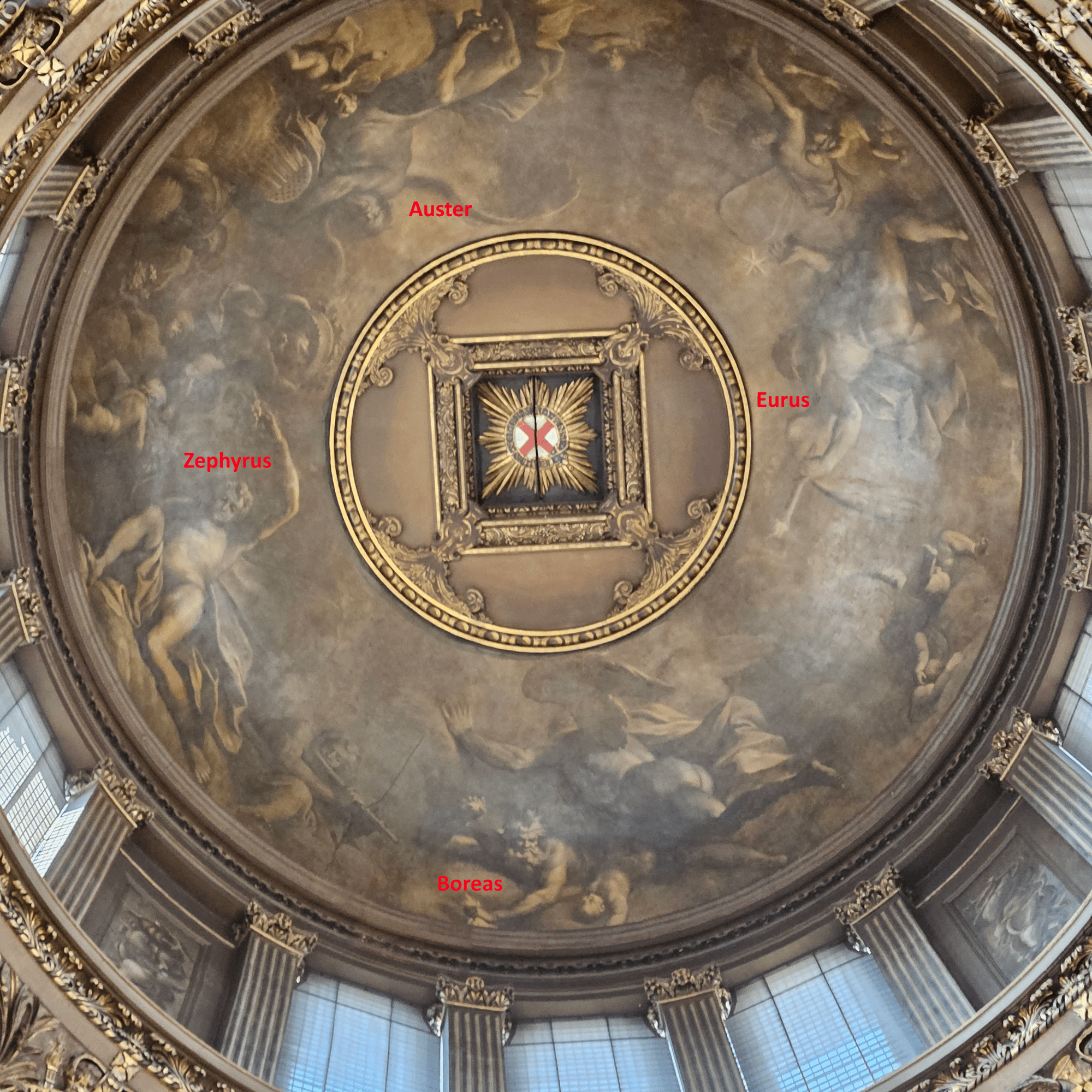
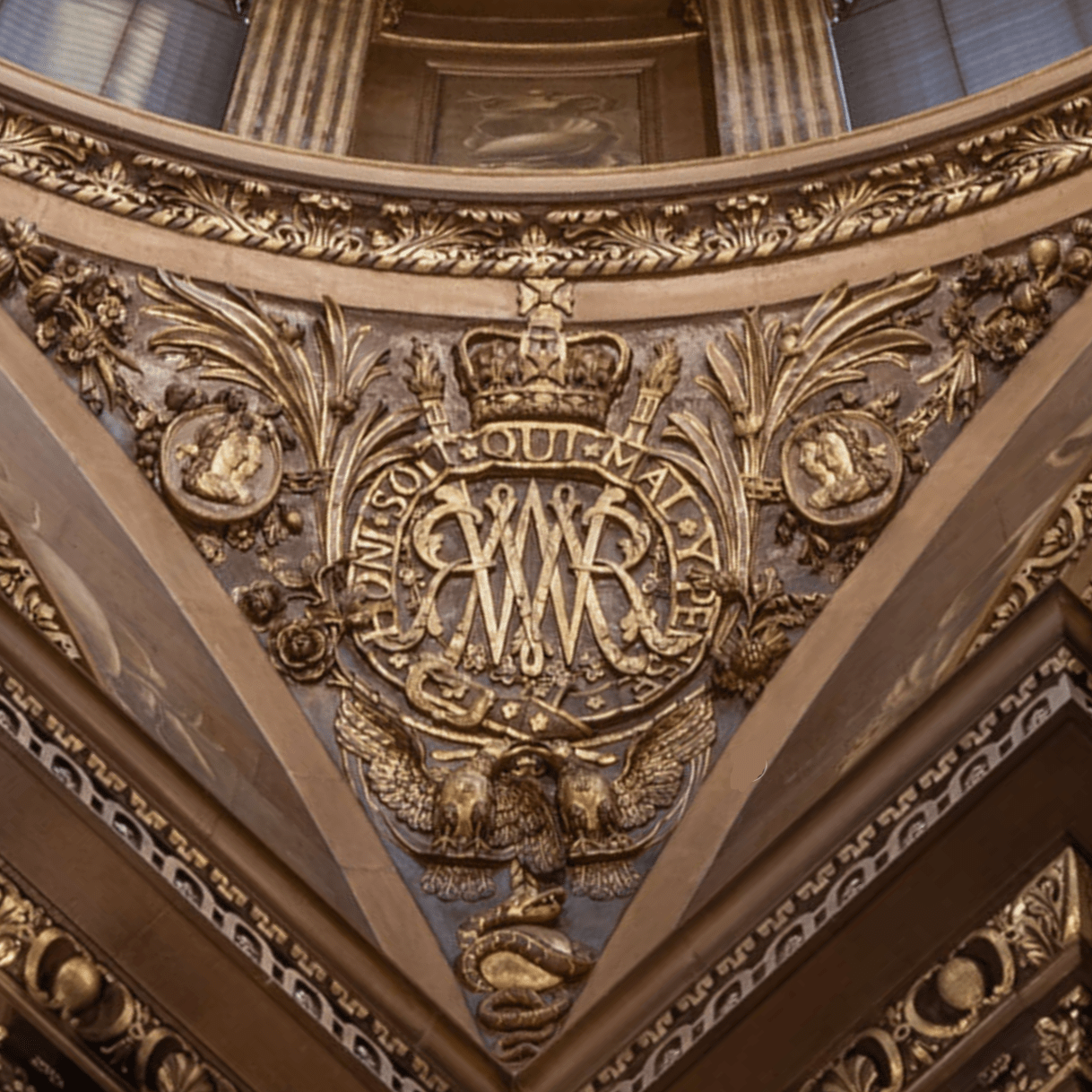
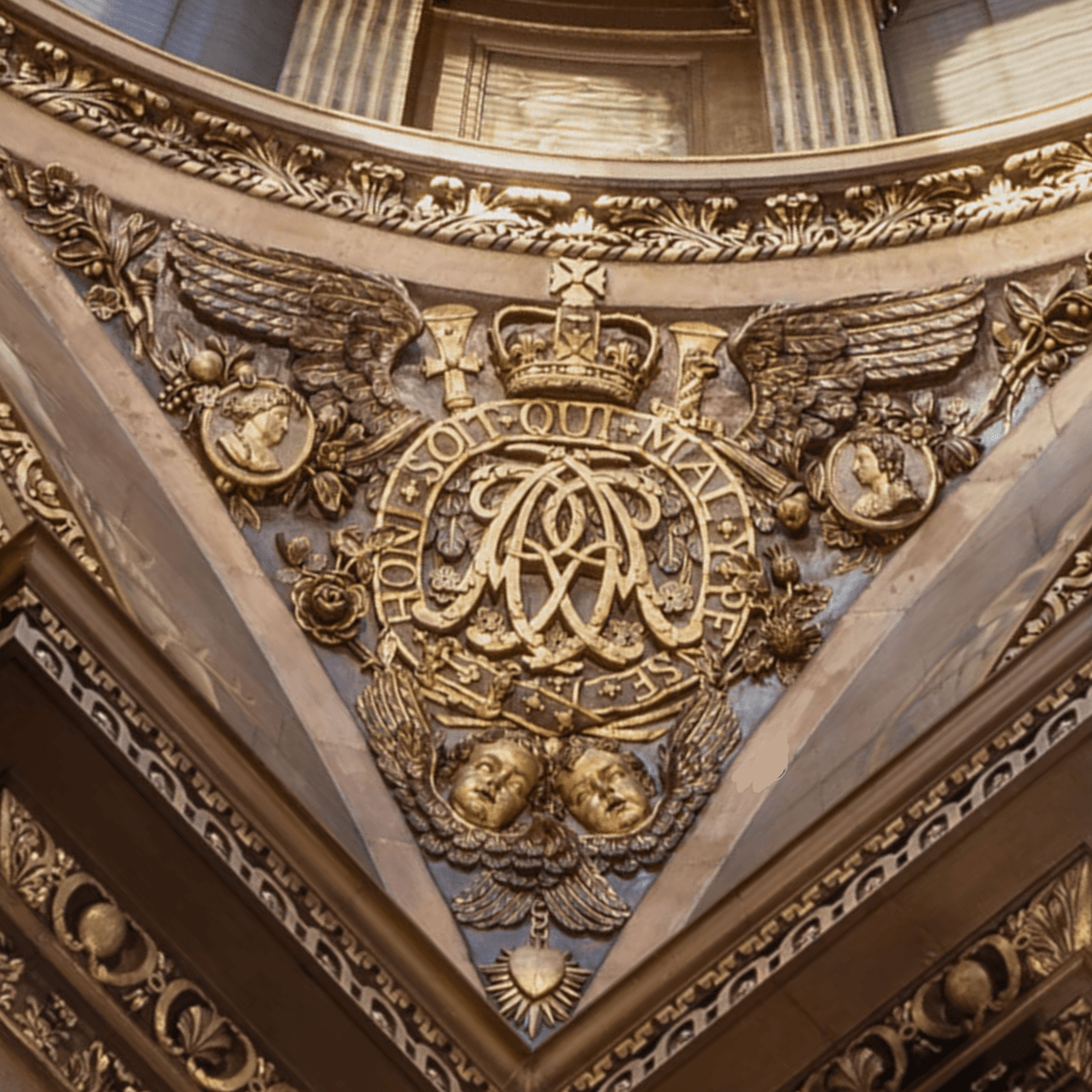
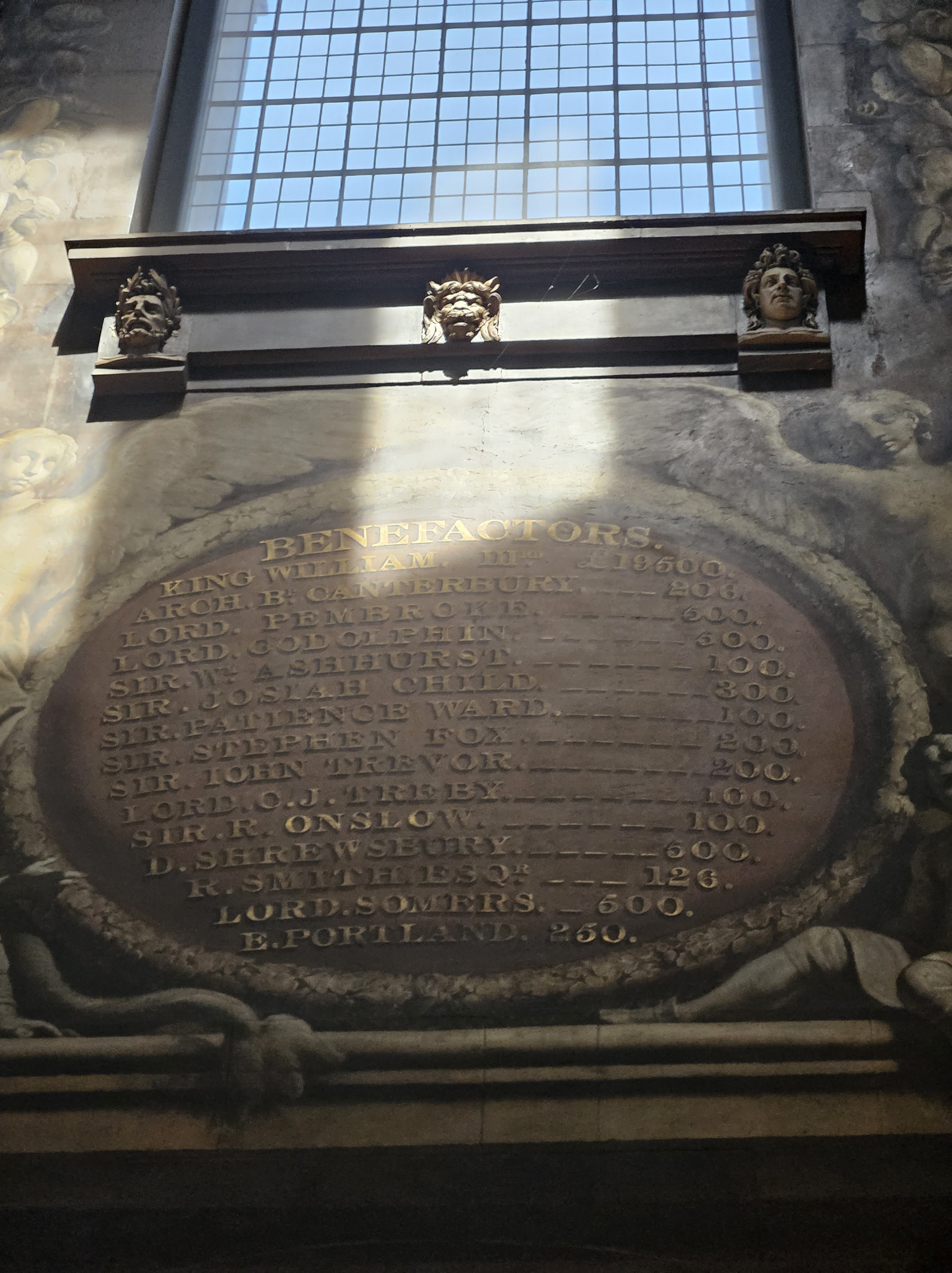
King William III and Queen Mary II, the royal couple of the Upper Hall, are represented by the interwoven W and M in this design. Since they shared governing, there is a twin portrait of them in the medallions on either side of the cipher. Queen Anne, who succeeded her sister Mary, is represented by the finely carved letter A. The medallion images on either side of the cipher depict Prince George and Anne apart because George was not a joint monarch but rather Anne’s consort. The names and sums of those who donated charitable donations to support the establishment of the Royal Hospital for Seamen at Greenwich are listed on the benefactor board. The amounts are between £50 and £20,000. The painted figures that frame these boards are sculptural, much like the rest of the decorative accents. This is an example of a trick called trompe l’oeil, which translates to “trick the eye” in French.
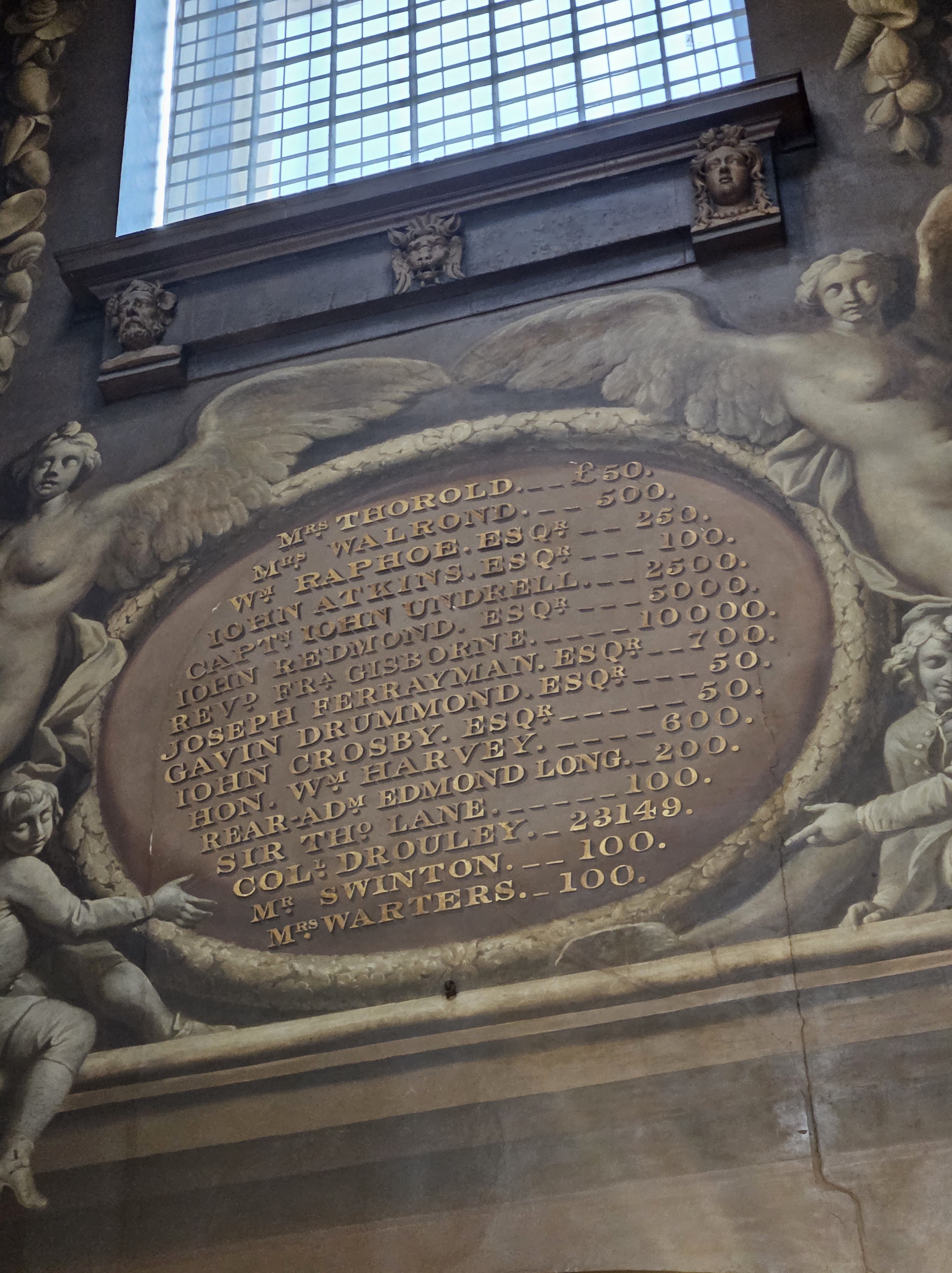
With more than 300 paintings with nautical themes on exhibit, the Painted Hall was known as the National Gallery of Naval Art from 1824 to 1936. These paintings served as the foundation for the National Maritime Museum’s art collection, which also included portrait busts, sketches, ship models, and artifacts belonging to Nelson. The officers of the Royal Naval College began using the Painted Hall for meals, including breakfast, in 1939 after it had undergone considerable repair. It served as the location for numerous elegant meals, such as the United Nations Foundation Day feast in 1946.
Note – The details of each painting can be accessed via the virtual tour of the Painted Hall that can be accessed at the main website of the Old Royal Naval College.
Further readings:
- Henry VIII and Tudor Navy
- Anthony Roll
- The Figure of Tyranny in the Glorification of William and Mary: Reassessing the interpretation of Thornhill’s Painted Hall
Related (and not-so related) Posts:
 The Lost Coordinates
[…] Sistine Chapel of UK […]
LikeLike
Wow. The beauty is overwhelming. And I have to add that I just traced the connection between ’tilt’ and ‘joust,’ so the term tiltyard struck me!
LikeLiked by 1 person
It truly was magnificent!! I am glad you liked it and happy to share a new factoid 😊
LikeLiked by 1 person
[…] The title sounds like a zodiac sign mayhem. To be honest, I have been wracking my brain over this next blog piece. As you know, my posts often stem from personal musings, a whimsical thought, or a pun that tickles my fancy. Regardless of the inspiration, I always dive deep because, while history might not be my major, it’s definitely my major passion. So, this time, instead of diving into the classic “battle of the sexes,” let’s stir things up with a duel between monarchs! To keep things “relatively” simple and a bit different, I’m leaving the British monarchs out of this one. But fear not! If you’re itching for some British royal drama, you can always check out my previous post on the Tudors. […]
LikeLike