
The quest for self-discovery is a lifelong journey, one that takes us through winding paths and unexpected twists. There were times in my life when I really struggled with my identity. Whether it was breaking free from the constraints of familial expectations, navigating the ever-changing tides of college friendships, or reclaiming my sense of self in the aftermath of a global pandemic, each phase brought with it a profound reckoning. But through all of this, the most profound and freeing experience has been the amazing adult friendships I’ve made over the last 8 years. Like a kaleidoscope of personalities, each friend brought their unique hues and perspectives. Together, they have lifted me up and helped me feel more at ease with myself than ever before.

And it is perhaps no coincidence that the city of Strasbourg has become my favorite European city. Just like me, this ancient city stands as a metaphorical crossroads of identities, its cobblestone streets and winding canals echoing tales of resilience and reinvention.
So how did this beautiful city end up on my itinerary? Well, I was having a random discussion this stained glass that I saw in a church in Pondicherry and we were laughingly discussing the fact that considering how Catholicism was imported to India, it was funny to see Virgin Mary dressed in Saree.


Somehow our conversation went into the tangent of various art form representing cultural identity – from street graffiti to anime. And knowing my love for all her such intriguing nuggets, she shared these two images, and I was captivated.


The scenes are from the movie “Howl’s Moving Castle” which was released in 2004 by Studio Ghibli and Hayao Miyazaki and was nominated for an Academy Award. Unlike the Japanese visuals used for its predecessor “Spirited Away”, Howl’s Moving Castle depicts distinct European architecture from Colmar and Riquewihr. Honestly, I would love to have an access to such a magical door which will transport me on my whims and fancy!
What’s in the name?
Strasbourg is situated at the eastern border of France with Germany. This border is formed by the Rhine, which also forms the eastern border of the modern city, facing across the river to the German town Kehl. The border town of France and Germany has an interesting personality, starting with its name alone. Strasbourg has been a significant settlement since the Bronze Age due to its excellent geographical position at the crossroads of waterways and overland routes. In 12 BC, this settlement became the main outpost of the Roman Empire in its defense against the Germanic tribes of Northern Europe and was named Argentoratum. Following the fall of the Roman Empire, the town began a resurgence under the new name of Stratisburgum, marking the start of its political and economic growth.

Over time, the name was further Germanized to Straßburg— with “Straß” meaning ‘street’ or ‘road’ and “Burg” meaning ‘fortress’, thus continuing reflecting its strategic location as a fortified town along key trade routes. The town’s name was changed to the French “Strasbourg” in 1919. This change reflected the town’s transition from German to French control, symbolizing its unique position at the intersection of these two cultures.
History of Strasbourg
The city underwent successive occupations by the Alemanni, Huns, and Franks before becoming part of the Carolingian Empire under Charlemagne around 800. Despite Mainz overshadowing it as a commercial hub, Strasbourg’s central location within the Carolingian Empire restored its significance following Charlemagne’s death. The empire was divided among his grandsons – Charles the Bald received West Francia comprising of what is now France; Louis the German recieved East Francia comprising of what is now southern German and Austria; and Lothair I was crowned as the Holy Roman Emperor and received Middle Francia comprising of the Rhine and Rhone River basins and Italy.

The division eventually led to the historic Oaths of Strasbourg in 842, where Charles the Bald and Louis the German forged an alliance against their brother Lothair I. The Oaths not only set out this alliance between the two brothers, but is also one of the first documents that demonstrates the splitting of France and Germany into two distinct cultural identities, with each brother taking the oath in the other’s language. Ironically, the breakup of Strasbourg’s identity was set forth on February 14, 842.
Throughout the medieval period, Strasbourg established itself as both a religious and commercial center within the Holy Roman Empire. Annexed into the Empire around 900, it became the seat of a bishopric by 982, with the prominent Bishop Werner I of the House of Habsburg initiating the construction of the iconic Strasbourg Cathedral in 1015. The cathedral, a blend of Romanesque and Gothic styles and bearing a unique red hue from the use of sandstone from the Vosges Mountains to the west, was completed in 1439 and stood as the world’s tallest building until 1874.


Strasbourg’s autonomy grew when it was granted rights as an Imperial Free City within the Holy Roman Empire in 1262 and later declared itself a free republic, leading the Decapole alliance of ten free cities in Alsace. The Decapole was signed by Emperor Charles IV in 1354, uniting ten free cities in alliance with each other. Strasbourg’s most important historical period is probably the 16th and 17th century, as the city became renowned for its role in the Protestant Reformation. As my friend showed her city proudly, she also mentioned how Strasbourg’s role as a contentious city was a result of its feuding Church movements, and can be seen through many of its churches that have complicated histories relating to the Reformation.
The city’s strategic location made it a key objective during the wars of the 17th century, leading to its annexation by Louis XIV in 1681. The city remained part of France until the Franco-Prussian War. As the largest city in Alsace and just across the Rhine from Germany, Strasbourg was a key objective for the Prussian army. The Siege of Strasbourg from August to September of 1870 saw the Prussians heavily bombard the city, resulting in damages to many historical structures. Prussia decisively won the Franco-Prussian War, and in 1871 Strasbourg became part of Germany, adopting a new name – Straßburg.

The 20th century has been a period of both turbulence and prosperity for Strasbourg. Strasbourg was still in German control when the armistice was signed on November 11, 1918. However, with the Treaty of Versailles, Alsace was returned to France. As Germany faced internal turmoil, Strasbourg became the first of several cities to declare itself a Soviet republic. Workers’ and soldiers’ councils took over, aiming to overthrow the German monarchy. This bold experiment in governance was short-lived, however. French forces, led by Henri Gouraud, arrived in Strasbourg on November 22, 1918, swiftly dissolving the Alsace Soviet Republic by December 5.

Between the world wars, Strasbourg found itself on the front-line of European defense. The city became part of the Maginot Line, a series of fortifications constructed along the French-German border. These defenses, however, proved inadequate against the German Blitzkrieg in 1940. Strasbourg endured over four years of occupation before being liberated by Allied forces on November 23, 1944.
The Hotspots
Let’s start with the prima donna of Strasbourg—La Petite France, the enchanting historic quarter nestled on the western end of the Grande Île. This “Large Island,” as its name translates, is a gem of Strasbourg, separated from the rest of the city by the picturesque Ill River and the Canal du Faux-Rempart. The entire island, including the beloved La Petite France, is a UNESCO World Heritage Site, teeming with history and charm.

The waters that so beautifully encircle the Grande Île—the Ill River and the Canal du Faux-Rempart, also known as Fossé du Faux-Rempart—create a natural embrace around the historic center. This canal loops around the island, meeting the Ill River at both ends and offering a scenic route for exploration. The mile-long canal is adorned with thirteen bridges, each offering perfect vantage points for travelers and some of the best spots for capturing unforgettable photos. Among these, the Pont du Faisan stands out, locally known as the “Pont Tournant” or the swiveling bridge.
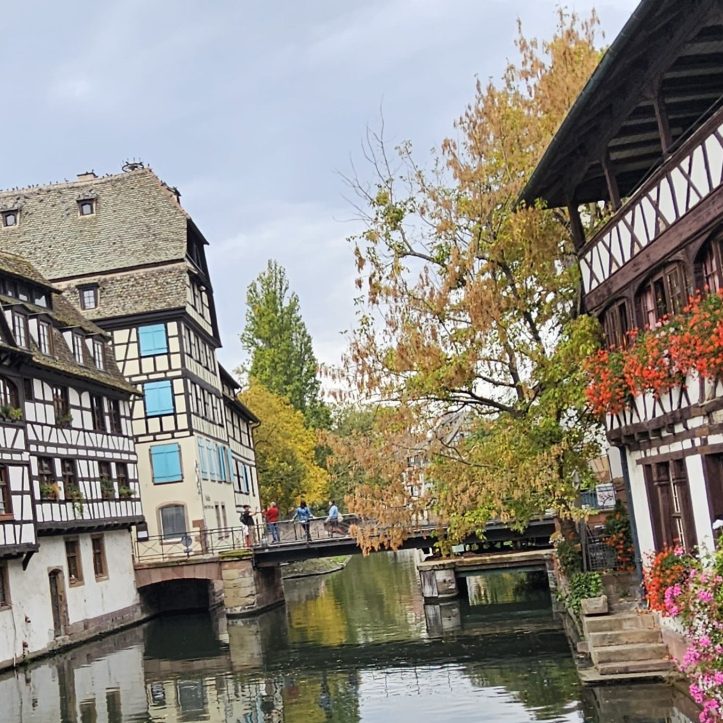
This small, discreet footbridge commands the attention of all who approach. Be prepared to wait your turn, as the bridge often pivots to allow tour boats to pass through. This unique mechanism, activated at each passage of a fly boat, turns the bridge horizontally (unlike a typical drawbridge that lifts vertically) thanks to a sophisticated hydraulic system.
The historic district is also known for its crucial role in Strasbourg’s military defenses. At its entrance stands the iconic Ponts Couverts, or “covered bridges,” a striking blend of medieval architecture and strategic fortification. These bridges, dating back to the 13th century, were originally topped with wooden roofs designed to shield soldiers from enemy attacks, giving them their distinctive name. Although the wooden canopies were destroyed in the 18th century, the name “covered bridges” endures among the locals.


Connecting these bridges are four massive towers that once guarded the city, creating a formidable barrier against invaders. Once numbered 90, these towers are among the most significant remnants of Strasbourg’s medieval fortifications. In 1686, the renowned military architect Vauban deemed the existing defenses inadequate and constructed a dam to further protect the city from riverine attacks. Referred to as the Grande Écluse, this bridge-lock featured valves that could seal its arches during enemy incursions. The dam’s function was to impede the river’s flow, causing it to inundate the surrounding fields and transform them into marshlands, rendering them impassable.
Behind the iconic bridges of La Petite France, the Ill River splits into four distinct arms: Zornmühle, Disenmühle, Spitzmühle, and the navigation canal. Here, you’ll still find charming remnants of water mills, dams, and locks. The German word “mühle,” meaning “mill,” serves as a nostalgic reminder that the tanners of La Petite France once shared their neighborhood with millers.

Today, this enchanting area is a favorite among tourists and is often referred to as the “Little Venice of France” due to its picturesque waterways and quaint ambiance. However, back in the 16th century, this area was far from the idyllic spot it is today. Known as “Französel,” it was a dingy quarter infamous for its tanneries and rough reputation.
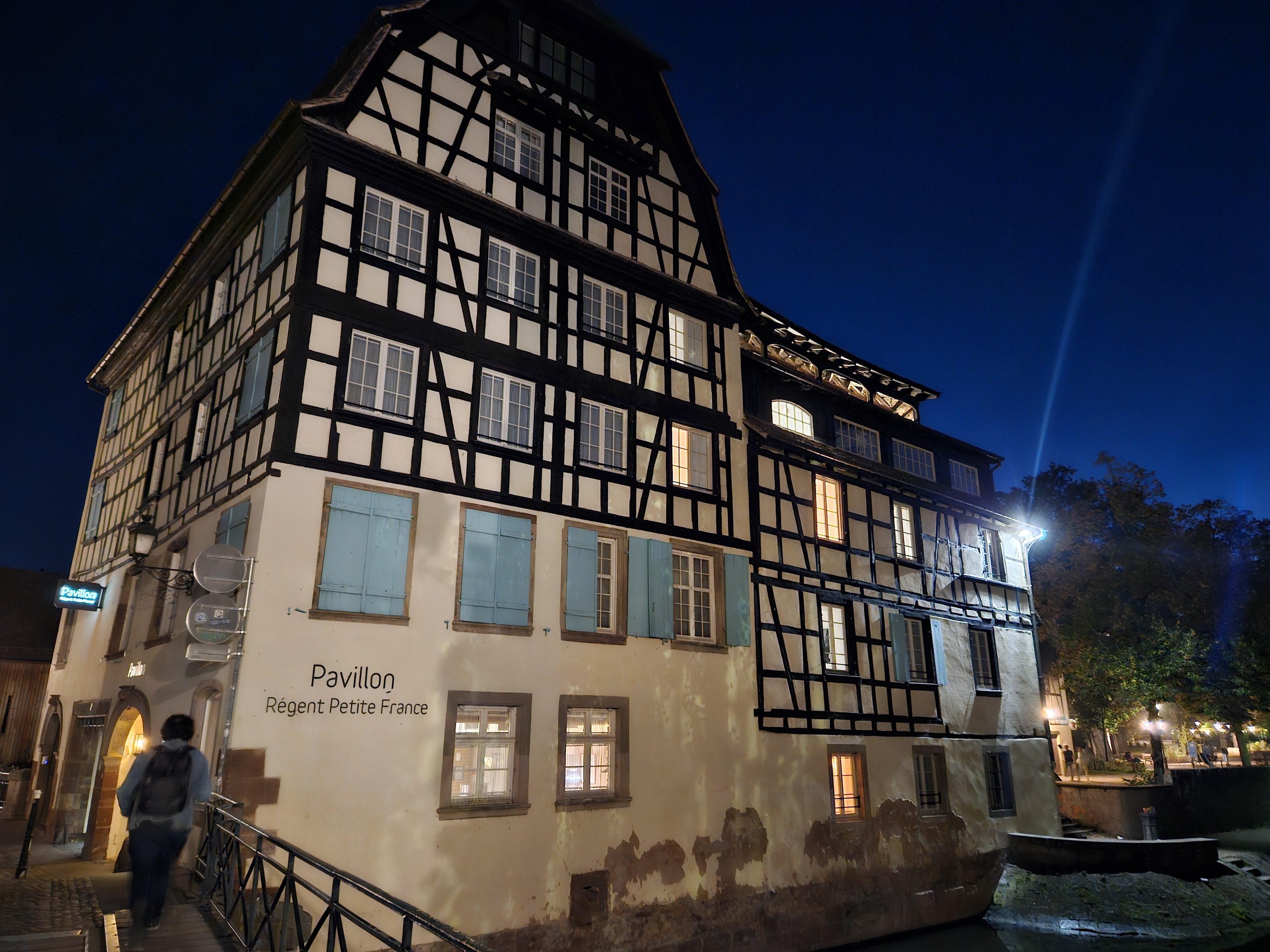
The name “La Petite France” itself has an unexpected origin. It dates back to the 15th century, not in homage to the French Quarter, but rather to the Hospice des Verolés. This hospital was built to care for Charles VIII’s soldiers who had contracted syphilis, colloquially known then as the “French disease,” during the Italian Campaign. This historical irony adds a fascinating layer to the neighborhood’s identity.
As a commercial area of interest during the Middle Ages, the area evolved into the domain of tanners, millers and fishermen, whose livelihoods were intricately tied to the river. Dark alleys, the unflattering smell of furs and skins, and a notorious reputation as a haven for criminals defined the district. The term “La Petite France” was anything but flattering, symbolizing the quarter’s unsavory character, where tanners mingled with the lowly rabble.

The Maison des Tanneurs, or Tanner’s house, built in 1572, is a fine example of the distinctive architecture adopted by tanneries with a rooftop open gallery used for drying hides.
Wander through the charming streets of Strasbourg, and you’ll be greeted by the colorful, decorative, and flower-adorned half-timbered houses that define the local landscape. These architectural gems contribute to the unique charm of this enchanting region on the edge of France.


The warm and welcoming appearance of these houses is truly striking, reminiscent of scenes straight out of a fairy-tale book. For a moment, I felt like I was a character in Hansel and Gretel, walking amidst all these cute gingerbread houses! Bright red geraniums, vibrant as lipstick, adorn the façades in meticulously tended window boxes, adding splashes of cheerful color to the picturesque setting. Each house, with its intricate timber framing and lush floral displays, invites you to step into a storybook world where history and beauty blend seamlessly.

Amidst the charming beauty of La Petite France, the ominous shadow of La Tour du Bourreau, also known as the Executioner’s Tower or Henckerturm, adds a haunting layer of history. This tower lived up to its grim name in the Middle Ages, notorious for the brutal “interrogations” conducted by the city’s executioner on unfortunate souls deemed deserving by the authorities.
One of the tower’s infamous tortures was the “Stockhus” torture, a horrific device that locked the condemned man’s feet in a press. A chilling local legend still whispers through the streets of Strasbourg: the tale of the tortured executioner. In 1565, Sébastien Rosenkrantz, the city’s own executioner, was arrested for harboring and training a band of criminals in the art of mischief. His betrayal was met with the highest penalty. In a twist of fate, Rosenkrantz was subjected to the same tortures he once inflicted on others before being executed. His lover did not escape unscathed either; she was publicly flogged and banished from the city forever.

Saint-Thomas Church, located in Strasbourg’s eastern district, dates back to the late 12th century and has been a Protestant church since 1529. It features two distinctive Romanesque bell towers – a square-shaped one above the main entrance and a hexagonal one at the transept crossing, and is designed in a late Gothic hall style with five naves of equal height and length.
Beyond the gingerbread houses and the cobbled pathways, I fell in love with the iconic Strasbourg Cathedral, also known as Cathédrale Notre-Dame de Strasbourg. Towering over the city with its striking pink sandstone walls, the cathedral sets a standard for Gothic Revival architecture across Europe. The iconic Rose Window, which measures 15 metres in diameter, features ears of wheat as part of its design, which is completely unique to Strasbourg cathedral and represents the city’s commercial power in the Middle Ages. To be fair, the pink hue that is often used to describe this global icon can be appreciated at various hours, throughout the day! The current structure’s construction began in the late 1100s, enduring over three centuries of development. Financial challenges caused delays, necessitating design changes along the way.


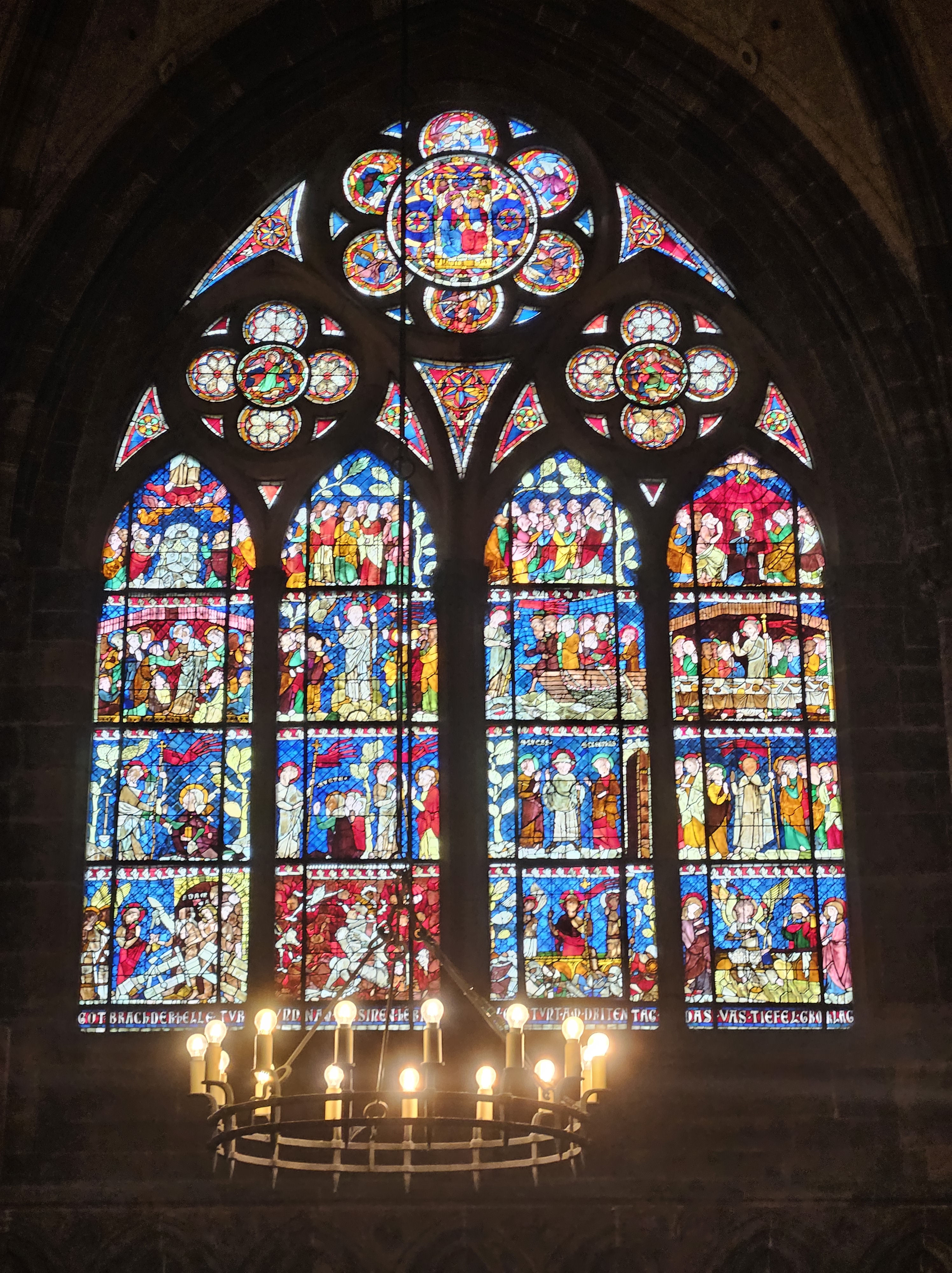
The cathedral’s story began even earlier, with its original construction in 1015 by Bishop Werner von Habsburg on the foundations of an old Carolingian basilica. The cathedral was tragically destroyed by fire in 1176, as its wooden framework easily succumbed to flames. Reconstruction in the Gothic architectural style began in the twelfth century, introducing elements that were ahead of their time. Erwin von Steinbach’s redesign in the 1260s added extravagant Gothic features, making it the most modern building in the Holy Roman Empire during that era. Throughout its history, the cathedral has endured numerous conflicts. During the Franco-Prussian War in 1870, it suffered severe damage, with its choir stalls and nave roof set aflame. World War I saw the removal of all but one of its bells, and in World War II, Hitler ordered the dismantling of its precious stained-glass windows. Fortunately, American soldiers recovered these windows in 1945, hidden in a German salt mine, and returned them to their rightful place.




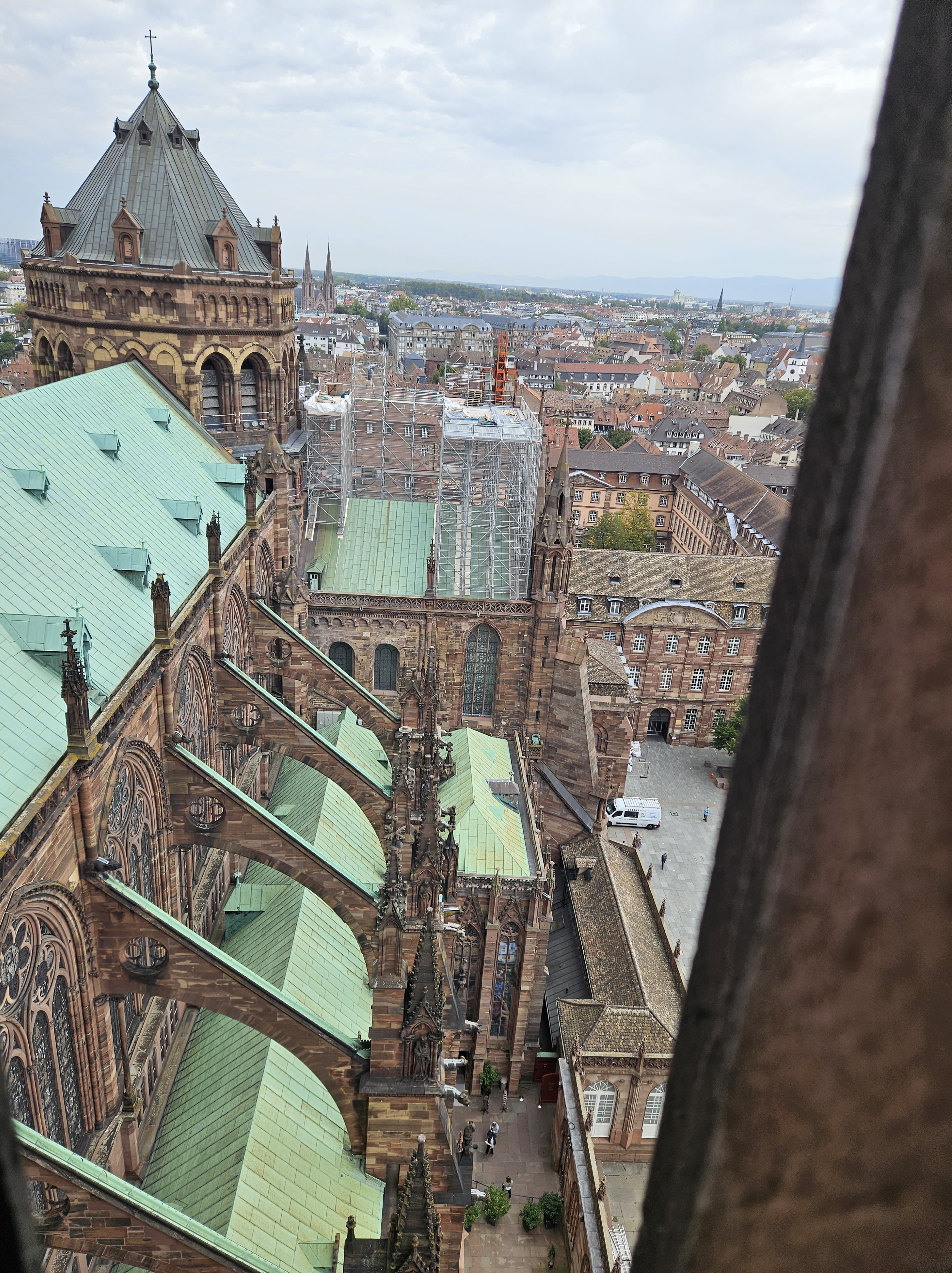
Strasbourg Cathedral’s 142-meter-high spire remains the highest medieval structure in Europe. The construction was started in 1399 by Ulrich d’ Ensingen who aspired for a spire with a central spiral staircase. After his death in 1418, his successor moved the staircases to the outside on the 8 ridges forming the spire.
Visitors can climb 332 steps to a 66-meter-high platform for panoramic views of the city. And if you know me by now, you will know how much I hated that endeavor if it wasn’t for the sole purpose of keeping the birthday wish of my friend! Incidentally, the platform with the infamous view has been a social meeting place back in 18th and 19th centuries when families would ascend every week during summer to attend picnics. The platform also said to be a source of inspiration for artists and writers such as Voltaire, Victor Hugo and Gustave Dore


Both sun dials and clocks are located at four compass points on the platform since the 14th century, thus helping the guards to set the clocks and ring the hours with the bells. The clock was built in 1843 by Jean-Baptiste Schwilgue, the master clockmaker.


During the Reformation in the 1500s, Strasbourg Cathedral became a Protestant stronghold, embracing Martin Luther’s ideas. The city’s status as a Free City of the Holy Roman Empire allowed it to resist Catholic control until 1681, when it was returned to Catholicism by King Louis XIV. The cathedral experienced a revival in the 1800s, inspired by German poet Johann Wolfgang von Goethe’s admiration. His essay on German architecture and subsequent works by politicians like Victor Hugo rekindled interest in Gothic architecture, influencing the redesign of Notre-Dame Cathedral in Paris.
The west façade, which is also the main façade, is the most richly decorated and work on it began at the end of the 13th century, and is said to be dedicated to the life and Passion of Christ as well as the Last Judgement.


Upon entering the cathedral you will certainly notice the Great Organ because it projects from the north side of the central nave. It was rebuilt 1298, in 1324–1327, in 1384, 1430, and 1489 and finally in 1716 by André Silbermann.
The pulpit, designed to resemble an ornate basket, was sculpted in 1485 by Hans Hammer. Amongst its carvings, there are depictions of Christ on the cross, the Virgin Mary crowned, the Apostles, scenes of the Crucifixion, as well as various Kings and doctors of the Church.

The main highlight of the cathedral is The Astronomical Clock. Built in 1574, this Renaissance masterpiece of clock making and mathematics is a testament to Renaissance ingenuity and craftsmanship. The 18-metre tall clock, one of the largest in the world, is not the first of its kind in the cathedral. Its predecessor, the Dreikönigsuhr (or “three-king clock”), dates back to 1352-1354 and was located on the opposite wall from the current clock. Construction of a new clock began in 1547 under Christian Herlin, but the project was halted when the cathedral was handed over to the Roman Catholic Church. It wasn’t until 1571 that Conrad Dasypodius, along with the Swiss clockmakers Habrecht brothers, resumed the project. This clock functioned until the late 18th century.

The current clock, crafted between 1838 and 1843 by Jean-Baptiste Schwilgué, combines the Renaissance casing designed by Dasypodius with entirely new mechanics. Schwilgué, who had been preparing for this project since 1816, created a design for the computus mechanism (used to calculate the date of Easter) and built a prototype in 1821. Legend has it that Schwilgué’s eyes were gouged out to prevent him from replicating his masterpiece, echoing a similar story about the clock in Prague’s city hall.


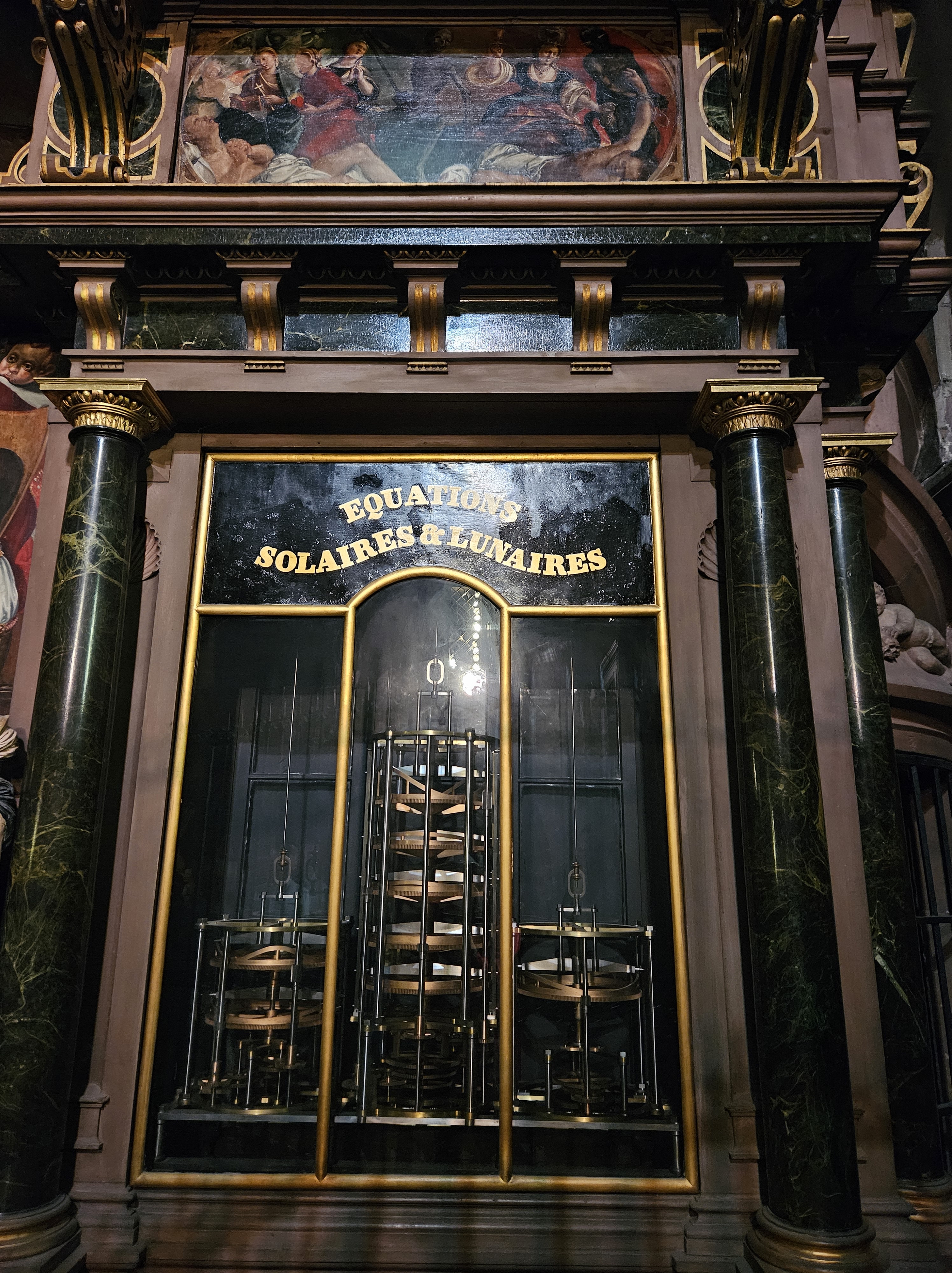
The clock’s astronomical accuracy is truly remarkable. It accounts for leap years, equinoxes, and other celestial events, making it a sophisticated calculating machine rather than a mere timekeeper. The clock can determine the computus, an impressive feat in an era before computers. As a visitor, we can typically admire the clock’s exterior, adorned with paintings and sculpted figures, while trying to imagine the real marvel that lies in the intricate mechanism behind the scenes. It truly felt like a theatrical performance of yesteryear! At different hours of the day, animated figures come to life, but the grand show begins at 12:30. From bottom to top, two angels flank a clock: one sounds a bell, while the other turns over an hourglass. Above them, figures representing different stages of life—childhood, adolescence, adulthood, and old age—pass before Death every quarter hour. Higher still, the Apostles march in front of Christ precisely at 12:30, accompanied by the crowing of a rooster.
Another notable feature of the cathedral would the Pillar of Angels, located adjacent to the clock. This colossal structure is not only a crucial support for the ceiling but also a stunning piece of art that brings biblical scenes to life. This masterpiece, crafted in the mid-13th century, is believed to be the work of talented sculptors from France or Burgundy.


From the gothic revival style of the cathedral, step into grandeur of 18th-century France as you step through the gates of Palais Rohan, a breathtaking neoclassical masterpiece nestled in the heart of Strasbourg. Built in 1742 for the illustrious Cardinal Armand-Gaston de Rohan-Soubise, this majestic palace once served as the opulent residence of a prominent aristocratic family. Designed to rival the grandeur of the great Parisian mansions, this architectural marvel is a true gem of 18th-century France. Today, this storied palace is home to three important museums, each offering a unique glimpse into the rich tapestry of Strasbourg’s heritage. From the exquisite artworks of the Fine Arts Museum (moved into the palace in 1889) to the fascinating artifacts of the Archaeological Museum (moved into the palace in 1913), and the intricate craftsmanship of the Decorative Arts Museum (moved into the palace in 1924), there’s something here to captivate every imagination.

Step into the bustling square, known as the Place Kleber, named after illustrious French revolutionary general Jean-Baptiste Kléber. At the center of it all stands a majestic statue of Kléber himself, a towering tribute to his legacy. But beneath this imposing figure lies a hidden gem – the very tomb where Kléber rests, forever intertwined with the city he called home.


When winter descends upon Strasbourg, the square transforms into a winter wonderland, adorned with the twinkling lights of the city’s famous Christmas market. The first Christmas market in Strasbourg was held in 1570, on the three days preceding 24 December, to replace the St Nicholas market which was organized around 6 December. The city, which had become Protestant, named this Christmas market “Christkindelsmärik (Christ Child)”.
While Korea was the first country in the world to develop metal movable typography, 200 years later, in 1428, Strasbourg was the place where German-born Johannes Gutenberg is said to have been working on a secret project of movable type and printing press. In 1455, Gutenberg’s printing press revolutionized the world, bringing the printed word to the masses. And in Strasbourg, they erected a statue to salute his time in their city.


The Gutenberg Monument by David d’Angers is a fascinating tribute to the revolutionary impact of the printing press. At the heart of this monument, Gutenberg stands proudly with his famous 42-line Bible from 1452, surrounded by four intricate bronze bas-reliefs added in 1844. These panels, after much debate, replaced the original painted plaster models and vividly depict the far-reaching benefits of printing across America, Africa, Asia, and Europe.
- In the American panel (top right), we see Benjamin Franklin alongside other signatories of the Declaration of Independence, including notable figures like George Clinton, Francis Hopkinson, and Thomas Nelson. General Lafayette and Simon Bolivar also make appearances, symbolizing the spread of liberation and ideas.
- The African panel (centre right) centers on the efforts of abolitionists like Wilberforce, who brought freedom and enlightenment to slaves. This powerful depiction showcases the transformative role of print in social justice.
- In Europe panel (bottom right) features luminaries such as Erasmus, Chaucer, Milton, Molière, Rousseau, Voltaire, Kant, and Schiller, all highlighting the intellectual renaissance fueled by the printing press.
- Though more weathered, the Asian panel (not included in the gallery above) includes scenes of Brahmans exchanging manuscripts for books and Chinese individuals reading Confucius, emphasizing the cultural exchange and knowledge dissemination facilitated by print.
Soon after Gutenberg’s success, a printing office was opened in Strasbourg in 1460. In fact, Strasbourg later became the first city with a published regular newspaper. The World Association of Newspapers now recognizes the Relation, first published by Johann Carolus in Strasbourg as 1605, as the world’s first newspaper. This cemented, Strasbourg’s role as a knowledge hub.

Nestled in the picturesque Neustadt district of Strasbourg, Église réformée Saint-Paul or St. Paul’s Church stands as a stunning example of Gothic Revival architecture and a key landmark of the city. Constructed between 1892 and 1897 during the period of Reichsland Elsass-Lothringen, this architectural marvel was initially designed for the Lutheran members of the Imperial German garrison stationed in Strasbourg. Designed by architect Louis Muller, it was inspired by the Elisabeth Church of Marburg but features unique rose windows modeled on those of St. Thomas’ Church. Its twin spires, each 76 meters high, and its strategic location at the southern tip of an island in the Ill River make it a standout landmark. St. Paul’s serves as a bridge between Strasbourg’s historic old city and the newer Neustadt. This strategic location, near the imperial quarter, underscores the church’s political significance and its role as a symbol of German power during its time.

Post-World War II, Strasbourg emerged as a symbol of European reconciliation and unity. With the aim of countering the Soviet bloc and fostering greater integration among Western European countries, Strasbourg’s strategic location made it an ideal site for key European institutions. The Council of Europe first convened in Strasbourg in 1949 and has since been housed in the Palais de L’Europe, meeting there annually since 1977. The European Parliament also found a home in Strasbourg, holding sessions every year in a building just across the River Ill from the Palais de L’Europe. This area, now known as the European Quarter, is a hub of continental governance. It hosts the European Court of Human Rights and several other significant institutions, making Strasbourg a crucial center for European politics and second only to Brussels in its claim as the “capital of Europe.”
alsatian gastronomy


The blending of French and German cultures isn’t just seen in the architecture, but also in the food you’ll find throughout Strasbourg and in La Petite France. When it comes to Alsatian cuisine, think comforting, rustic ingredients, like eggs, potatoes, smoked meats, sausages, and cabbage. A must recommended place would be La Fignette. There’s the delicious and crispy Tarte flambee, also called Flammekueche in German, which is essentially a thin-crust flatbread topped with creme fraiche, sliced onions, and bacon. This was followed by Waedele, Grumbeerekiechie, and Bibeleskaes. To pair with these delicious dishes, you’ll probably want an Alsatian wine. Most wine you’ll find available will be white, because most wines produced in the region are white (except for Pinot Noir).

Imagine, in one single city, you can see architecture and urban planning of the classical antiquity, the Middle Ages and the Rhineland Renaissance, the French 18th-century classicism, and then of the 19th and early 20th centuries which saw the emergence of modernism. Can you imagine what it would be like for a person like me who enjoy such layers of architecture and culture? I would love to return back to Alsace region just to explore more of these nuances. The hug of an old friend amidst the warmth of a historic city! No wonder Le Corbusier said that “in Strasbourg, the eye is never bored!”

Disclaimer – While we walked around the majority of the time, the Batorama Tours are a good way of having a quick orientation of the city while enjoying a beautiful ride during the sunset. Whichever image has not been credited has been diligently captured by me. As such, it would be much appreciated if any reproduction of the images are duly credited.
Recent (and not-so recent) Posts:
 The Lost Coordinates
[…] So here is another travelogue from last year! […]
LikeLike
I missed this one. I have been to Pondicherry. I don’t know why you mentioned it. On the whole: skimming through these pictures gives a nice feeling as if we were actually visiting the place. Didn’t open the video link. Thanks for visiting your alma mater.
LikeLiked by 1 person
Thank you!!
LikeLiked by 1 person