
The Ancient Ties
It may be difficult to imagine today, but the nations of Iran and India were once geographic neighbors. Their separation occurred in 1947 with the creation of Pakistan and the Partition of the Indian subcontinent. However, the Persian Empire (present-day Iran) and the Indian subcontinent have shared close political, economic, and social links for about two millennia. To understand the context of this blog, it is also important to know what defines Iran.

The concept of Iran as a unified state is relatively modern. Historically, people from the geographic region of Iran were referred to as “men of Khorasan” or “men of Iraq” in texts like the Ma’âṣer al-omarâ. Typical to all history, political boundaries were fluid, often blurred by the flux of immigration and shifting regimes. Iranians living in Bombay are a living reminder of this once-soft border.
Waves of Iranian Migration
Let’s break it down further!
There were two primary types of Iranian immigration to India:
- Forced Migration: Some Iranians fled to India as a consequence of being suspected rebels, accused of being Sunni Muslims, or falling out of royal favor. India became a political asylum for them, and they never returned to Iran.
- Voluntary Migration: Others moved to India of their own free will, often maintaining ties with friends and relatives back home.
The chronology of history documents that a significant wave of Iranian migration coincided with the dawn of the industrial revolution in India between 1860 and the 1900s. The vast network of silk roads facilitated trade and connectivity between East Asia, West Asia, South Asia, northern Africa, and Eastern Europe. As always, money paves the way! The railways had arrived in 1853 and the first cotton mill opened the following year, as a result of the cotton boom that manifested during the American Civil War (1861-65). Maritime trade with Europe was further bolstered by the opening of the Suez Canal in 1869.
The Persian Consulate
Bombay’s commercial prominence led to the establishment of a permanent Persian consulate in Bombay in the early half of the 19th century, following diplomatic exchanges between through Hajji Muhammad Khalil, a resident of Bushire and representative of the Qajar ruler Fath `Ali Shāh. One of the consulate’s major responsibilities was overseeing Haj pilgrims from Persia, who disembarked first in Bombay before taking a ship to Jeddah. The ships from ports like Bushire and Bandar Abbas not only carried goods and merchants but also mendicants and Iranian Sufi preachers drawn by the generosity of the wealthy Iranian merchants and the presence of the Ismaili Khoja spiritual head, Aga Khan I, who had taken refuge in Bombay in 1848.


Hasan ‘Ali Shah, the 46th Imam and the first Aga Khan (an honorific bestowed on him by the Persian emperor, Fath Ali Shah), settled in Bombay in 1848, under the protection of the British government. He was the first Ismaili Imam to set foot in the Indian subcontinent, marking the beginning of a modern period in the community’s history. Prior to the 1800s, the Ismaili Shia Imams were based in Persia and had limited contact with the Ismaili communities scattered across Central Asia, Afghanistan, the Middle East, and South Asia – where they were concentrated along the Silk Road. With the Imamat shifting from the province of Kirman in Iran to Bombay, the Ismaili Imam came into full public view, invigorating the local Khoja Ismailis and prompting missions from distant Central Asian communities to meet him. Aga Khan I was formally recognized by the British Raj in 1877 due to his help in suppressing a regional rebellion against the British, and became the only religious or community leader in British India who was granted a personal gun salute; all other salute dynasties were either rulers of Princely States, or Political Pensioners holding ancestral princely titles in states abolished by the Raj.

Often described as ‘Mumbai’s Taj Mahal’, Hasanabad dargah is the final resting place of Aga Khan I. Built in 1884 in Mughal architecture style with Rajasthani Marbles, the iconic and yet lesser known mausoleum comprises of three domes, the central and eastern ones donated being 16 feet tall and weighing 1,300kg and intricate minarets flanking the corners.
Iran’s first printing business was established in Tabriz in 1824-25, followed by a second in Tehran in 1837-38. In 1868-69, Mīrzā Moḥammad b. Moḥammad Rafīʿ Šīrāzī, an entrepreneur from Shiraz, opened the first Persian-language publishing firm and bookshop in Bombay. His success earned him the title Malek-al-Kottāb (King of Scribes). His firm published new editions of Persian classics, including “Taḏkerat al-šoʿarāʾ” by Dawlatšāh Samarqandī in 1887. This venture marked a significant milestone in Persian publishing history, bridging cultural ties between Iran and India.
Cosmopolitan spirit of Mumbai: The Cultural ties of two nations
Early Iranian Settlers
The earliest Iranian community to settle in Bombay (now Mumbai) were Muslim Shia merchants from the cities of Shiraz, Bushire (now Bushehr), and Isfahan. They arrived in the early 19th century, having been involved in the Persian Gulf trade for generations. These early settlers were involved in trading commodities like horses, dried fruits, floral oils (attar), Shiraz wine, curios, and luxury items such as books, embroidered slippers, and silk shawls. The export from Bombay to Persia involved items such as rice, ghee, teak wood, spices, sugar, indigo, and textiles, both British and Indian mill-made.

In the latter half of the 19th century, Bombay experienced an economic boom that transformed it into a bustling port city and a magnet for migrants. The British, who ruled India at the time, had several strategic reasons for focusing their efforts on developing Bombay. Firstly, the city offered an escape from the Hindu-Muslim conflicts plaguing the mainland. Secondly, its natural harbor provided a better alternative to the silting port of Surat. But perhaps most importantly, Bombay’s proximity to Persia held immense potential for lucrative trade. In fact, Bushire had a British resident since 1763, who reported directly to the governor in Bombay. The British Residency in Bushire, which had a factory or fortified warehouse, facilitated trade mainly between the Presidency of Bombay and Persia.
To facilitate this burgeoning commerce, the British established the Bombay Port Trust in 1873. This ushered in a flurry of ambitious infrastructure projects, including the construction of major docks – the Sassoon Dock (1875), Prince’s Dock (1880), and Victoria Dock (1888). Many of the ships built in Bombay’s dockyards were specifically designed for the Persian trade route.As the city’s economy soared, so did the demand for labor. The opening of the grand Victorian Gothic revival edifice, Victoria Terminus (now Chhatrapati Shivaji Terminus) in 1888, became the gateway for vast numbers of migrants pouring into Bombay. They came from far and wide, seeking opportunities in this rapidly prospering port city at the heart of the British Empire’s trade networks.


The Irani cafe Culture
Later immigrants, both Zoroastrian and Shia, came from the drought-hit provinces of Yazd and Kerman and found a new livelihood in Bombay through the cafes they set up. These regions were once oasis settlements along the southern Silk Route, known for their horticulture, artisanal items like silk embroidery, and their traditional Qahva-Kanas (coffee houses). These Qahva-Kanas used to supply opium for smoking, coffee and black tea.
The concept of Qahva-Kanas evolved into the Irani cafes and restuarants in Bombay under the expertise of Yazdis who had practical experience of preparing tea. Since, Hindu merchants considered corner premises inauspicious, they were willing to let them out cheap to the Irun, the term by which the local people referred to the owners sitting at the cash till.


The large influx of Iranians into Bombay and the opening of Irani tea shops and restaurants in the late 19th and early 20th centuries changed the way citizens ate, socialised, and shopped. The Irani cafes, with their distinctive names (often referring to ancient Persian dynasties such as Kyani, Bastaani, Sassanian Boulanderie, or British royalty such as Brabourne, Edward or generic terms like “Light of Persia”), became a hub for the city’s working-class patrons, offering a distinctive a la carte menu at affordable prices.
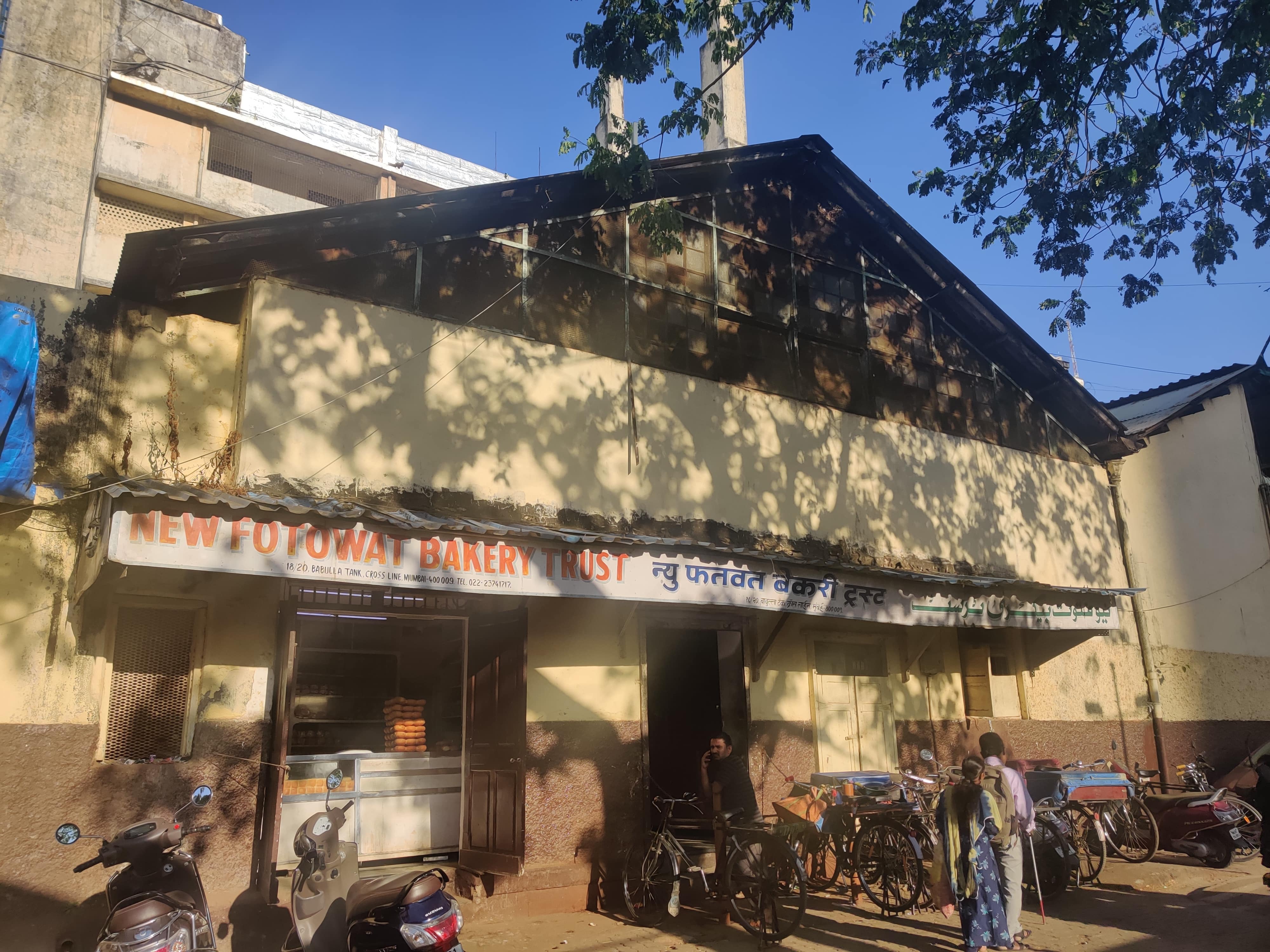


While the traditional Iranian cuisine features flatbreads like naan and robust, flavorful dishes like Ab Ghosht (mutton soup), the Irani cafes adapted their fare to suit local tastes. They introduced Mughlai and Parsi-inspired dishes, as well as baked goods like the crusty brun bread and sweet buns, which were likely influenced by the Goan Christian bakers in areas like Dhobi Talao. While the tea in Iran actually comprised of reddish-black tea without milk, the tea served to the working class clientele in Bombay was mostly milky and sweet.

Second row (L to R): Bhakra, Egg curry pattis, Mawa boi;
Third row (L to R): Mawa boi with peda, Irani chai with Khari and Bun maska, Mawa peda;
Last row (L to R): Kulfi, Ginger and Ice cream soda, Dhansak with rice
Besides breakfast fare, the clientele also had access to varied household provisions such as toiletries, over-the-counter medicines, detergent and other knick-knacks. But the most unique, or rather engaging aspect of Irani restaurants would be their characteristic no fills ambience with mirrored walls that acted as closed circuit TV’s, European bentwood chairs with marble-topped tables that reminds you of cute Parisian cafes, chequered flooring and a simple menu with a set of instructions displayed that are longer and equally funnier.


(Note – the last image in the gallery below is a poetry by Nissim Ezekiel)
The Parsi Connection
One of the earliest references to Bombay Parsis was made by Gerald Aungier, Governor of Bombay (1669-77) in a report dated December 16, 1673 where he wrote: “There is also another caste of people called Persees which are those flieing the cruelty of the first promoters of the Mahometan religion in Persia, settle themselves on India, where they enjoy their own rights and customs unmolested, their religion being very ancient left them by their prophet, Zertusht, differing from all others in these parts of the world. They are an industrious people and ingenious in trade, therein they totally employe themselves, they are at present but few of them, but we expect a greater number having gratified them in their desire to build a bureing place for their dead in the Island.”
Aungier’s prophecy of a Parsi influx was indeed fulfilled in British Bombay. Two key factors drew minority groups, especially the Parsis, to the city: the promise of religious freedom and equality before the law. Before Iran became Islamic, it was Zoroastrian, world’s oldest monotheistic religion that established the Persian empire some 2500 years ago. It comes as no surprise that the Iranian Shias and Zoroastrians, including the Parsis, share a common language and culture that predates the Arab conquest of the pre-Islamic Sassanid Empire in the 7th century AD. This shared heritage includes the celebration of the Iranian New Year, Navroz, on March 21 (the Spring Equinox), a tradition that both communities honor.


Firdausi, in his Shah Nameh, Book of Kings, attributes the origin of Navroz to the legendary King Jamshed of the Peshdadian dynasty in Iran. “The legend follows that the King sought the help of astronomers and mathematicians who devised a calendar, the ‘Tacquim-e-Nowrooze-e-Sheheriyari’. The King decided that Navroz or the New Year would start on the Vernal Equinox when night and day were of equal duration.” Nauruz is the quintessential Persian holiday. It is observed in Iran, as well as in central Asia and some regions of the Caucasus. It is a festival that has been celebrated for over three thousand years and is rooted in Zoroastrian tradition. A special table called the Haft Seen is set, which consists of various symbolic objects, starting with letter S, that represent rebirth and positive wishes for the new year:
- sabza (wheat or lentil sprouts), representing rebirth
- samanu, a sweet pudding made of wheat sprouts, representing good food
- seeb (apples), representing health and beauty
- sinjid (dried lotus fruit), representing love
- seer (garlic), representing medicine
- sumaq (sumac berries), representing the color of sunrise; with the appearance of the sun, good conquers evil
- sirka (vinegar), representing age and patience

The Parsis, whose name literally means ‘people from Paras or Fars’ (Persia), trace their ancestry to Iranian Zoroastrians. They fled to Gujarat in the 7th century to escape religious persecution. According to the popular myth in the Qissa-e-Sanjaan, when the Zoroastrian refugees arrived in Sanjan, Gujarat, the local ruler Jadi Rana sent them a glass of milk, symbolizing that his kingdom was full. In response, the Zoroastrians (or Bombay Zoroastrians as they are popularly called) added sugar (or a ring, in some versions) to the milk, indicating their desire to assimilate harmoniously into the local society, “like sugar in milk.”
Parsi migration to the city of Bombay from rural areas of Gujarat continued over the next several decades as the British took control of Bombay with the establishment of the East India Company. Dorabji Nanabhoy is considered to be the first Parsi to move to the islands of Mumbai in 1640. He was employed by the Portuguese to transact trade with the local population, and was later employed by the British to collect taxes. Today, Parsi heritage and influence can be found in every nook and cranny of the city – from the various Parsi businesses that have steered the growth of the city, the premier Jehangir Art Gallery, the landmark Taj Mahal Palace Hotel, the famous Petit Library with its stained glass windows, consisting of portraits of members of the Petit family to the city’s historic Parsi cafés.


A particularly important early Parsi arrival was Lowje Wadia, brought by the British from Surat in 1736 to build the Bombay Dockyard, which remained under the Wadia family’s stewardship for 150 years. With the western trade under British control and the hinterland trade dominated by Hindus and Muslims, the Parsis turned eastward, developing the lucrative Bombay-China trade. Hirji Jivanji Readymoney was among the first known Parsi merchants involved in this trade in 1756. By 1833, there were 52 Parsis among the traders operating in China.


The period from 1813 to 1846 marked the peak of Parsi commercial enterprise. Many owned large fleets, with the Banajis reportedly having up to 40 ships in the 1840s. The influx of trade required rapid growth in supporting services like agents and suppliers, where Parsis flourished due to factors like lack of caste restrictions, social mobility, reputation for honesty, and English fluency. The embodiment of Parsi aspirations during this period was Jamsetjee Jeejeebhoy (1783-1859), celebrated for his wealth, influence with the British, and magnificent philanthropy through institutions like the Parsi Benevolent Institution that ran 21 schools by 1864, including pioneering co-educational schools. He was the first Indian to be knighted (1842), made a Freeman of the City of London (1855), and a baronet (1857).


From 1857 to 1907, Parsis enjoyed their peak period of political influence. They led industrial enterprises like the textile trade, with the first Indian steam cotton mill founded by Cowasji Nanabhai Davar in 1854. Jamsetji Nusserwanji Tata (1839-1904) founded India’s steel industry. Parsi political associations like the Bombay Association (1852) and Bombay Presidency Association (1885) paved the way for the Indian National Congress (INC). Many early INC leaders were Parsis, including Dadabhoy Naoroji, Sir Pherozeshah Mehta, and Sir Dinshah Wacha.


Parsis were also the first Indians elected to the British Parliament before 1947. One such individual is Dadabhoy Naoroji who was the first Asian to become a British MP, although David Ochterlony Dyce Sombre, an Anglo-Indian, was briefly an MP in 1841 before being removed for corruption. Unlike others, Naoroji, a Zoroastrian, took his oath of office on the Khordeh Avesta, the Zoroastrian religious text, rather than the Bible.


After independence, the community’s influence may not appear to be at its former peak, yet Parsi contribution to Bombay’s economic and civic life continues through giants like Tata Industries, Godrej Brothers, the Bombay Stock Exchange, and holding key positions in education, medicine, and law.
The Irani Masjid and Shia Traditions
This mix of Iranian settlers and visitors invariably converged on the Irani Masjid (also known as the Mughal Masjid), a turquoise blue mosque established in 1860 by the prominent Iranian merchant Malik al-tujjar Hajj Muhammed Husayn Shirazi. The mosque and the surrounding Imambada Road area became the heart of Shia Mumbai, with several imambaras (prayer halls) like Amin, Sostori, Nemāzī, and Darbār-e-Ḥosaynī. The name Mughal Masjid is a misnomer since it alludes to the fact that Persian was the official language of the Mughal court where many Persian poets, intellectuals and artists took up residence.


The mosque bears Shirazi design, found in the city of Shiraz in Iran. The mosque was refurbished in the 1990s by Iranian architect Reza Kabul who added the mosaic work at the entrance of the mosque, and inside the prayer hall. The soil for the mehrab (a semicircular niche in the wall of a mosque that indicates direction of the Kaaba in Mecca) of the mosque, was brought from Karbala, known for the martyrdom of Imam Husayn and his male supporters during the Battle of Karbala.
The masjid also came with another interesting Iranian reminder – Hammam. Its humble exteriors may be responsible for some of its anonymity but Irani Hammam at Imamawada is (was) the only communal bath in the city that has been fashioned after its middle eastern counterparts with stone floors for rubs and massages and a stone version of a bathtub big enough to fit many grown men. The bath also has stone arches and sunlit windows that we imagine would have given you a wholesome experience.

The Iranian community congregates at the Amin Imambara during Muharram, the first month of the Islamic calendar, when special preachers and mullahs are brought from Qom, Iran, to conduct sermons in Persian. Mourning assemblies (majāles-e-‘azā’) are held at the imambaras, featuring rituals like carrying replicas of Imam Husain’s shrine (taʿziya), standards (‘alam), and images of the open hand (panja) symbolizing the five holy ones. Another Iranian tradition that the early merchants brought to Bombay is the dramatic enactment of the Battle of Karbala and the martyrdom of Imam Husain in 680 AD, complete with ritual self-flagellation on the final day of Muharram.
The Baha’i Faith Connection
Beyond the colonial history and architectural legacies, Mumbai also has a lesser-known connection to the Baha’i faith, the largest religious minority in Iran. Facing persecution from the ruling Qajar Dynasty and the orthodox Shia community, the Baha’is and their precursor Babi movement found refuge in Bombay during the second half of the 19th century.
The Baha’i Faith, a religion devoid of pageantry, ritual or a priestly class, emerged from Messianic movements like the Shaikhis in Persia in the 1840s. The Bab (meaning ‘Gate’ in Arabic) proclaimed in 1844 that the arrival of a new Prophet (Baha’u’llah) was imminent, animating these movements which became known as Babis. However, this brought a violent backlash from the Qajar rulers and Shia clergy on grounds of religious heresy, impelling the Babis to flee Persia.

Can you see the peeping board saying Babulla Chowk? Well, Babulla chowk is the only remnant of the Babulla Tank that used to be present in the vicinity of this road name. Incidentally, the name of the tank was bestowed after the Babis. Beyond the role of a safe haven for the persecuted Babis and later Baha’is, Bombay served as a place where the faith’s foundational texts written by Baha’u’llah were printed and disseminated. The Afnan family, said to be the direct descendants of the Bab’s family, set up the Nasiri Press in the 1880s that enabled the printing of Baha’u’llah’s earliest writings in Persian and Arabic. The first National Convention of Baha’is in India (which then included Sindh and Burma) was held in Bombay in 1920 to elect the first Baha’i National Spiritual Assembly of India. While not as visibly practiced as older religions, the Baha’i faith’s roots in Mumbai run deep. Shoghi Effendi, the head of the faith after Baha’u’llah, anointed Mumbai’s Baha’is as the “Mother Community” of India, enshrining the city’s role in spreading the religion across the subcontinent and Southeast Asia. The spectacular Lotus Temple, built in New Delhi in 1986, is now the faith’s national headquarters in India.

Somehow, weekends often reveal the hidden layers and nuances that make Mumbai the vibrant “City of Dreams.” Since arriving in 1997, Mumbai has always felt like home to me, no matter where I am in the world. It has been my gateway, and thanks to Khaki Tours, I now understand it’s been a gateway for countless others as well.
Disclaimer – If there is an image with a credit mentioned, then please assume that it has been not clicked by yours truly!
Further readings
- Bombay in the early 19th century
- Emigration of Iranian elites to India
- Iconic Irani Cafe
- When Bombay was home to Aga Khan
- Bombay
- Bombay’s Bahai’
- Irani chai Mumbai
Recent (and not-so recent) Posts:
 The Lost Coordinates
[…] So here is another fascinating nugget that I found about my city. Let me know what you think? […]
LikeLike
Love this post! Had so wanted to do this walk with Khaki but always somehow missed it. Am glad I could, through your post, at least do the walk virtually. 🙂
LikeLiked by 1 person
Thank you so much!!! I am glad the words could do some job. I hope I get to see you on the next walk!
LikeLiked by 1 person
I live in South Goa now. But if ever I am in Bombay doing a walk with Khaki, I will let you know. 🙂 Would love to meet you.
LikeLiked by 1 person
Looking forward to your next Bombay visit!! 😊
LikeLike